San Mateo County Birding Guide by Sequoia Audubon Society - Printed on October 30, 2026
Spring: ••• Summer: • Fall: •••• Winter: •••
This large open space just south of downtown Half Moon Bay combines Coastal Terrace Prairie habitat with agricultural land, and magnificent "edge" habitat for sparrows. It has proven to be a rarity magnet, especially for sparrows in fall and birds of prey over-wintering. Because of the topography, one can be searching assiduously for passerines without missing the raptor show above.
The key to birding this area is to follow the edge habitat along the borders of the area, looking and listening for mixed flocks during migration, and sparrow flocks on the ground during the fall and winter. The sparrows are often partial to Brussel Sprouts fields and remnants.
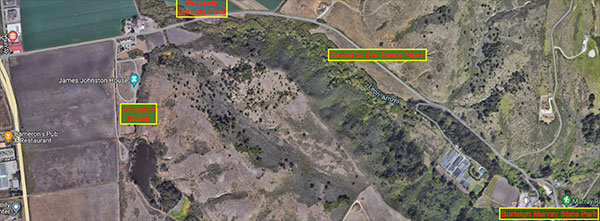
Higgins Canyon Road between the Pacific Coast Highway (SR1) and Burleigh Murray State Park has many agricultural fields. These are generally not open to pedestrian traffic, but if you park in safe spaces along the road, or walk/bike the road, there are many potential gems to be found, especially sparrows in fall and winter. The Brussel-Sprouts field just east of Leon Arroyo on the north side of the road is the best one to scan because of the riparian, which makes the area especially attractive to birds. This field can be accessed from the road if you have parked at Johnston House. But BE CAREFUL - people drive quickly along Higgins Canyon!
At night, Higgins Canyon's agricultural fields often have Barn or Great Horned Owls, especially on telephone poles and fence posts (of which there are many). A slow drive up and down this road provides the best viewing, without scaring the birds. But once again, be cautious about traffic along this road, and always pull over safely, put your blinkers on, and/or wear reflective patches when walking.
Canada Goose, Cinnamon Teal (uncommon here), Mallard, Green-winged Teal, Canvasback (uncommon here), Ring-necked Duck, Greater Scaup (uncommon here), Lesser Scaup (uncommon here), Bufflehead, Common Goldeneye, Hooded Merganser, Ruddy Duck, California Quail, Wild Turkey, Pied-billed Grebe, Eared Grebe, Rock Pigeon, Band-tailed Pigeon, Eurasian Collared-Dove, Mourning Dove, White-throated Swift, Anna's Hummingbird, Allen's Hummingbird, Virginia Rail (uncommon here), American Coot, Semipalmated Plover (uncommon here), Killdeer, Long-billed Curlew, Least Sandpiper (uncommon in migration), Long-billed Dowitcher (uncommon here), Wilson's Snipe, Spotted Sandpiper (uncommon here), Greater Yellowlegs (uncommon here), Short-billed Gull (uncommon here), Western Gull, California Gull, Herring Gull, Glaucous-winged Gull, Caspian Tern (uncommon here), Double-crested Cormorant, Great Blue Heron, Great Egret, Snowy Egret, Black-crowned Night-heron, Turkey Vulture, Osprey (uncommon here), White-tailed Kite, Northern Harrier, Sharp-shinned Hawk, Cooper's Hawk, Red-shouldered Hawk, Red-tailed Hawk, Barn Owl, Great Horned Owl, Short-eared Owl (rare here), Belted Kingfisher, Red-breasted Sapsucker (uncommon here), Acorn Woodpecker (uncommon along Higgins Canyon Road), Downy Woodpecker, Hairy Woodpecker, Nuttall's Woodpecker (uncommon here), Northern Flicker, American Kestrel, Merlin, Peregrine Falcon, Olive-sided Flycatcher (mainly on Higgins Canyon Road), Western Wood-Pewee (along Higgins Canyon Road), Pacific-slope Flycatcher (along Higgins Canyon Road), Black Phoebe, Say's Phoebe, Hutton's Vireo, Cassin's Vireo (rare here), Warbling Vireo (uncommon here), Steller's Jay, California Scrub-Jay, American Crow, Common Raven, Chestnut-backed Chickadee, Tree Swallow, Violet-green Swallow, Northern Rough-winged Swallow, Barn Swallow, Clif Swallow, Bushtit, Wrentit, Ruby-crowned Kinglet, Golden-crowned Kinglet (very uncommon along Higgins Canyon Road), Red-breasted Nuthatch (rare here), Pygmy Nuthatch (uncommon here), Blue-gray Gnatcatcher (uncommon here), House Wren, Pacific Wren, Bewick's Wren, Marsh Wren (uncommon here), European Starling, California Thrasher, Northern Mockingbird, Western Bluebird, Swainson's Thrush, Hermit Thrush, American Robin, Cedar Waxwing (uncommon here), House Sparrow, American Pipit, House Finch, Purple Finch, Pine Siskin, Lesser Goldfinch, American Goldfinch, Grasshopper Sparrow, Fox Sparrow, Dark-eyed Junco, White-crowned Sparrow, Golden-crowned Sparrow, Savannah Sparrow, Song Sparrow, Lincoln's Sparrow, California Towhee, Spotted Towhee, Western Meadowlark, Hooded Oriole (uncommon along Higgins Canyon Road), Bullock's Oriole (uncommon along Higgins Canyon Road), Red-winged Blackbird, Tricolored Blackbird (uncommon here), Brown-headed Cowbird, Brewer's Blackbird, MacGillivary's Warbler (uncommon along Higgins Canyon Road), Orange-crowned Warbler, Common Yellowthroat, Yellow Warbler (fall migration), Yellow-rumped Warbler, Townsend's Warbler, Black-throated Gray Warbler (uncommon in migration along Higgins Canyon Road), Wilson's Warbler, Western Tanager (uncommon in migration along Higgins Canyon Road), Black-headed Grosbeak, Lazuli Bunting (uncommon along Higgins Canyon Road)
In this guide, "rarities" are defined as those species given an County Abundance Code of 4, 5, or 6.
Greater White-fronted Goose (2012, 2014, 2016, 2018, 2020, 2021, 2022), Cackling Goose (2010, 2013, 2014, 2015, 2018, 2020, 2021), Snow Goose (2018, 2020), Ross's Goose (2018), Pacific Golden-Plover (2012), Golden Eagle (1997, 2003, 2013, 2015, 2018), Bald Eagle (2020, 2021), Ferruginous Hawk (2012, 2015, 2019), Crested Caracara (2015), Prairie Falcon (2010, 2011, 2015), Tropical Kingbird (2000, 2022), Western Kingbird (2014, 2015), Loggerhead Shrike (2012, 2014, 2015, 2016, 2017, 2018, 2020, 2022, 2023), Lapland Longspur (2013), Brewer's Sparrow (2010, 2014, 2020), Chipping Sparrow (2008, 2013, 2014, 2019), Clay-Colored Sparrow (2011, 2013, 2014, 2015, 2016, 2018, 2020, 2021), Lark Sparrow (2013), Lark Bunting (2014), American Tree Sparrow (2014), White-throated Sparrow (2010, 2011, 2012, 2013, 2014, 2015, 2016, 2018, 2021), Swamp Sparrow (2001, 2004, 2010, 2011, 2012. 2013, 2014, 2015, 2016, 2018), Vesper Sparrow (2013, 2022), Orchard Oriole (2015), Hooded Warbler (1997), Palm Warbler (2013, 2014, 2016, 2019, 2020), Prairie Warbler (2014, 2022), Nashville Warbler (2010, 2011), Black-and-White Warbler (2012), Black-throated Green Warbler (2015), Blue Grosbeak (2018)
The Johnston House is easily seen from Highway One, and at the southwestern end of Main Street in Half Moon Bay; it is, after all, the only New England-style white house atop a hill in town!
There are no fees connected with this area
While official hours for the Johnston House property are not posted, the local police are assiduous in guarding it after dark. So consider the birding hours for the Johnston House property itself to be dawn to dusk. Owling along the road - whether by car, foot, or bicycle - is legal at any hour, but please be cautious!
Mountain lions have been sighted here, and there are ticks and poison oak along the field and roadside edges. Any roadside birding must be conducted with extreme caution; your author has seen drag races along Higgins Canyon Road, and it is a narrow road even when people are not speeding.
There are bathroom facilities near the parking for Johnston House. You are also quite close to Half Moon Bay proper here for victuals and other life-sustaining snacks.
The Johnston House Foundation, and the tours it sponsors, can be contacted at (650) 726-0329 or at events@johnstonhouse.org
The general contact number for Peninsula Open Space Trust (POST) is 650-854-7696
The eBird hotspot for Johnston House has data in 47 of 48 quadrants, representing 152 species.
The eBird hotspot for Higgins Canyon Road has data in 37 of 48 quadrants, representing 119 species.
Author: Jennifer Rycenga, Uploaded: