San Mateo County Birding Guide by Sequoia Audubon Society - Printed on October 30, 2026
Spring: •• Summer: ••• Fall: •••• Winter: ••
Half Moon Bay is the largest harbor on the coast between San Francisco and Monterey Bay. The harbor is a well-known port for fishermen, who engage in both inshore crabbing and rock fishing and deeper voyages to albacore tuna grounds, when those are present. Once a top salmon fishing destination, in recent years less predictable numbers have had a negative impact on the fishing. Historically, Half Moon Bay's potential as a pelagic birding port had been overlooked.
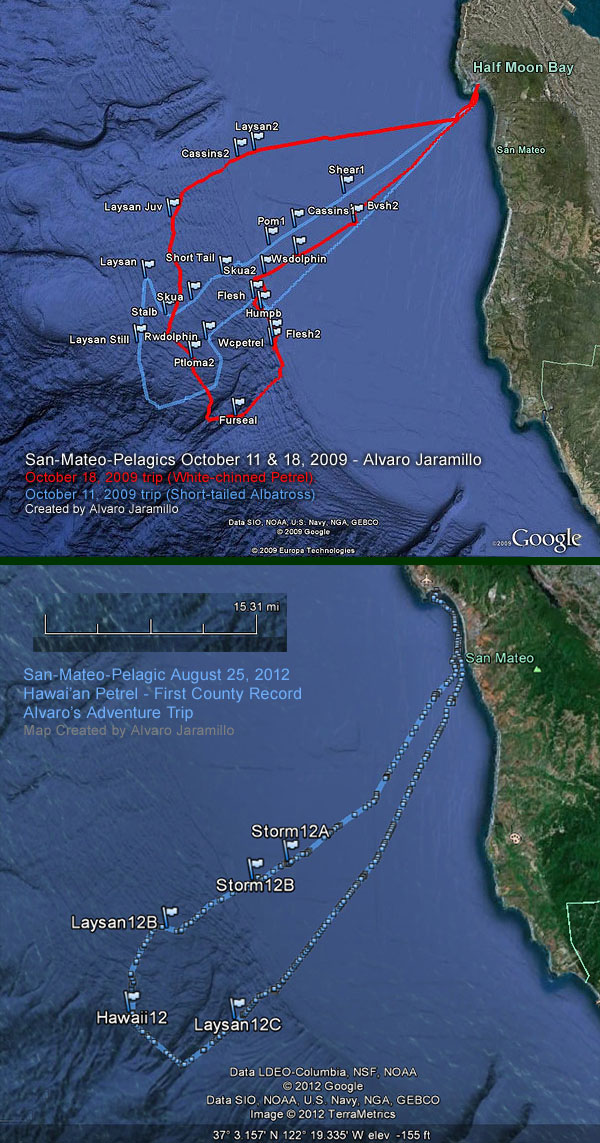
Dramatic change occurred in 2009, though, as internationally renowned ornithologist Alvaro Jaramillo, along with two board members of Sequoia Audubon Society - Gary Deghi and Jennifer Rycenga - joined forces to plan two fall pelagic trips out of Half Moon Bay. Due to weather problems, the trip Alvaro Jaramillo planned, under the auspices of San Francisco Bay Bird Observatory, went out first, on October 11, 2009. Their spectacular trip spotted a very rare Short-tailed Albatross; so rare, in fact, that their sighting of this radio-tagged bird made the television news in Japan, where conservation of this species is centered! The very next week, the Sequoia Audubon trip, with Alvaro Jaramillo as one of the leaders, discovered the first living and confirmed White-chinned Petrel in North American waters. These two highly-publicized sightings ensured the fame of Half Moon Bay waters.
In 2010, many trips were planned, and while none of them observed a rarity of the previous year's magnitude, the bird lists from every trip (even one aborted an hour into the voyage) were excellent. Cook's Petrels were seen from some late summer boats. A large storm-petrel flock lingered in the area near Pioneer Sea Canyon (San Francisco county waters) in the early fall, featuring all six species, including Wilson's, Fork-tailed, Least, and Leach's Storm-petrels. Laysan Albatross were seen on a majority of trips, and spectacular displays of feeding Humpback Whales and Blue Whales were awe-inspiring. We now realize that storm-petrel flocks are regular here, and now essentially missing from Monterey Bay where historically they congregated. If you want to see storm-petrels, Half Moon Bay is the better port. Over the years, other rarities have occurred, most famously, the continent's first Salvin's Albatross.
Currently the only pelagic operator working out of Pillar Point Harbor is Alvaro's Adventures. Approximately 15 trips a year are scheduled with most between the July - October seabird season. Most trips visit waters both in San Mateo and San Francisco counties, although at least one trip a year focuses strictly in San Mateo county. The boats used for pelagic trips are The New Captain Pete, under the enthusiastic leadership of Captain Dennis Baxter, or the Huli Cat skippered by Tom Mattusch or Michael Cabanas.
Fall - from late July to middle of October - is the best season for ocean birding in northern California. This time corresponds to a migratory season for many species, including Long-tailed Jaeger, storm-petrels, Arctic and Common Terns, Buller's and Flesh-footed Shearwaters, and more. Mid-summer, especially in July, produced huge numbers of Cook's Petrels in 2009 and 2010, but this is not to be expected as these events are rare. Distribution of birds in spring seems less varied; fewer trips are planned for that season. Winter pelagic birding can be difficult because of weather, but there are some birds worth searching for: Black-legged Kittiwake, Ancient Murrelet, and Short-tailed Shearwater. Half Moon Bay has turned out to be a good port for finding Laysan Albatross, largely from the Mexican breeding population which is increasing, leading to the belief that they will become easier to see over the years. Earlier season trips seem to be best for Scripps's Murrelet and Wilson's Storm-Petrels, mid season is good for greatest chance of finding storm-petrel flocks, while late season is best for higher numbers of South Polar Skua and diversity of shearwaters. Flesh-footed, Short-tailed and Black-vented shearwaters are most likely later in the season, as are higher densities of Buller's Shearwaters. Earlier in the season the migration of terns and jaegers can be phenomenal on a good day, their numbers decrease starting in early September.
The unpredictable nature of the weather creates the biggest problem with pelagic birding in Half Moon Bay. Perhaps an average of one in ten trips needs to be cancelled or rescheduled due to weather. For people from out-of-town, remember that if your trip is cancelled or postponed, you can use this guide to plan an alternative day of land birding! Note that trips out of Pillar Point Harbor (Half Moon Bay) all go to marine sanctuary waters where chumming is not permitted. The groundwork for having some chumming for research purposes allowed is currently being worked on.
Open Ocean Waters
Black-footed Albatross, Northern Fulmar, Pink-footed Shearwater, Buller's Shearwater, Sooty Shearwater, Short-tailed Shearwater, Flesh-footed Shearwater, Black-vented Shearwater, Ashy Storm-Petrel, Black Storm-Petrel, Wilson's Storm-Petrel, Fork-tailed Storm-Petrel, Leach's Storm-Petrel, Red Phalarope, Red-necked Phalarope, Black-legged Kittiwake, Sabine's Gull, Bonaparte's Gull, Heermann's Gull, Arctic Tern, Common Tern, South Polar Skua, Parasitic Jaeger, Pomarine Jaeger, Long-tailed Jaeger, Common Murre, Scripps's Murrelet, Ancient Murrelet, Cassin's Auklet, Rhinoceros Auklet, Tufted PuffinWater Closer to Shore and in Harbor
Brant, Northern Pintail, Surf Scoter, Red-throated Loon, Pacific Loon, Common Loon, Horned Grebe, Eared Grebe, Western Grebe, Clark's Grebe, Double-crested Cormorant (harbor), Brandt's Cormorant, Pelagic Cormorant, Brown Pelican, Great Blue Heron, Snowy Egret, Great Egret, Black-crowned Night-heron (harbor), Black-bellied Plover (breakwater), Black Oystercatcher, Black Turnstone (breakwater), Surfbird (breakwater), Sanderling, Wandering Tattler (breakwater), Short-billed Gull, Ring-billed Gull, Western Gull, California Gull, Herring Gull, Iceland Gull thayeri, Glaucous-winged Gull, Elegant Tern, Pigeon Guillemot, Marbled Murrelet, Rock Pigeon, Belted Kingfisher, European Starling, Brewer's Blackbird
In this guide, "rarities" are defined as those species given an County Abundance Code of 4, 5, or 6.
Greater White-fronted Goose (rare migrant over open water), Red-necked Grebe (2013 in breeding season), Laysan Albatross (nearly annual; recorded in 1990 on an early exploratory pelagic), Short-tailed Albatross (2009, 2021), Salvin's Albatross (2014 State record!), Hawaiian Petrel (2012, 2014, 2022), Great-winged Petrel (2011), Great Shearwater (2011, 2013), Wedge-tailed Shearwater (2017), Streaked Shearwater (2020), Manx Shearwater (2013, 2019, 2021), Cook's Petrel (2009, 2010, 2011, 2021), Murphy's Petrel (2015, on a repositioning cruise), White-chinned Petrel (2009), Leach's Storm-Petrel (2016, 2017, 2021, 2022), Red-billed Tropicbird (2014, 2022 on a research vessel), Red-footed Booby (in harbor), Brown Booby (now regular), Nazca Booby (2020, 2022), Little Gull (2016), Glaucous Gull, Black Tern (2018, close to shore), Craveri's Murrelet (2014), Guadalupe Murrelet (2014, 2017)
Stray passerines, disoriented over open ocean, are often observed. These have included rarities, among them Burrowing Owl (2012), Lark Sparrow, Tennessee Warbler (2022), Virginia Warbler (2023), Bay-breasted Warbler (2014), and American Redstart.
If you are traveling over SR 92 to get to Half Moon Bay, turn right onto SR1 and go north four miles. Turn left at the stop light for Capistrano Road. Make the next immediate left onto Pillar Point Harbor Boulevard. At the stop sign turn right onto Johnson Pier Road, and park behind the row of shops (the spaces in front of the shops are mostly time-metered, and cars parked there are regularly ticketed). Huck Finn Sportfishing is among the shops in this tiny plaza. If this lot is full, there are plenty of other free spaces on the east side of your entry road, Pillar Point Harbor Boulevard.
If you are coming from San Francisco along SR 1 southbound, pay attention when you see the Half Moon Bay Airport on your right. Do NOT turn right at the first Capistrano Road sign. Go to the light and turn right onto the second Capistrano Road. Make the next immediate left onto Pillar Point Harbor Boulevard. At the stop sign turn right onto Johnson Pier Road, and park behind the row of shops (the spaces in front of the shops are mostly time-metered, and cars parked there are regularly ticketed). Huck Finn Sportfishing is among the shops in this tiny plaza. If this lot is full, there are plenty of other free spaces on the east side of your entry road, Pillar Point Harbor Boulevard.
Offshore pelagic birding trips out of Half Moon Bay are priced similarly to pelagic trips elsewhere in the continent. In 2020, a standard trips costs $140 per person. Some trips are run in collaboration with local Audubon societies, and part of the proceeds goes to fund their programs. Parking for the day is free in the upper parking lots: this is a distinct advantage over pelagics from Monterey Bay. Currently the boats operating in Half Moon Bay do not have a galley on board. However, tipping the deck hand is customary; $10/person is appropriate, but sliding scale can apply.
Scheduled trips are almost always set for the full daylight hours, because of the time it takes to get to the continental shelf waters, two hours in good weather. A half-day trip is not feasible at this time from Half Moon Bay, so count on these being 8-12 hour trips, typically 10 hours. The harbor is active 24 hours a day, seven days a week.
Seasickness. The author of this account loves pelagic birds and pelagic birding, but is highly susceptible to mal de mer, so listed here are many of the known methods. The measures that work for me include:
- Get a good night's sleep. This may be the most essential of all.
- Eat a substantial, healthy, non-greasy breakfast the morning of the trip
- Avoid alcohol the day and night before, and during, the pelagic.
- Avoid eating greasy food the day before, and during, the pelagic.
- Use an anti-seasickness medication (Scopolamine patch, Dramamine, Bonine). I recommend using the Scopolamine patch (still needs a prescription), and wearing it overnight before the pelagic. Whatever method you use, you must take it before the boat leaves the dock. It does no good to take an anti-seasickness medication once you are already seasick.
- When on the boat, keep your eyes on the horizon.
- Don't try to read, or look down, if you are not feeling well!
- Breathe deeply. Stay away from strong smells (for me, this includes the smell of diesel fuel). Most pelagic operators prohibit the wearing of perfume or colognes, because of the negative impact these can have on we who are susceptible.
- Stay in the fresh air.
- Stay focused on how amazing the birds and mammals and other creatures are.
- Some people use wrist bands, others swear by ginger. Collect and try methods until you find the one(s) that work for you.
- Stay hydrated with water, ginger ale, whatever works for you
- During the trip, keep eating. I bring Goldfish crackers (thematically appropriate), which I just keep eating in small amounts. A hunk of sour dough bread also works wonders. A full, busy stomach is less likely to betray you.
- If you do feel sick, go to the back of the boat, and send overboard whatever it is that your stomach is ready to surrender. Once this rejected material is in the water, it becomes "chum," attracting birds. You are part of the great cycle of life, and perhaps the bringer of a rarity to the stern! Whether or not you attract more birds, you will feel better after expelling that which needs expelling.
Other hazards on board a pelagic boat include the possibility of getting soaked: wear layers and rain gear! Half Moon Bay and San Mateo county waters can be cold year-round. Come prepared. Wear close-toed shoes that you don't mind getting wet. Make sure you have gloves. If you are wearing a baseball cap, attach some twine to keep it from flying off into the ocean waters.
No matter how overcast, cold, or dark it seems, you can get sunburned on an open boat. Apply sunscreen while leaving the harbor, and renew it at lunchtime! Sun exposure can tire you out at mid-day, and lead to a loss of energy just when the birds improve.
Scopes are useless on a small boat; leave them at home. Carry a handkerchief for cleaning your glasses and binoculars of spray.
All boats used for organized pelagic trips meet Coast Guard regulations. This means that they carry adequate life jackets, and have established protocols for emergency situations.
It is inappropriate, and dangerous, to bring children on a pelagic. Consult with the pelagic operator concerning children and adolescents who are serious young birders, age twelve and up. Do not assume that bringing children is OK without explicit permission. Likewise, if you have a disability or a physical condition that you think might endanger you, discuss it with the pelagic operator.
If you have never been on a pelagic before, they can be quite exhausting. They can also run longer than originally planned. Therefore, it is best to not schedule something immediately following a pelagic, or to set yourself for up for a six-hour grueling drive the moment you get off the boat.
The harbor has a large public bathroom just east of the dock. All boats have what is called a "head" for your comfort. Just remember not to enter the "head" when you feel queasy, as being in a small confined space only makes it worse. There are plenty of places in Half Moon Bay to buy provisions for your pelagic journey. Do not forget sunscreen and protection against seasickness. When your trip returns to land, the many seafood restaurants near the harbor are there to serve you. Ask locals for more specific restaurant recommendations: like most tourist towns, Half Moon Bay sports a plethora of restaurants, but many of them have better atmosphere than food. The Old Princeton Landing is the one spot in the harbor that has an agreement with local fishing boats and serves local fish. Most others serve frozen fish, it is not local.
Lodging in Half Moon Bay can be expensive, but there are some national chains as well as charming bed-and-breakfast places. Given that a good night's sleep provides the pelagic birder with added security against mal de mer, the expense of the lodging might make the expense of the pelagic worthwhile. Half Moon Bay lodging webpages are listed in the links below.
All advertised birding trips out of Half Moon Bay will include the specific contact information for that trip. If you happen to be in the area, and want to determine if there is a fishing boat that would take you along as a birding customer, contact Capt. Dennis Baxter (http://www.newcaptainpete.com/) at 650-726-6224. Note that most fishing trips do not go out to the continental shelf, but they nevertheless do see many pelagic species, if you are on a fishing trip you may need to get a fishing license for the day. Check with fishing operators.
The return of pelagic birding to Half Moon Bay makes a contribution to research in sea bird distribution, since these areas had not been regularly visited by birders and ornithologists (compared to nearby areas such as Monterey Bay and the Farallon Islands). Some features of the first few years of regular trips have confirmed the need for more study of this area's pelagic birds: the first two trips finding mega-rarities (2009), a disproportionately high number of trips seeing Laysan Albatross, and huge flocks of storm-petrels in San Francisco county waters near Pioneer Canyon.
The pelagic trips out of Half Moon Bay were launched squarely in the eBird era. Note that when these trips started, the use of offshore hotspots was the norm, but no longer. Currently, operators are using the pelagic protocol, which sets a point at the beginning of a transect which then lasts between 30 minutes and an hour. Operators tend to keep track of details such as when county boundaries are crossed offshore.
If you go out on a fishing boat, or on your own, follow that protocol. If you are attempting to determine species timing and distribution, utilize eBird's "Explore" tab and bring up San Mateo county as the region you wish to explore. Then go to the bar charts function, and look for either your species of interest or your time window.
Author: Alvaro Jaramillo and Jennifer Rycenga, Uploaded: