San Mateo County Birding Guide by Sequoia Audubon Society - Printed on October 30, 2026
Spring: •• Summer: • Fall: ••• Winter: ••
This is the kind of place that every county resident should hike at least once. The dramatic landscape reveals beauty at every turn. The under-utilized trail system, easy to follow, can provide quiet space to reflect and contemplate. The extensive coastal terrace prairie habitat facilitates immersion in its rhythms and changes. If you seek only rarities, or only a long bird list for the day, this is not your best choice. But if you want to experience a classic California habitat, you've found the place.
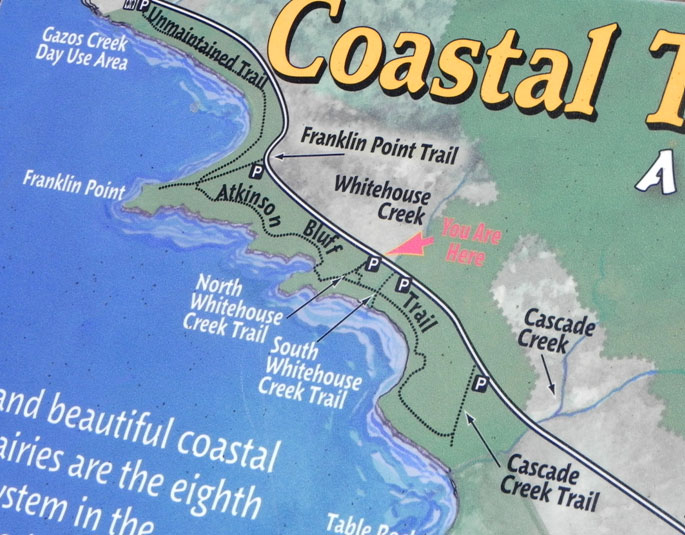
This coastal terrace prairie is located north of the main area of Año Nuevo. There are four trails that go from SR1 west to the ocean. From north to south, they are 1) the Franklin Point Trail, 2) North Whitehouse Creek Trail, 3) South Whitehouse Creek Trail, and 4) Cascade Creek Trail. These trails all end at the beach, and connect, near the beach, to a perpendicular trail that runs north-south: Atkinson Bluff Trail. The crossing at Whitehouse Creek mouth takes a bit of creativity, but it is neither impassable nor impossible. If you walk the entire loop, starting at either the Franklin Point or the Cascade Creek trailhead, you have a walk of about 3.5 miles, fairly level except for some sand dunes near Franklin Point. The best riparian and passerine habitat, though, is around the Whitehouse Creek trailhead, so starting in the middle and branching out to whichever side appears more interesting is also a viable option.
The Franklin's Point trail crosses the bluffs and ends in a boardwalk and a raised platform with benches, suitable for sea-watching. It can also be accessed by walking across the entirety of Gazos Creek Beach Access. Because this is the furthest west peninsular point between Pigeon Point and Año Nuevo Island, any bird that you could see at those two places could be seen here also. This includes many alcids; the prize would be seeing one of the breeding Cassin's Auklets here in summer. The platform is large enough for two or three scope users to share the space. The bluff walk, and the distance necessary to walk there, make Franklin's Point less attractive than Pigeon Point. But if you are walking this area, why not check for Sooty Shearwater, Marbled Murrelet, and Parasitic Jaeger.
The Atkinson Bluff Trail, going south, gives spectacular views of Año Nuevo Island, and the coastal terrace prairie you'll soon be encountering. The coast changes from rocky to sandy shoreline at points. One of the most interesting locations here is Smuggler's Cove, a small-mouthed but expansive cove that has small sandy areas as well as extensive off-shore rocks.
Whitehouse Creek mouth is not a wide creek to cross. The riparian closest to the mouth is a good spot for warblers and small passerines. Once you climb up the rather steep stairs to continue on the Atkinson Bluff Trail, you find yourself in the prairie. As one of your authors puts it, this is Año Nuevo's African Savannah! Grassland species like Western Meadowlark, Say's Phoebe, White-tailed Kite, Northern Harrier, and Savannah Sparrow can be expected here. In general, raptors (including the larger owls) love this large open area. An Osprey has been observed hunting in the near-shore ocean waters, and anything could happen hear in fall hawk migration. Likewise, rare sparrows should be watched for in fall and winter.
Approaching the Cascade Creek Trail at the end of the Atkinson Bluff Trail, you will note a pair of wind-sculpted trees that are the lone survivors of a one-time larger grove. The isolation of this pair of trees makes them worth examining for passerines that might have taken them for a glimmer of hope and a perch in the wind. South beyond the end of the Atkinson Bluff Trail, beach access is allowed. Table Rock here holds some fossils that are 100,000 years old. A small marsh has formed here, too, near the end of Cascade Creek: listen for Common Yellowthroat and other small passerines.
The Año Nuevo Coastal Terrace Prairie provides a vastly different experience from the trail at the main park entrance. Because of the popularity of the elephant seal walks, the main portion of Año Nuevo is often quite busy. By contrast, this coastal prairie section is depopulated, peaceful (except for some noise from SR1), and intriguing because underexplored. Treat yourself to the area, and record your sightings in eBird, so that we can come to an understanding of how the bird life here differs from that in the more visited portion of the park.
Brant, Surf Scoter, Black Scoter, White-winged Scoter, Red-breasted Merganser, Common Merganser, Red-throated Loon, Common Loon, Pacific Loon, Western Grebe, Clark's Grebe, Brown Pelican, Brandt's Cormorant, Pelagic Cormorant, Double-crested Cormorant, Great Blue Heron, Great Egret, Turkey Vulture, Osprey, White-tailed Kite, Northern Harrier, Red-tailed Hawk, Red-shouldered Hawk, American Kestrel, Peregrine Falcon, Black Oystercatcher, Willet, Spotted Sandpiper, Whimbrel, Black Turnstone, Ruddy Turnstone, Wandering Tattler, Surfbird, Western Sandpiper, Sanderling, Long-billed Curlew, Parasitic Jaeger, Heermann's Gull, California Gull, Herring Gull, Western Gull, Glaucous-winged Gull, Caspian Tern, Elegant Tern, Rhinoceros Auklet, Common Murre, Pigeon Guillemot, Marbled Murrelet, Mourning Dove, Rock Pigeon, Band-tailed Pigeon, Belted Kingfisher, Barn Owl, Great Horned Owl, Black Phoebe, Say's Phoebe, Loggerhead Shrike, Northern Flicker, Western Scrub-Jay, American Crow, Common Raven, Barn Swallow, Bank Swallow, Chestnut-backed Chickadee, Bushtit, Bewick's Wren, Ruby-crowned Kinglet, American Robin, Hermit Thrush, Wrentit, European Starling, California Thrasher, Yellow-rumped Warbler, Orange-crowned Warbler, Townsend's Warbler, Hermit Warbler (rare at this location), Common Yellowthroat, California Towhee, Spotted Towhee, Savannah Sparrow, Grasshopper Sparrow (uncommon), Fox Sparrow, Song Sparrow, White-crowned Sparrow, Golden-crowned Sparrow, Red-winged Blackbird, Western Meadowlark, Brewer's Blackbird, House Finch, Lesser Goldfinch, American Goldfinch, Pine Siskin
In this guide, "rarities" are defined as those species given an County Abundance Code of 4, 5, or 6.
White-winged Scoter, Golden Eagle, Rough-legged Hawk (2020), Glaucous Gull, Cassin's Auklet (breeds on A?o Nuevo Island, occasionally seen on sea-watches here), Eastern Phoebe, Loggerhead Shrike (2017), Western Kingbird, Tropical Kingbird (2017), Lapland Longspur (2022, on the Christmas Bird Count)
The parking areas for this habitat are all along SR1. If you are traveling south of SR1, start paying attention after passing Gazos Creek. The parking area for Franklin Creek will be on your right; it looks like a large dirt scrape, because the signage is difficult to see from the road. The other areas - all on your right in this direction - are much easier to spy, as their fences and story-boards are more exposed. All of the parking areas for this section of the park are unpaved: beware of this fact in mid-winter have weeks of rain.
Coming north on SR1, all the parking areas will be on your left. Use caution turning into any of them, as drivers behind you are not expecting a stopped car, and the oncoming traffic might not understand for what reason you are turning. Start looking for the first parking area, for Cascade Creek trail, after you pass the Cascade Farm on your right. You have the advantage, traveling north, of seeing the vast expanse of the Coastal Terrace Prairie opening before you, to give you a further visual sense of arrival.
There are no fees associated with this spot, which distinguishes it from the main Año Nuevo entrance.
The posted hours are 8:00 am to sunset.
There are ticks galore, and poison oak is rife on the edges of the trail system. There are some steep steps to the beach at Whitehouse Creek mouth. Mountain lions are possible here, though unlikely. Car break-ins are discouragingly frequent along this stretch of SR1: take all valuables with you when you park here.
There are no facilities here. Carry your own water. The nearest food and supplies are at Gazos Creek Road, or in Pescadero.
Recorded Information about Año Nuevo: 650-879-0227
Año Nuevo Park Office (do NOT use this number for Seal Walk reservations): 650-879-2025
When entering eBird data for this site, you can use either the general Año Nuevo site, or the hotspot under the name Año Nuevo SP--Coastal Terrace Prairie-Whitehouse Creek and Cascade Creek trails system. The latter, more specialized site has grown from one to 43 time quadrants covered between 2009 and 2020. Keep it going!
In addition to the general Año Nuevo site, there is a Cascade Ranch place marker in iNaturalist.
Be attentive for banded gulls and shorebirds. There are at least four separate studies going on right now with birds that regularly appear in Año Nuevo waters. Note species and gain as much information from the banding as possible. Then check with the birding community on peninsula-birding to determine in which study your bird likely belongs.
This area was affected by the CZU Complex Fires in August-September 2020. Please join the iNaturalist project charting the response to this fire - the largest in southwestern San Mateo county in over a century - by visiting its home page here.
Author: Jennifer Rycenga and Mark Kudrav, with thanks to Leslie Flint, Uploaded: