 Summer
Fall
Winter

Spring
Summer
Fall
Winter
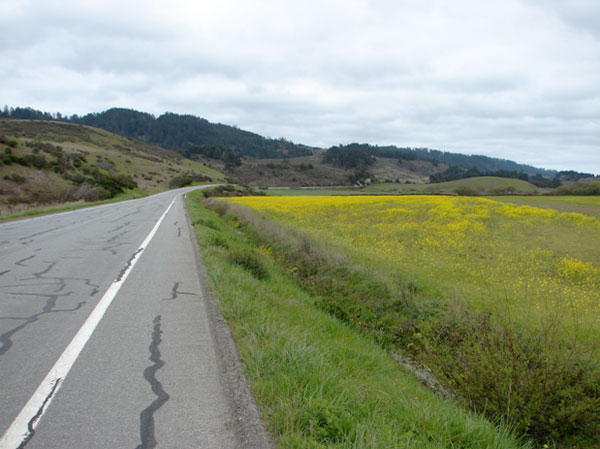
Panoramic view of Cloverdale Road, looking south (Shantanu Phukan)
Cloverdale Road winds through rolling open rangeland with scrubby hillsides, willow-lined creeks and grassy pastures. The entire course of the road runs for five and a half miles, from Pescadero Creek Road to Gazos Creek Road. Cloverdale Road provides the only road access to Butano State Park. A drive on Cloverdale will impress visitors, even if you don't see any unusual birds, because of the kaleidoscopic range of wonderful scenery. Almost all of the land along Cloverdale Road is private property, or is held by the Peninsula Open Space Trust (POST), so there is no hiking along the road at this time. Please respect private property.
This account will begin in Pescadero and run southeast the length of the road. Between Pescadero Creek Road and Butano Cutoff (about 1/2 mile), Cloverdale Road parallels Pescadero Creek's riparian corridor. There is a dirt pull off to your left, from which you can look for migrants in spring and fall. This part of the riparian corridor abuts onto the property of Phipps Ranch, which itself attracts good migrants and vagrants, so almost anything can turn up here.
Butano Cutoff (on your left, 1/2 mile from Pescadero Creek Road) would take you by Pescadero High School. The agricultural fields here along Butano Cutoff, and going southeast along Cloverdale, have hosted some rare raptors for the county, including Ferruginous and Rough-legged Hawks, and Golden Eagle.
After these fields, Cloverdale Road climbs a bit, and opens up into mixed agricultural uses. When you spot bird activity, stop wherever you can safely pull off. Raptors are still the star of the show here, including American Kestrel, Merlin, Peregrine Falcon, Cooper's Hawk, Red-tailed Hawk, and Turkey Vulture. Night drivers should look for Barn Owl and Great Horned Owl.
One of the principal attractions of Cloverdale Road consists in its reputation for Grasshopper Sparrow - a scarce but regular breeder in the county. The hillsides over almost the entire length of the eastern side of the road can contain this species: listen for them most assiduously from April to June, when they perform their insect-like song a great deal from early to mid-morning. They prefer gradually sloping hillsides with short grass and scattered coyote brush, where you can find them singing from a wire fence or low shrub on a grassy hillside. Savannah Sparrows also occur in this habitat, so take care in separating these two species. In winter, watch for Say's Phoebe competing with Black Phoebe along the many fence lines.
About two and a half miles from Pescadero, Hippo Harvest occurs on your right hand (western) side at 3439 Cloverdale. The small pond with marshy edges below the road can be productive. The usual birds - American Coot, Ruddy Duck, Mallard, Common Yellowthroat and Red-winged Blackbird - nest here but there can be some unusual visitors in migration or in winter. Ring-necked Duck, Sora, Common Gallinule (rare), Wilson's Snipe and Long-eared Owl have all been seen here. In addition to the usual grassland birds, the fields here are a favorite foraging spot for Great Blue Herons. Access to the spot by foot and by car has varied over the years; it is best to ask permission directly, or to bird the pond from above along the road. An office of the Peninsula Open Space Trust (POST), one of the foremost guardians of San Mateo's wild places, is located next door to Hippo Harvest, at 3393 Cloverdale; the trees along their driveway can yield Pygmy Nuthatch, numerous woodpeckers, and Chestnut-backed Chickadee.
Two small residential roads - Eden West and Canyon Road - go off to the east from Cloverdale in this area. There can be good birding along the roadside, especially on Canyon Road (3.3 miles from the start of Cloverdale). However, this is all private property, and residents have been known to get a bit edgy about birders with binoculars here. Both of these roads are very narrow, so utilize any pull-offs you can find.
Butano State Park entrance road occurs 4.3 miles south of Pescadero Creek Road on Cloverdale. The agricultural fields to your left here are among the best places along the road to pick through the large feeding flocks of blackbirds that can sometimes be observed along Cloverdale. Tricolored Blackbirds are usually among them, sometimes by the hundreds, from fall until spring. Sharp-eyed birders have turned up one or two Rusty Blackbirds in these flocks during some winters. Butano State Park is covered in a separate entry in this guide.
Once past the Butano entrance road, Cloverdale Road climbs through a short but narrow set of passes. When you reach the top of this hill (about 1/4 mile beyond Butano), you are at the gate for one of the local POST properties: the Cloverdale Coastal Ranches. To hike on this land, you must obtain written permission from POST (information available at the weblink given below). Many birders asked for and received this permission in the early months of 2009, when a Brown Thrasher graced the boundaries of one of two lakes on this property. Even just standing at the locked gate, the wide expanse of open space, ringed with mixed forest, creates another haven for raptors and night birds. The fence lines along Cloverdale Road from here to Gazos Creek Road are quite dependable for Barn Owl at night.
The southeast end of Cloverdale Road is often birded along with Gazos Creek Road. Grasshopper Sparrow, Lincoln's Sparrow, Say's Phoebe, American Kestrel, Peregrine Falcon, Barn Owl, and Great Horned Owl have all been seen in the last 1/4 mile of Cloverdale Road. Pullouts here are non-existent, and traffic can be more plentiful than one would guess; to bird the southeastern end of Cloverdale Road, park at the junction pulloffs for Gazos Creek Road.
Canada Goose, Gadwall, American Wigeon, Mallard, Cinnamon Teal, Northern Shoveler, Green-winged Teal, Ring-necked Duck, Bufflehead, Hooded Merganser, Common Merganser, Ruddy Duck, California Quail, Wild Turkey, Pied-billed Grebe, Eared Grebe, Western Grebe, Double-crested Cormorant, Great Blue Heron, Great Egret, Green Heron, Turkey Vulture, White-tailed Kite, Northern Harrier, Sharp-shinned Hawk, Cooper's Hawk, Red-shouldered Hawk, Red-tailed Hawk, American Kestrel, Merlin, Peregrine Falcon, Virginia Rail, American Coot, Killdeer, California Gull (unusual; seen during grasshopper hatches), Herring Gull (unusual), Rock Pigeon, Band-tailed Pigeon, Eurasian Collared-Dove, Mourning Dove, Barn Owl, Great Horned Owl, Northern Pygmy-Owl, Western Screech-Owl, Northern Saw-whet Owl, Vaux's Swift, White-throated Swift, Anna's Hummingbird, Allen's Hummingbird, Acorn Woodpecker, Red-breasted Sapsucker, Downy Woodpecker, Nuttall's Woodpecker, Hairy Woodpecker, Northern Flicker, Olive-sided Flycatcher (migration), Western Wood-Pewee, Pacific-Slope Flycatcher, Ash-throated Flycatcher, Black Phoebe, Say's Phoebe, Loggerhead Shrike, Hutton's Vireo, Warbling Vireo, Steller's Jay, California Scrub-Jay, American Crow, Common Raven, Tree Swallow, Violet-green Swallow, Barn Swallow, Cliff Swallow, Chestnut-backed Chickadee, Bushtit, Pygmy Nuthatch, Red-breasted Nuthatch, Brown Creeper, Bewick's Wren, House Wren, Marsh Wren, Pacific Wren, Blue-gray Gnatcatcher, Golden-crowned Kinglet, Ruby-crowned Kinglet, Wrentit, Northern Mockingbird, Western Bluebird, Swainson's Thrush, Hermit Thrush, American Robin, Varied Thrush, European Starling, American Pipit, MacGillivary's Warbler, Yellow Warbler, Common Yellowthroat, Yellow-rumped Warbler, Townsend's Warbler, Hermit Warbler, Wilson's Warbler, Orange-crowned Warbler, Spotted Towhee, California Towhee, Savannah Sparrow, Grasshopper Sparrow, Fox Sparrow, Song Sparrow, Lincoln's Sparrow, White-crowned Sparrow, Golden-crowned Sparrow, Dark-eyed Junco, Red-winged Blackbird, Tricolored Blackbird, Western Meadowlark, Brewer's Blackbird, Brown-headed Cowbird, Hooded Oriole (near palm trees), Bullock's Oriole, House Sparrow, House Finch, Purple Finch, Red Crossbill, Pine Siskin, Lesser Goldfinch, American Goldfinch, Western Tanager, Black-headed Grosbeak, Lazuli Bunting.
In this guide, "rarities" are defined as those species given an County Abundance Code of 4, 5, or 6.
Greater White-fronted Goose (2011), Cackling Goose (2016), Osprey, Rough-legged Hawk, Golden Eagle (annually), Ferruginous Hawk (many years), Common Poorwill (2013 near Butano State Park, in migration), Red-naped Sapsucker (2019, Eden West Road), Williamson's Sapsucker (Girl Scout Camp), Loggerhead Shrike (2011, 2015, 2017, 2018, 2019, 2020), Willow Flycatcher (1977), Eastern Phoebe (2016), Western Kingbird (2010, 2015), Cassin's Kingbird (1986), Tropical Kingbird (2023), Eastern Kingbird (1990), Horned Lark (1976), Purple Martin (1977), Brown Thrasher (2009), Townsend's Solitaire (2019), Chipping Sparrow (2013), Lark Sparrow (2018), Rusty Blackbird (1985-6), Palm Warbler (2010), Blackpoll Warbler (2016, at intersection/stream crossing with Pescadero Creek Road), Yellow-breasted Chat, White-throated Sparrow, Indigo Bunting (2013)
Cloverdale Road can be reached either from Pescadero Creek Road, or from Gazos Creek Road. This account runs southeast from Pescadero Creek Road to Gazos Creek Road.
Red Markers: Parking Area or Trail Head
Hover mouse pointer over marker, or click marker, for pin identification.
Use + or - buttons to change map zoom. Click & Drag to pan.
24/7. It's a road! There is good owling to be had along this road, because of the plentiful fences, but be watchful for wildlife and other drivers.
Ticks are plentiful along the grass margins of the road, especially in late spring and early summer. Always use pull-offs, and take care when doing roadside birding; Cloverdale Road (and all the inland roads in the greater Pescadero area) are used by motorcycle clubs, agricultural vehicles, and folks in fancy rented sports cars who want to look like the automobile ads they've seen. None of these groups is really expecting the sort of seemingly random behavior that a careless car-birder can perform, or the obliviousness of a birding pedestrian who has finally achieved the proper angle on a perched raptor, by standing in the middle of the road.
The park rangers at Butano State Park will usually waive the entrance fee for those needing to use the restrooms at the first parking lot. (Please do not abuse this privilege as some of us value it quite highly.) The gas station and restaurant at the junction of Gazos Creek Road and SR1 are now open regularly, and you can also find food, drink, and fuel in Pescadero.
Accessibility information is currently not available for this location.
Because Cloverdale Road is not parkland, there is no direct contact number. To reach POST, use weblink below or call (650) 854-7696.
Cloverdale Road has four hotspots in eBird, as detailed below:
Cloverdale Rd., San Mateo, CA is the general site. It has 133 species in 37 of 48 time quadrants.
Cloverdale Rd.--(south) Gazos Creek Rd. to Eden West Rd., San Mateo, CA includes the portion by the entrance road to Butano State Park. It only has data in 9 of 48 time quadrants. Feed a hungry hotspot today!
Cloverdale Rd.--(north) Eden West Rd. to Pescadero Creek Rd., San Mateo, CA. This emaciated hotspot has data in but 4 of 48 time quadrants, yet it includes some wonderful habitat for raptors. Operators are standing by to include your sightings!
Cloverdale Rd.--Hippo Harvest pond, San Mateo, CA has data for 24 of 48 time quadrants.representing 77 species.
Please do continue to use eBird
Being a public roadway with mixed uses of the land adjoining, Cloverdale Rd. is inappropriate for the iNaturalist "place" designation, but it is still important to accurately document the sightings you find along here. The experience of birders shows that there are all sorts of surprises 'round here!
Peninsula Open Space Trust (POST) is conducting an erosion control project near the southeastern end of Cloverdale Road. There is a sign explaining this project, located about 2/10 of a mile south of the Cloverdale Coastal Ranch sign.
Much of Cloverdale Road was affected by the CZU Complex Fires in August-September 2020. Please join the iNaturalist project charting the response to this fire - the largest in southwestern San Mateo county in over a century - by visiting its home page here.
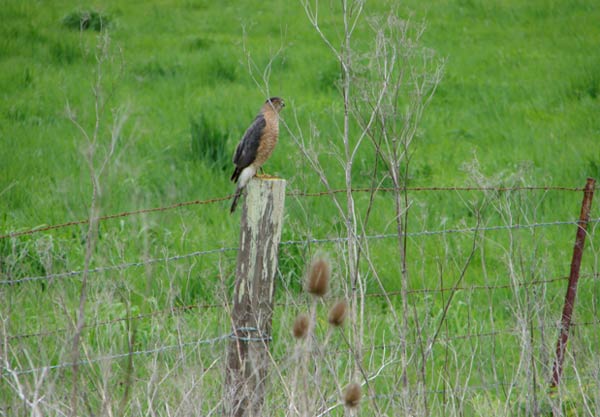
Cooper's Hawk, fence post, Cloverdale Road, March 2009 (Shantanu Phukan)
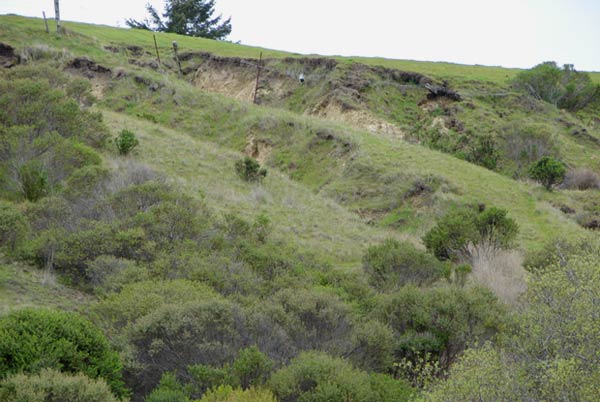
Cloverdale Road Hillside (Grasshopper Sparrow habitat) (Jennifer Rycenga)
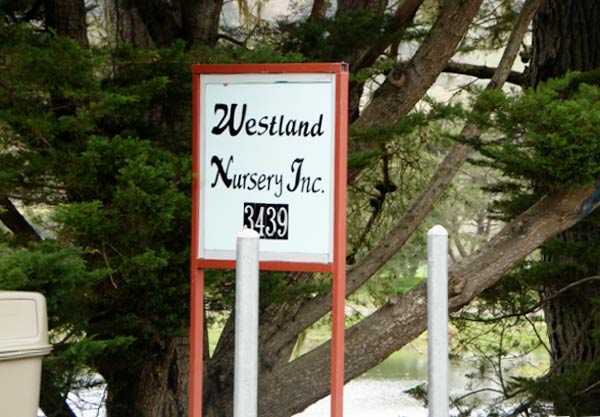
Westland Nursery (now Hippo Harvest) sign, with pond visible below (Jennifer Rycenga)
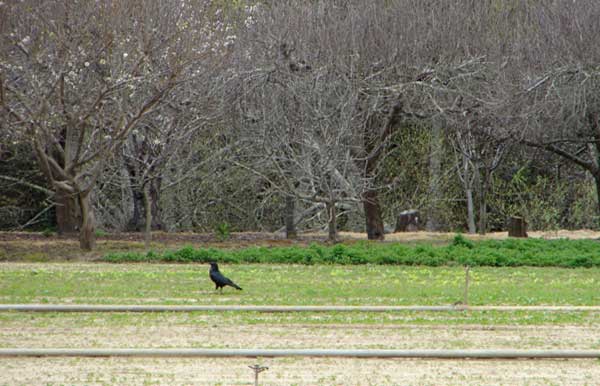
Common Raven in Agricultural Field, Cloverdale Road, March 2009 (Jennifer Rycenga)
Author: Peter Metropulos and Jennifer Rycenga
Uploaded:
March 15, 2009
Last Update:
October 3, 2023 8:15am
All content ©Sequoia Audubon Society and others
No use without written permission
