 Summer
 Fall
Winter
Spring
Summer
Fall
Winter
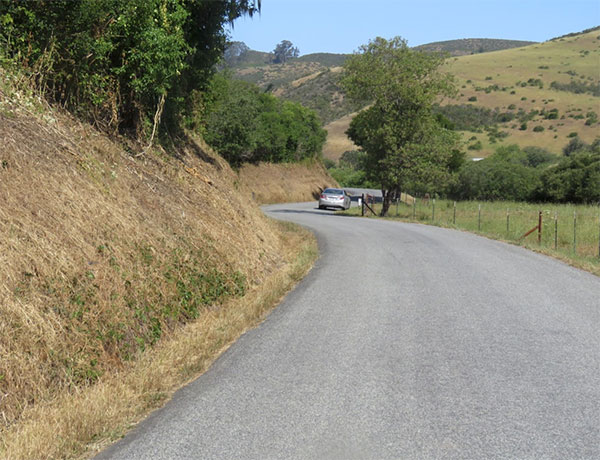
Backroad Birding along Pomponio Creek Road, June 2021 (Jennifer Rycenga)
The area described here, including Pomponio Creek Road and Stage Road south of there to Pescadero, is quintessential backcountry birding in San Mateo county. These roads have been here since the nineteenth-century, and are dotted with family ranches. The habitat is varied and scenically beautiful.
Pomponio Creek Road fits the Platonic ideal of rural road: isolated, out-and-back, family farms, some riparian, and relatively free of traffic. It follows Pomponio Creek, and this fact of geography means that the road sits at the bottom of a gentle canyon, with grassy hillsides rising to the north and south. This makes the road ideal habitat for hawks, falcons, large owls, and grassland passerines. The problem, though, is that there are not many opportunities for parking. The best pull-out is located by a crumbling stone cut about a quarter of a mile from the intersection with Stage Road (the only public access point to Pomponio Creek Road). However, the best areas for birding are two miles further east on the road. There are places where one car can pull over, especially since this road is so infrequently traveled. Often there are wider shoulders near the farm buildings, but be sure you don't block access. Birding by bicycle is likely the best way to cover Pomponio Creek Road effectively and efficiently. All of Pomponio Creek Road's three-mile length is private property; water features are not directly accessible, but may lead to waterfowl/shorebird fly-overs. On a clear June day, a team of birder-naturalists detected 54 species of birds along the road - the possibilities here are largely untapped.
The southern half of Stage Road, from Pomponio Creek Road to Pescadero, has many natural pullouts in its initial two winding miles. These are good hawk lookout spots. When near grassland in spring, listen for breeding Grasshopper Sparrows, and be on the alert for the rarer Lark Sparrow and, in migration, Brewer's Sparrow. Two miles south of Pomponio Creek Road, you descend to Tahana Gulch. This area has residences, eucalyptus groves, and a much more level topography than the previous two miles. The road takes a sharp turn at this point (approximately 4000 Stage Road). Tahana Gulch features a new suite of birds, including (sometimes) nesting Bullock's Orioles, Western Bluebirds, blackbirds, and open range species.
Another mile south on Stage Road is the spot where a riparian zone is closest to the road. This is Bradley Creek, a small but usually running stream, that parallels Stage Road for a considerable distance. This is the location where the multi-year overwintering Eastern Phoebe and Yellow-bellied Sapsucker delighted birders in the 2010s. Anything could happen here in fall and winter. Pulling over to naturalize is made easier by wide road margins, but take care not to block any driveways. For the sake of GPS ease, the closest address is 1700 Stage Road, Pescadero.
The remainder of Stage Road as it heads into Pescadero, is promising but the birding is not as concentrated as in other sections covered by this entry, Just before you arrive at North Street, look to the west: in winter the field here often contains Tricolored Blackbirds in the farm field foraging flock.
Mallard, Common Merganser, California Quail, Wild Turkey, Rock Pigeon, Eurasian Collared-Dove, Band-tailed Pigeon, Mourning Dove, Vaux's Swift (rare here), White-throated Swift (unusual here), Anna's Hummingbird, Allen's Hummingbird, Killdeer, Double-crested Cormorant (fly-overs), Great Blue Heron, Great Egret, Snowy Egret, Turkey Vulture, White-tailed Kite, Northern Harrier, Sharp-shinned Hawk, Cooper's Hawk, Bald Eagle (rare here), Red-shouldered Hawk, Red-tailed Hawk, Barn Owl, Western Screech-Owl, Great Horned Owl, Belted Kingfisher, Red-breasted Sapsucker, Acorn Woodpecker (uncommon here), Downy Woodpecker, Nuttall's Woodpecker (uncommon), Hairy Woodpecker, Northern Flicker, American Kestrel, Merlin, Peregrine Falcon, Olive-sided Flycatcher, Western Wood-Pewee, Pacific-slope Flycatcher, Black Phoebe, Say's Phoebe, Ash-throated Flycatcher, Hutton's Vireo, Cassin's Vireo (rare here), Warbling Vireo, Steller's Jay, California Scrub-Jay, American Crow, Common Raven, Chestnut-backed Chickadee, Northern Rough-winged Swallow (quite rare here), Tree Swallow, Violet-green Swallow, Barn Swallow, Cliff Swallow, Bushtit, Wrentit, Ruby-crowned Kinglet, Red-breasted Nuthatch (rare here), White-breasted Nuthatch (rare here), Pygmy Nuthatch, Brown Creeper, Blue-gray Gnatcatcher (unusual here), House Wren, Pacific Wren, Bewick's Wren, European Starling, California Thrasher, Northern Mockingbird (uncommon here), Western Bluebird, Hermit Thrush, Swainson's Thrush, American Robin, Cedar Waxwing, House Sparrow, House Finch, Purple Finch, Red Crossbill (rare here), Pine Siskin, Lesser Goldfinch, American Goldfinch, Grasshopper Sparrow (one of the better locations in the county), Fox Sparrow, Dark-eyed Junco, White-crowned Sparrow, Golden-crowned Sparrow, Savannah Sparrow (surprisingly uncommon), Song Sparrow, Lincoln's Sparrow, California Towhee, Spotted Towhee, Western Meadowlark, Hooded Oriole, Bullock's Oriole, Red-winged Blackbird, Tricolored Blackbird, Brown-headed Cowbird, Brewer's Blackbird, Orange-crowned Warbler, MacGillivray's Warbler, Yellow Warbler, Yellow-rumped Warbler, Townsend's Warbler, Wilson's Warbler, Western Tanager, Black-headed Grosbeak, Lazuli Bunting
In this guide, "rarities" are defined as those species given an County Abundance Code of 4, 5, or 6.
Common Poorwill (2017, 2019), Rufous Hummingbird (1975, 2013), Common Gallinule (2014, private property), Golden Eagle (2013, 2014, 2015, 2016, 2017, 2018, 2019, 2020), Ferruginous Hawk (2014, 2015, 2016, 2017, 2018), Rough-legged Hawk (2012), Yellow-bellied Sapsucker (2015, 2016, 2017, 2018, 2020, 2021), Willow Flycatcher (2020), Gray Flycatcher (2016), Eastern Phoebe (2011, 2012, 2013, 2014, 2015, 2016, 2017, 2018), Western Kingbird (2018), Loggerhead Shrike (1976, 1980, 1984, 2009, 2015), Horned Lark (2011), Clay-colored Sparrow (2018), Black-chinned Sparrow (1977), White-throated Sparrow (1976, 2015, 2016, 2018, 2019), Yellow-breasted Chat (1976, 1987), Black-and-White Warbler (2010), Nashville Warbler (2014, 2017), Magnolia Warbler (2016, 2017), Black-throated Blue Warbler (1971), Rose-breasted Grosbeak (2013, 2019), Blue Grosbeak (2012, found on A?o Nuevo CBC), Indigo Bunting (2017)
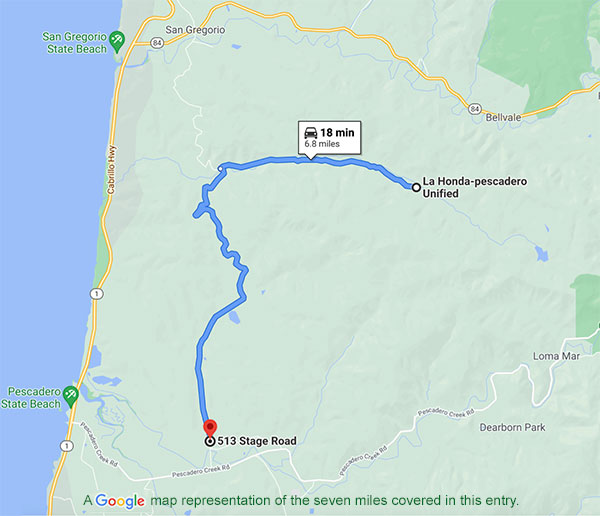
Stage Road is the main street of Pescadero; just follow it north out of town. Pomponio Creek Road is at the base of a gully, and is the most prominent turn eastward since you left town.
From the north, Stage Road can be picked up from SR 1 or from SR 84 in San Gregorio. From San Gregorio to Pomponio Creek Road is about 2.5 miles, but these are winding miles. This northern portion of Stage Road is covered in a separate entry in this guide.
Red Markers: Parking Area or Trail Head
Hover mouse pointer over marker, or click marker, for pin identification.
Use + or - buttons to change map zoom. Click & Drag to pan.
There are no fees associated with this area
This is a road, so there are no official hours, but this is a road on which people live, so consider that when thinking of birding at obscure hours.
Respect private property. Roads are narrow and winding.
None really, but you are near Pescadero's amenities and charm.
While these roads are well-paved, the narrowness and winding nature would make them uncomfortable and potentially unsafe for people with mobility issues or who are in a wheelchair.
If you see road damage - such as a fallen tree or deep pothole - both Stage Road and Pomponio Creek Road are cared for by County of San Mateo Public Works Road Department, 650-363-4103.
The area is divided neatly into three eBird hotspots.The area of riparian around the Eastern Phoebe site has its own limited range hotspot. Stage Road from North St. in Pescadero to Pomponio Creek Road is a longer-range hotspot. Pomponio Creek Road is its own hotspot. The northern section of Stage Road is covered in a separate entry.
- Stage Rd. (Riparian and Eucalyptus)? was stakeout Eastern Phoebe, Pescadero (2011-2016), San Mateo, US-CA - https://ebird.org/hotspot/L3171457 111 species in 29 of 48 time quadrants
- Stage Rd.(south) North St. to Pomponio Creek Rd., San Mateo, US-CA - https://ebird.org/hotspot/L9287446 114 species in 32 of 48 time quadrants
- Pomponio Creek Rd., San Mateo, US-CA - https://ebird.org/hotspot/L1236565 113 species in 34 of 48 time quadrants
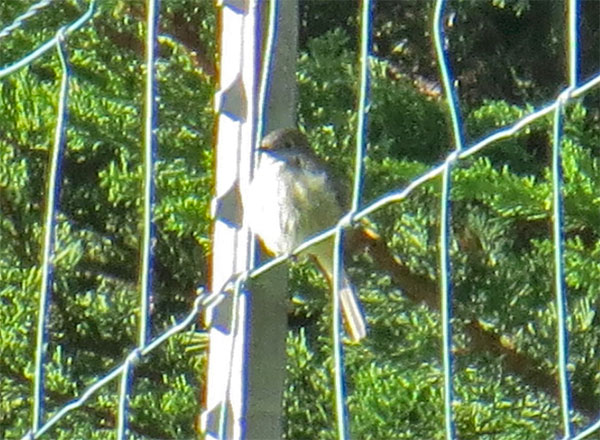
Gray Flycatcher at the Riparian along Stage Road, November 2016 (Chris O'Connell)
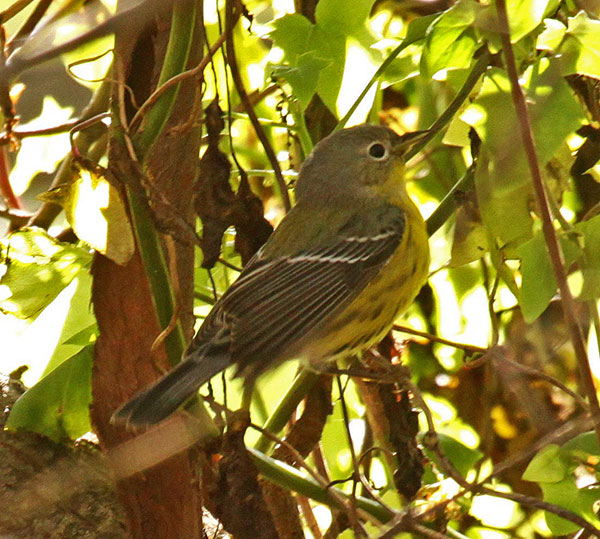
Magnolia Warbler at the Riparian along Stage Road, December 2016 (Ken Schneider)
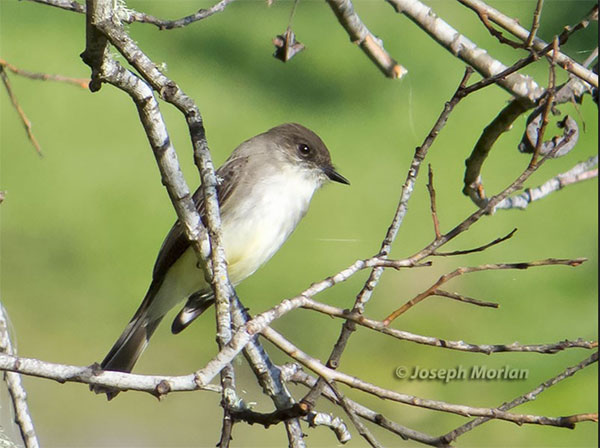
Eastern Phoebe, the bird that made the Riparian zone along Stage Road famous, December 2016 (Joe Morlan)
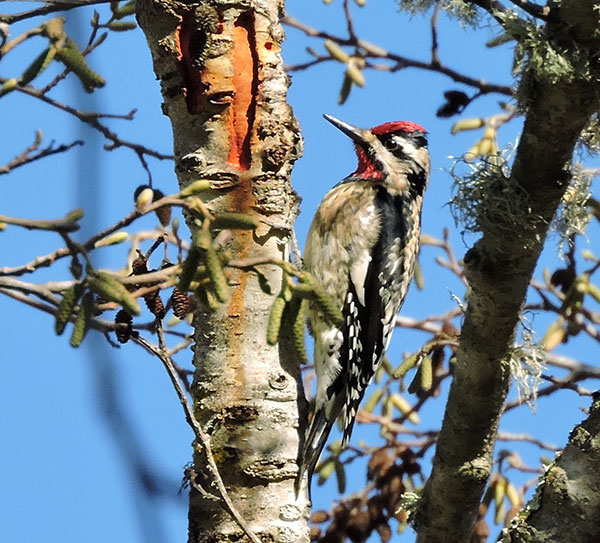
Yellow-bellied Sapsucker, January 2017 (Leslie Flint)
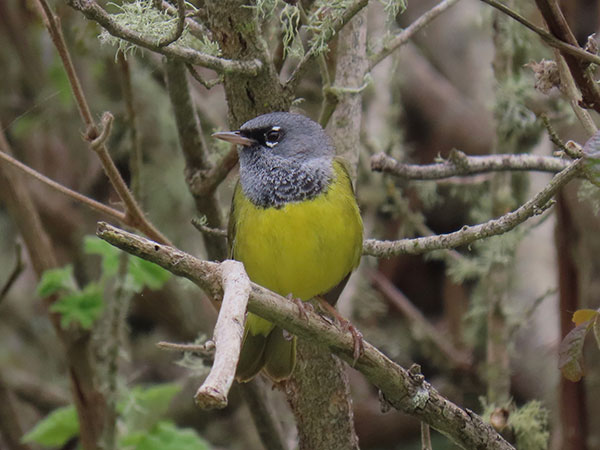
MacGillivray's Warbler, April 2021, Pomponio Creek Road (Alane Gray)
Author: Jennifer Rycenga
Uploaded:
June 21, 2021
Last Update:
November 12, 2021 10:27am
All content ©Sequoia Audubon Society and others
No use without written permission
