 Summer
 Fall
Winter
Spring
Summer
Fall
Winter

Pigeon Point, looking north, January 2008 (Jennifer Rycenga)
Located 50 miles south of San Francisco, Pigeon Point has become famous among birders as one of the finest vantage points for observing seabirds anywhere on the California coast. Its accessibility, geography (located immediately to the north of bird-rich Monterey Bay) and the presence of deep ocean waters very close to shore combine to produce excellent birding possibilities. Success can be extremely variable, ranging from fair to excellent, depending on season, visibility, observer's skill, duration of visit, wind direction and wind velocity.
Park along the dirt shoulder of Pigeon Point Road anywhere north of the famed lighthouse facility. A good spotting scope is essential because on many days the birds are far offshore. The best time of day for bird observation is morning when light conditions are most favorable. The prime time of the year is during spring migration (March-May) when thousands of north-bound loons, scoters, brant, cormorants, shearwaters, gulls, terns and shorebirds pass this promontory.
By slowly and repeatedly scanning the sea from surf to horizon, a birder's patience is often rewarded. There are three principal spots from which to scan for ocean birds. If your time is limited, set up your scope anywhere along the rocky shore north of the lighthouse. The road here has a wide shoulder on the west side, and the rocks themselves produce good numbers of shorebirds, including Wandering Tattler.
However, better views can be achieved by walking into the state park area (the Pigeon Point Lighthouse is a State Historical Park). Walk toward the lighthouse; there is a small fence that separates the state park from the hostel, the state park being to the south of that fence. When you get to the lighthouse, continue past this to a viewing deck. This has been established for visitors and whale-watchers primarily, but what a boon to birders! It gives great, unencumbered views of two large off-shore rocks where cormorants roost, very good vantage points for rocky shorebirds right below you, and a distant view of Año Nuevo Island (and the channel between Año Nuevo and Pigeon Point, which is one of the best places to look for Rhinoceros Auklet). Pigeon Guillemots nest here (March-August), immediately below the viewing deck. The deck is large enough for a birder to stay for hours without depriving other visitors of a chance to enjoy the setting. Photographic opportunities are manifold, too.
The third location for sea-watching may seem counterintuitive at first, but yields your best chance at seeing a Marbled Murrelet. In the southeast portion of the State Park, there is a trail to another viewing deck. This deck, completed in recent years, appears to have been established as a photo-opportunity: if you stand in the viewing circle, the lighthouse forms a backdrop for your souvenir shot. But from a birder's point-of-view, the waters between the shore and the point often hold the diminutive Marbled Murrelet. Pigeon Point is one of the most reliable locations, especially during spring and summer, for observing Marbled Murrelet. A few pairs are resident in the area and may often be found feeding just beyond the surf when the sea is not too rough. This also provides a good angle on Año Nuevo Island: as you search for Murrelets, look for Rhinoceros Auklets as well.
Knowing which way the wind blows can be a helpful indicator of the likely success of your land-hugging pelagic search. An intensive survey of migrant seabirds passing Pigeon Point in the spring of 1976 recorded over one million individual birds (most of them Pacific Loons)! To observe the numbers and variety of pelagic species here visibility must be good with no fog, haze or glare. A stiff breeze (10 miles per hour or more) from the West or Northwest is very helpful. When conditions are calm or wind blows from east or northeast, birding can be far less productive.
From all locations, check the tide-washed rocks below for the resident Black Oystercatchers, as well as Wandering Tattler (August-May), Surfbird (September-April) and Black Turnstone (year-round). From November through February a few Ancient Murrelets are often seen here just offshore. During summer months feeding masses of Sooty Shearwaters are seen from here and may number in the tens of thousands.
In addition to seabirds, Pigeon Point can also be a good place to check for unusual land birds during periods of migration, especially fall (September-November). Check the wires, scrub, and weedy edges of the roadside and Brussels sprout plantings for "field birds." Rarities such as Tropical Kingbird, Bobolink, Palm Warbler, Red-throated Pipit, Common Ground-Dove, and Clay-colored Sparrow have been spotted here. There are often a few Band-tailed Pigeons on the wires, especially in the morning. Pigeon Point, however, was not named for its pigeons but rather in memory of the U.S.S. Pigeon, a ship that crashed into the rocks here early in the twentieth century). Large flocks of Tricolored Blackbirds may be found throughout the year in freshly plowed fields and cow pastures in this vicinity. Northern Harriers often patrol these fields, replaced at night by a pair of resident Barn Owls, who can sometimes be seen along telephone wires prior to dawn; Great Horned Owls use the area, too. Pigeon Point is also an excellent vantage point from which to scan for migrating Gray Whales during their northbound migration from March through May. Seals, sea lions, porpoises and sea otters are regularly spotted from Pigeon Point.
A good spotting scope and sturdy tripod are essential for good views. Dress warmly and be patient. Consult local weather forecast before your visit to get current conditions. There is no better academy for sea-watching from land than a few hours spent at Pigeon Point, whether honing your skills alone or learning from one of the county's accomplished experts.
Species Highlights
- Loons: Loon migration in spring (March-May) can be quite impressive with rates of over one hundred birds per minute passing north not being unusual. The vast majority (over 90%) are Pacific Loons. The remainder consist of Common and Red-throated Loons, and by April the majority are in alternate ("breeding") plumage. All three species are found here virtually year round, a few even in mid-summer.
- Red-necked Grebe: Very rare, December-April.
- Black-footed Albatross: Perhaps regular in very small numbers. (April-June)
- Laysan Albatross: A few records in March and April.
- Northern Fulmar: Erratic in numbers, but occurs in most years from November until March (a few seen daily); occasionally dozens in mid-winter.
- Pink-footed Shearwater: Uncommon to fairly common, mid-April to October.
- Buller's Shearwater: Uncommon but regular, August to October.
- Black-vented Shearwater: Erratic in occurrence, being present by the hundreds some years; in other years they may be totally absent. Occurs October-March. Tends to forage closer to shore than other Shearwaters.
- Sooty Shearwater: Common to abundant, April-November; uncommon to rare at other seasons. Sometimes seen in large numbers close to shore.
- Short-tailed Shearwater: Difficult to identify at a distance, perhaps rare but regular here November-March.
- Flesh-footed Shearwater: Very rarely seen from shore, but possible in fall.
- Brant: Fairly common in spring (March-May) when hundreds may be seen in a day.
- Scoters: Hundreds may be seen flying north in spring (March-May); over 90% are Surf Scoters, the rest are usually Black with an occasional White-winged (the percentages of the more uncommon Scoters have flipped in recent years). All 3 species may be seen here nearly year-round, a few even in mid summer.
- Black Oystercatcher: Resident.
- Wandering Tattler: Uncommon, but regular, August-May.
- Whimbrel: One or two are usually present year-round; small flocks can be seen migrating north in April and May.
- Surfbird: Fairly common, September-April.
- Red Phalarope: Erratic; usually uncommon in spring (April-May) and fall (November-December). Stiff westerly breezes are usually responsible for their appearance. Hard to distinguish from Red-necked Phalarope if too distant.
- Pomarine Jaeger: Uncommon April-May and July-October, with one or two seen on most days. Rare but regular in winter. This is the Jaeger most often seen here.
- Parasitic Jaeger: Uncommon April-May and July-October. Usually more regular in the fall.
- Bonaparte's Gull: Common spring migrant (March-May), sometimes several hundred passing north in one day.
- Heermann's Gull: Common summer and fall visitor (June-November), uncommon to rare at other seasons.
- Franklin's Gull: Very rare, several records in April and May.
- Little Gull: Very few records, all in April.
- Glaucous Gull: Rare, several records, December-April.
- Short-billed Gull: Fairly common winter visitor (October-February).
- Sabine's Gull: Rare and irregular but sometimes seen in small numbers in May.
- Black-legged Kittiwake: Erratic in occurrence. In some years it is very rarely seen, while in other years dozens can he seen in a day. Occurs November-May. A few normally present in winter, but often far offshore.
- Elegant Tern: Fairly common July-November. Numbers variable annually.
- Common Murre: Common most of the year (especially winter and spring) with a few often fairly close to shore. Thousands have been seen flying past Pigeon Point on some days in winter.
- Pigeon Guillemot: Fairly common spring and summer visitor (March-September), rare at other seasons. A few pairs nest on sea cliffs in the area.
- Marbled Murrelet: Fairly common to uncommon resident. A pair or two are usually present throughout the year, often fairly close to shore. Large numbers occur in spring and fall when over a hundred have passed Pigeon Point in a day.
- Ancient Murrelet: Erratic; usually uncommon winter visitor (November-February), often fairly close to shore. Not present each year.
- Cassin's Auklet: Quite uncommon, occurring further offshore than the other alcids. Most likely here in winter. However, most reports are of mis-identified Marbled Murrelets which appear all dark
- Rhinoceros Auklet: Uncommon to fairly common throughout the year. Most often seen in winter when hundreds have been seen in a day. Rare but regular in spring and summer when foraging birds from the nearby Año Nuevo Island colony may occur at a distance in alternate plumage.
- Tufted Puffin: Rare (April-June)
- Horned Puffin: Very rare; seen here during the singular 2007 irruption of this species along the California coast.
Brant, Canada Goose, Gadwall, Mallard, Northern Shoveler, Northern Pintail, Surf Scoter, Black Scoter, Bufflehead, Common Goldeneye, Red-breasted Merganser, Ruddy Duck, Red-throated Loon, Pacific Loon, Common Loon, Pied-billed Grebe, Horned Grebe, Eared Grebe, Western Grebe, Clark's Grebe, Northern Fulmar, Pink-footed Shearwater, Buller's Shearwater, Sooty Shearwater, Brown Pelican, Brandt's Cormorant, Pelagic Cormorant, Double-crested Cormorant, Great Blue Heron, Great Egret, Snowy Egret, Turkey Vulture, Osprey, White-tailed Kite, Northern Harrier, Sharp-shinned Hawk, Cooper's Hawk, Red-shouldered Hawk, Red-tailed Hawk, American Kestrel, Merlin, Peregrine Falcon, American Coot, Snowy Plover, Semipalmated Plover, Killdeer, Black Oystercatcher, Wandering Tattler, Greater Yellowlegs, Willet, Whimbrel, Long-billed Curlew, Marbled Godwit, Ruddy Turnstone, Black Turnstone, Surfbird, Sanderling, Western Sandpiper, Dunlin, Long-billed Dowitcher, Short-billed Dowitcher (rare at this location), Red-necked Phalarope, Red Phalarope, Bonaparte's Gull, Heermann's Gull, Short-billed Gull, Ring-billed Gull, Western Gull, California Gull, Herring Gull, Iceland Gull thayeri, Glaucous-winged Gull, Glaucous Gull, Black-legged Kittiwake (rare), Caspian Tern, Forster's Tern, Elegant Tern, Black Skimmer (unusual), Pomarine Jaeger, Parasitic Jaeger, Long-tailed Jaeger (rarest Jaeger to see from land, seen in 2017), Common Murre, Pigeon Guillemot, Marbled Murrelet, Ancient Murrelet (decidedly uncommon) Rock Pigeon, Band-tailed Pigeon, Eurasian Collared-Dove, Mourning Dove, Burrowing Owl (2010 Bolsa Point, 2017), Barn Owl, Great Horned Owl, Anna's Hummingbird, Belted Kingfisher, Black Phoebe, Say's Phoebe, Loggerhead Shrike, American Crow (notably uncommon here), Common Raven, Tree Swallow, Cliff Swallow, Barn Swallow, Bushtit, Ruby-crowned Kinglet, Hermit Thrush, American Robin, Northern Mockingbird, European Starling, Yellow Warbler, Yellow-rumped Warbler, California Towhee, Savannah Sparrow, Song Sparrow, White-crowned Sparrow, Golden-crowned Sparrow, Dark-eyed Junco, Red-winged Blackbird, Tricolored Blackbird, Western Meadowlark, Brewer's Blackbird, Brown-headed Cowbird, Hooded Oriole (near palms across SR1), Purple Finch, House Finch, American Goldfinch, House Sparrow
In this guide, "rarities" are defined as those species given an County Abundance Code of 4, 5, or 6.
Cackling Goose (2009, 2011, 2013, 2014, 2016), Snow Goose (2016), Blue-winged Teal (2012), Long-tailed Duck (many years), White-winged Scoter (2011, 2012, 2017), Harlequin Duck (2010, 2011, 2014, 2017, 2021), Ring-necked Pheasant (2010), Yellow-billed Loon (1979, 1997), Red-necked Grebe (most years), Brown Booby (2012, 2015), Blue-footed Booby (2013), Nazca Booby (2020, seen near the harbor by fishing boats), Northern Gannet (2017, 2018), Black-footed Albatross, Laysan Albatross (2019), Short-tailed Shearwater (2011, 2013, 2014, 2015, 2016, 2017, 2021), Black-vented Shearwater, Flesh-footed Shearwater (2011, 2013, 2022), Manx Shearwater (2010, 2011, 2013, 2017, 2018, 2019), Fork-tailed Storm-Petrel (2017), Leach's Storm-Petrel (2016), White-faced Ibis (2011, 2015), Cattle Egret, Ferruginous Hawk (2010), Rough-legged Hawk (2020), Prairie Falcon, Pacific Golden-Plover (2013, 2015, 2021), Ruff, Pectoral Sandpiper (2010), Rock Sandpiper (2014), Baird's Sandpiper (spring 2014, fall 2015), Red Phalarope (most years), Little Gull (1977), Laughing Gull (2017), Franklin's Gull (2017, 2018, 2022), Glaucous Gull (2011), Black-headed Gull (1996), Sabine's Gull (annual), Common Tern (2012, 2014, 2016, 2017), Royal Tern (2019), Least Tern (2017), Horned Puffin (2011, 2013, 2016), Tufted Puffin (rare but annual, 2012 was a good year), Long-billed Murrelet (2001), Common Ground-Dove, Burrowing Owl (2014, 2015, 2016, 2017, 2018, 2019, 2020), Black Swift (2018), Loggerhead Shrike (2015), Tropical Kingbird (2011, 2018), Rock Wren (2012, 2014), Red-throated Pipit (1991), Blackpoll Warbler (2013), Palm Warbler (2016, 2017, 2022), Yellow-throated Warbler (2022), Canada Warbler (2022), Yellow-breasted Chat (2017), Lark Sparrow (2013), Clay-colored Sparrow (2013, 2017), Chipping Sparrow (2017), Brewer's Sparrow (2017), Vesper Sparrow (2013), Lapland Longspur (2019), Bobolink (2016, 2017), Yellow-headed Blackbird (2010, 2012, 2014), (2010, 2015 Eider sp. in flight)
Having a prominent lighthouse makes this location easy to see from a distance! Take Coast Highway One to Pigeon Point Road about 6 miles south of Pescadero Beach. Park along the dirt shoulder of the road anywhere north of the lighthouse facility.
Red Markers: Parking Area or Trail Head
Hover mouse pointer over marker, or click marker, for pin identification.
Use + or - buttons to change map zoom. Click & Drag to pan.
The State Historic Park opens officially at 8:00 am, but the gate is a pedestrian gate and can be entered anytime in daylight. The presence of the Hostel means there is always activity here. Please be respectful of Hostel guests' quiet and privacy, especially if you visit early in the morning.
The rocky shore, especially in the area north of the lighthouse, can be slippery and dangerous. The agricultural fields and grassy areas have ticks. Great White Sharks sometimes roam the waters near the lighthouse on occasion, so eschew any desire to jump into the turbulent sea.
Outhouses are available in the State Park, as well as a public telephone (cell phone coverage is spotty in this area). There is a small gift shop by the viewing deck; it is staffed irregularly, though. Inexpensive overnight accommodations are available at the Pigeon Point Hostel operated by Hostel International. Call (650) 879-0633 for reservations, or 1-888-GO-HI-USA for information. The nearest food and gas are in Pescadero.
Accessibility information is currently not available for this location.
650-879-2120 gives you the information line. The state park district can be reached at 831-335-6318. The street address of the park is 210 Pigeon Point Road.
Pigeon Pt. is a hotspot in eBird, with data all calendar quadrants, and 244 (!) species recorded. Continue to enter sightings to build the data base on this extraordinary site at eBird.
The iNaturalist place marker, named Pigeon Point Light Station State Historic Park, has some data, but is not yet near the level of eBird in this regard.
Pt. Reyes Bird Observatory (PRBO) maintains a long-running study of Western Gulls; if you see Western Gulls with colored leg bands, note the respective legs and colors, and contact PRBO to forward this data to the researchers on this project.
The San Francisco Bay Bird Observatory (SFBBO) is conducting a long-range study of gull movements in the Bay Area. California Gulls have been leg-banded with plastic colored bands. If you see any of these gulls, please note the leg and the color of the band; if it is possible to read the number on the band, record that also. This information can be shared directly with Carly at SFBBO (cschacter@sfbbo.org). If the birds also have a metal band, and you can read that number, too, please report that to the National Bird Banding Lab.
Sequoia Audubon Society has led fifteen field trips to Pigeon Pt., including ones in the 1970s and 1980s that aimed to teach pelagic birding from shore. Pigeon Pt. is often included in multi-stop southwestern field trips and Big Days.
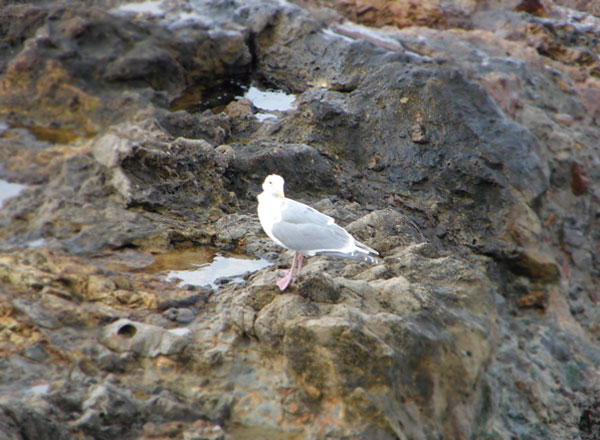
Glaucous-winged Gull on the rocks, Pigeon Point, January 2008 (Jennifer Rycenga)

A frothy ocean cove, south side of Pigeon Point, January 2008 (Jennifer Rycenga)
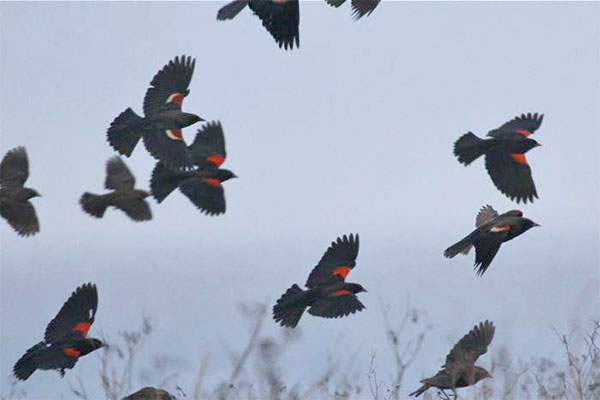
Tricolored and Red-winged Blackbirds. Pigeon Point normally has a large mixed flock of blackbirds from early fall through mid-spring. Pigeon Point, October 2011 (Michael Retter)
Author: Peter J. Metropulos
Uploaded:
March 20, 2009
Last Update:
December 25, 2022 7:16pm.
Updated by: lightly revised by Jennifer Rycenga
All content ©Sequoia Audubon Society and others
No use without written permission

