 Summer
Fall
 Winter

Spring
Summer
Fall
Winter
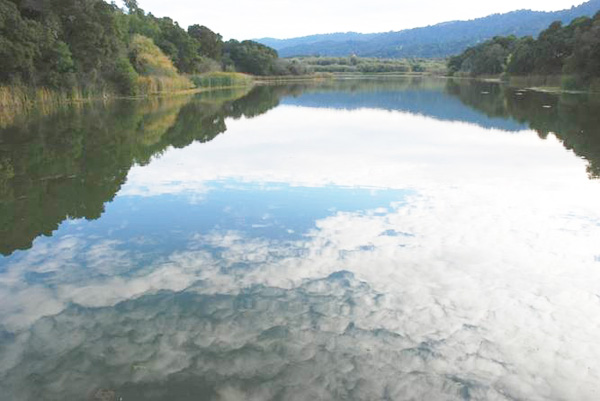
Searsville Lake, Jasper Ridge (Don Mason)
Jasper Ridge Biological Preserve (Preserve) is located near Stanford University's campus in the eastern foothills of the Santa Cruz Mountains. The Preserve encompasses remarkable geologic, topographic and biotic diversity within its 1,189 acres and provides a natural laboratory for researchers from all over the world, educational experiences to students and docent-led visitors, and refuge to native plants and animals. The Preserve includes a wide range of habitats which provide a nice variety of flora and fauna. Access to the preserve is by pre-arranged docent-led walks on well-maintained trails and roads that can range from two to four miles, with some hilly areas. No one can access the preserve without prior contact and an appointment, unless you are part of an ongoing volunteer program at the preserve. There is an active year-round bird monitoring program staffed by volunteers. Among the birds of especial note here are Wood Duck, White-breasted Nuthatch, Green Heron, Blue-gray Gnatcatcher, and Common Gallinule.
Common Year-round Residents
Canada Goose, Wood Duck, Cinnamon Teal (somewhat unusual), Mallard, Lesser Scaup, Hooded Merganser, Ruddy Duck, California Quail, Wild Turkey, Pied-billed Grebe, Eared Grebe (somewhat unusual), Western Grebe, Double-crested Cormorant, Great Blue Heron, Great Egret, Green Heron, Black-crowned Night-Heron, Turkey Vulture, White-tailed Kite, Osprey, Northern Harrier, Cooper's Hawk, Red-shouldered Hawk, Red-tailed Hawk, Golden Eagle, American Kestrel, American Coot, Virginia Rail, Ridgway's Rail, Common Gallinule (unusual), Killdeer, Spotted Sandpiper, California Gull, Herring Gull, Forster's Tern, Rock Pigeon, Band-tailed Pigeon, Eurasian Collared-Dove, Mourning Dove, Barn Owl, Western Screech-Owl (unusual for location), Great Horned Owl, Northern Pygmy-Owl, Burrowing Owl (unusual), White-throated Swift, Anna's Hummingbird, Belted Kingfisher, Acorn Woodpecker, Nuttall's Woodpecker, Downy Woodpecker, Hairy Woodpecker, Northern Flicker, Peregrine Falcon, Black Phoebe, Say's Phoebe, Hutton's Vireo, Steller's Jay, California Scrub-Jay, American Crow, Common Raven, Chestnut-backed Chickadee, Oak Titmouse, Bushtit, Golden-crowned Kinglet (unusual), Red-breasted Nuthatch, White-breasted Nuthatch, Pygmy Nuthatch, Brown Creeper, Bewick's Wren, Pacific Wren, Marsh Wren, Western Bluebird, American Robin, Wrentit, Northern Mockingbird, California Thrasher, European Starling, House Sparrow, American Pipit (unusual for location), Common Yellowthroat, Spotted Towhee, California Towhee, Song Sparrow, Lincoln's Sparrow, Dark-eyed Junco, Red-winged Blackbird, Brewer's Blackbird, Brown-headed Cowbird, Purple Finch, House Finch, Pine Siskin, Red Crossbill, Lesser Goldfinch, American Goldfinch, Hermit Warbler (somewhat unusual).Winter Visitors
Gadwall, American Wigeon, Green-winged Teal, Northern Shoveler, Northern Pintail, Canvasback, Ring-necked Duck, Bufflehead, Common Goldeneye, Common Merganser, Clark's Grebe, Snowy Egret, Sharp-shinned Hawk, Sora, Long-billed Dowitcher, Ring-billed Gull, Glaucous-winged Gull, Pacific Loon (unusual for location), Common Loon, Red-breasted Sapsucker, Merlin, Loggerhead Shrike, Ruby-crowned Kinglet, Hermit Thrush, Varied Thrush, Cedar Waxwing, Yellow-rumped Warbler, Townsend's Warbler, Savannah Sparrow, Fox Sparrow, White-crowned Sparrow, Golden-crowned Sparrow, Western MeadowlarkSpring and Summer Visitors
Caspian Tern, Vaux's Swift, Allen's Hummingbird, Rufous Hummingbird, Olive-sided Flycatcher, Western Wood-Pewee, Pacific-slope Flycatcher, Ash-throated Flycatcher, Warbling Vireo, Tree Swallow, Violet-green Swallow, Northern Rough-winged Swallow, Barn Swallow, Cliff Swallow, House Wren, Blue-gray Gnatcatcher, Swainson's Thrush, Grasshopper Sparrow, Chipping Sparrow, Orange-crowned Warbler, MacGillivray's Warbler, Black-throated Gray Warbler, Wilson's Warbler, Western Tanager, Black-headed Grosbeak, Lazuli Bunting, Bullock's Oriole, Hooded Oriole.Migrants
Greater Yellowlegs, Western Kingbird, Cassin's Vireo, Bank Swallow, Yellow Warbler
In this guide, "rarities" are defined as those species given an County Abundance Code of 4, 5, or 6.
Greater White-fronted Goose (2000, 2018, 2019), Tundra Swan (1948), Blue-winged Teal (1963), Redhead (1948, 1949), Ferruginous Hawk (2014, near SLAC), Golden Eagle (uncommon resident), Common Nighthawk (1932), Chimney Swift (2009), Solitary Sandpiper (1939, 1997, 2019), Lesser Yellowlegs (1939), White-faced Ibis (2010), Pileated Woodpecker, Red-naped Sapsucker (1985, 1986), Lewis's Woodpecker (1940, 1986, 1987, 2009), Bald Eagle (2010, 2016, 2021; becoming more common), Broad-winged Hawk (2010), Ferruginous Hawk (2009; a bit East of ridge), Willow Flycatcher (2009), Western Kingbird (2013), Phainopepla (2009-2010), Purple Martin (2010, 2015), Evening Grosbeak (1993, 2012, 2013), Lawrence's Goldfinch (many years), Lark Sparrow (1975, 2013), White-throated Sparrow (many years), Bell's Sparrow (1955, 2018), Yellow-breasted Chat (1996), Rusty Blackbird (1997), Ovenbird (1985), Nashville Warbler (1998, 2016), Palm Warbler (1973), Summer Tanager (2010).
Tours are by appointment only from October through mid-June. You cannot access the preserve without prior contact and an appointment, unless you are part of an ongoing volunteer program. From Highway 280 use the Sand Hill Road exit west towards the foothills approximately 1.8 miles. Carpooling is encouraged; the closest park and ride is at the intersection of Sand Hill Road and Lawler Ranch Road, which is the first road on the right after exiting the off-ramp/overpass.
Red Markers: Parking Area or Trail Head
Hover mouse pointer over marker, or click marker, for pin identification.
Use + or - buttons to change map zoom. Click & Drag to pan.
$5/person
Access to the Preserve is restricted to tours by appointment only docent-led bird and wildflower walks. Sequoia and Santa Clara Valley Audubon Societies sponsor yearly visits to the Preserve. Children under the age of 14 years are not allowed on a tour unless part of a formal class or event that has been approved by Preserve staff. Visitors not affiliated with Stanford University must sign a release form.
Restrooms at the Leslie Sao-ming Sun Field Station, but no facilities for tours starting at the Escobar gate; no food allowed on any trails.
Accessibility information is currently not available for this location.
For docent-led tours, call 650-851-6813. If you wish to volunteer for bird monitoring program, please call 650-851-6813.

Jasper Ridge is a hotspot in eBird, with data entered for all calendar quadrants. Over 190 species have been recorded in this eBird hotspot. Because this is an active scientific research station, it is very important to log the sightings you have here, since this contributes to a solid body of research.
Quite a few Stanford-based naturalists have contributed to the iNaturalist place marker, Jasper Ridge Biological Preserve.
Jasper Ridge is a constituent part of the research activities of various natural science departments at Stanford University. An overview of current and past research can be found at the web page for JRBP.
Sequoia Audubon Society has sponsored 21 field trips to Jasper Ridge since 1984. These are special trips that require a Jasper Ridge docent to lead them; if you see one on the schedule, sign up as soon as you can! between 1958 and 1970, there were ten field trips sponsored to Searsville Lake; Jasper Ridge was formally set aside by Stanford in 1975.
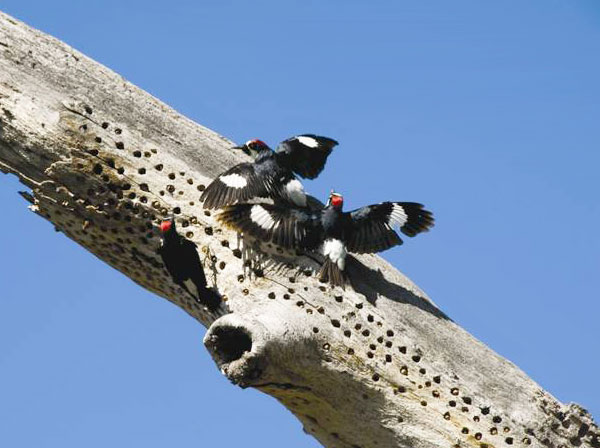
Acorn Woodpeckers on their granary tree (Dan Quinn)
Author: Leonie Batkin
Uploaded:
April 1, 2009
Last Update:
April 7, 2021 8:20am
All content ©Sequoia Audubon Society and others
No use without written permission
