 Summer
 Fall
Winter
Spring
Summer
Fall
Winter
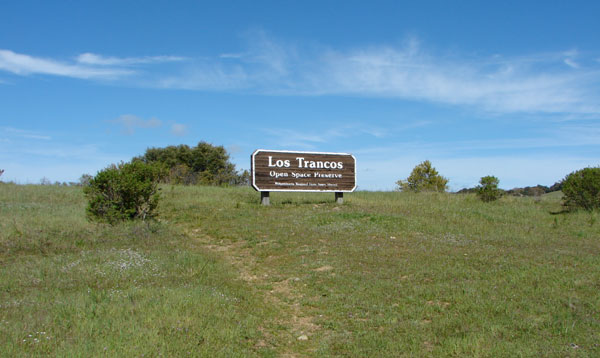
Main entrance, Los Trancos Open Space Preserve, April 2009 (Jennifer Rycenga)
Los Trancos Open Space Preserve seems to suffer in comparison to its neighbors: having come this far, birders are much more likely to want to explore the multiple habitats of Skyline Ridge, Russian Ridge, or Monte Bello Open Space Preserves, rather than attend to the less-bird-rich Los Trancos. This neglect may have some justification: birds have been fewer in number and variety here on my visits than in other portions of the Skyline region. Occasionally some of Monte Bello's best rarities cross over into Los Trancos OSP. However, there are still some excellent reasons to visit Los Trancos: it has spectacular views of the entire sweep of San Mateo county, and the San Andreas fault runs directly through it. The MROSD has built a special earthquake trail to educate visitors about the geological forces held in fragile balance beneath your feet. Actually, if you are birding here, and all the birds go silent at once, think about getting off the fault line!
Los Trancos Creek forms the county border between Santa Clara and San Mateo counties here, with San Mateo being to the north and west of the creek. Keep you GPS and map resources handy in this park, if county records matter to you. The immediate area in front of you from the main parking lot, has a mix of grasslands and scrub, with the usual species: Wrentit, Bushtit, California Scrub-Jay, and so on. The parking lot's elevation is well above 2100 feet, so look up for migrating raptors. The San Andreas Fault Trail forms an easy loop for a birder, taking just under an hour.
In the language of wikipedia, this article is a stub, as the author has not had the opportunity to explore all the trails in the park. Contributions from birders who have explored this area in greater depth, and at all seasons, are appreciated. Your author has no direct experience of the Franciscan Loop Trail nor the Lost Creek Loop Trail. She will try to amend that shortly, but her enthusiasm needs your encouragement when it comes to this park.
Mallard (fly-over), Northern Pintail (fly-over), California Quail, American Coot (rare here), Turkey Vulture, White-tailed Kite, Cooper's Hawk, Northern Harrier, Red-shouldered Hawk, Red-tailed Hawk, American Kestrel, Band-tailed Pigeon, Mourning Dove, Anna's Hummingbird, Barn Owl, Great Horned Owl, Northern Pygmy-Owl, White-throated Swift, Vaux's Swift (spring-summer), Red-breasted Sapsucker, Downy Woodpecker, Nuttall's Woodpecker (surprisingly common here), Hairy Woodpecker, Acorn Woodpecker, Northern Flicker, Olive-sided Flycatcher (uncommon), Ash-throated Flycatcher (late spring-summer), Pacific-slope Flycatcher, Say's Phoebe, Black Phoebe, Warbling Vireo, Hutton's Vireo, Steller's Jay, California Scrub-Jay, American Crow, Common Raven, Wrentit, Bushtit, Brown Creeper, White-breasted Nuthatch, Chestnut-backed Chickadee, Oak Titmouse, Violet-green Swallow, Tree Swallow (uncommon migrant), Barn Swallow (uncommon migrant), Cliff Swallow (uncommon migrant), House Wren, Pacific Wren, Bewick's Wren, Ruby-crowned Kinglet, Swainson's Thrush, Hermit Thrush, Western Bluebird, American Robin, Varied Thrush, European Starling, Northern Mockingbird (uncommon here), California Thrasher, Black-throated Gray Warbler, Wilson's Warbler, Yellow-rumped Warbler, Yellow Warbler (uncommon here), Orange-crowned Warbler, Hermit Warbler (seen almost annually as a migrant), Townsend's Warbler, Spotted Towhee, California Towhee, Dark-eyed Junco, Fox Sparrow, Song Sparrow, White-crowned Sparrow, Golden-crowned Sparrow (Fall-spring), Western Meadowlark, Red-headed Blackbird, Brown-headed Cowbird, Black-headed Grosbeak, Western Tanager, Lazuli Bunting (uncommon, spring-summer), Purple Finch, Red Crossbill (irruptive), Lesser Goldfinch, Pine Siskin
In this guide, "rarities" are defined as those species given an County Abundance Code of 4, 5, or 6.
Wild Turkey (perhaps the easiest place in the county to see them), Osprey (fly-over), Black Swift (2014), Pileated Woodpecker, Purple Martin (2013), Cassin's Vireo (spring migration), Vesper Sparrow (2022), Lawrence's Goldfinch (numerous years; listen for them near the parking lot), Indigo Bunting (2000, 2009), Evening Grosbeak (2011, 2013)
The best access to the San Mateo portions of Los Trancos OSP are from the main parking lot, located on Page Mill Road directly across the street from Monte Bello OSP (Santa Clara County).
Red Markers: Parking Area or Trail Head
Hover mouse pointer over marker, or click marker, for pin identification.
Use + or - buttons to change map zoom. Click & Drag to pan.
Use of Los Trancos Open Space Preserve is free.
The parking lot is open from 8:00 am to one half-hour after sunset.
Ticks and poison oak are plentiful; rattlesnakes and mountain lions can be present. You are hereby warned, once again, that this park is bisected by the San Andreas Fault. The longer the passage of time from the 1906 San Francisco Quaker and the 1989 Loma Prieta Quake, the more carefully you should calculate the statistical risk of birding here!
Los Trancos itself has no facilities, but there are bathrooms across the street from the main parking lot, at Monte Bello OSP.
Accessibility information is currently not available for this location.
650-691-1200 is the Mid-peninsula Region Open Space District general office; they can give you information about access and trail closures.
Los Trancos has two hotspots in eBird. The first one, located primarily in San Mateo county, is labeled "Los Trancos OSP -- (SM county) San Andreas Fault tr. and Franciscan Loop Tr. to intersection of Lost Creek Loop Tr." Its information page can be found here. The second one is centered around the southeastern sections of the park that are in Santa Clara County. It can be found under the title "Los Trancos OSP (SCL Co.)--Page Mill Trail and Lost Creek Loop Trail, Santa Clara, US-CA" with an eBird reference page here. Most birders use the San Mateo county hotspot as the default, even though the park is almost evenly split, area-wise, between the two counties. Between the two hotspots, there is data in 37 of 48 time quadrants, representing 103 species. Please share your sightings, especially for under-visited spots like this, in eBird.
Los Trancos has an iNaturalist place page.
A BioBlitz was held here in November 2022, a joint project between Sequoia Audubon Society and the South Bay's BioBlitz Club.
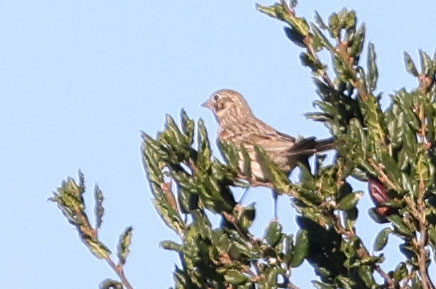
A pair of Vesper Sparrows flew between the Monte Bello and Los Trancos OSP parking lots, on a wing and a prayer, in October 2022 (Garrett Lau)
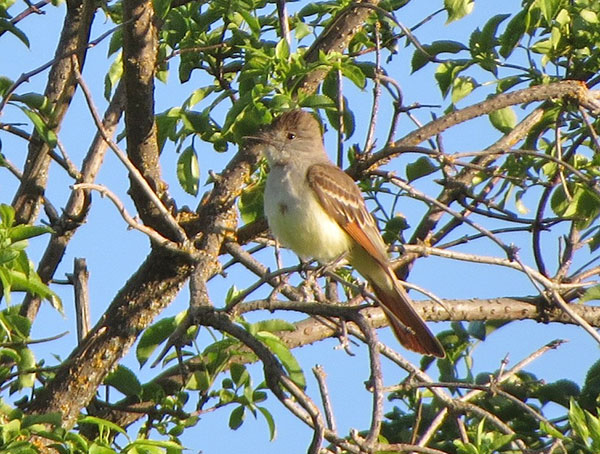
Ash-throated Flycatcher, April 2019 (Garth Harwood)
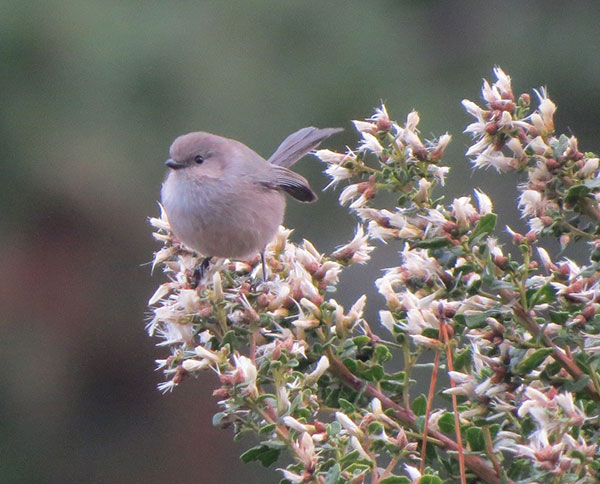
Bushtit, November 2017 (Garth Harwood)
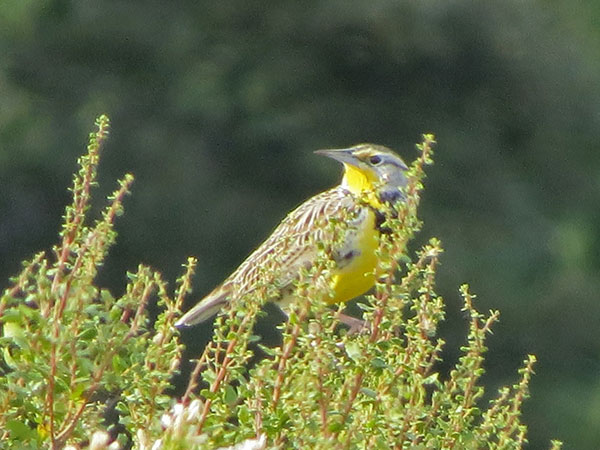
Western Meadowlark, December 2017 (Garth Harwood)
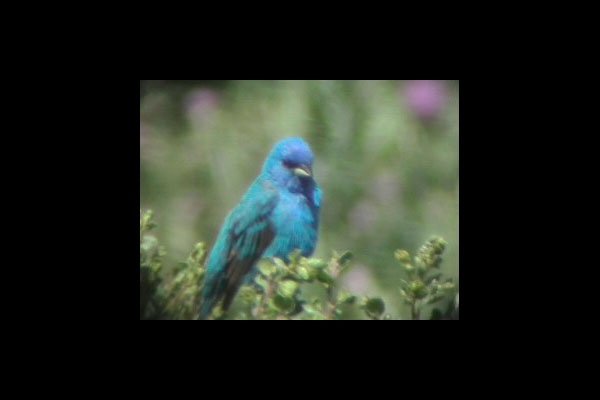
Indigo Bunting, June 2001; most often when this rare bird turns up in the county, it is in these high-elevation parks on or near Skyline Boulevard. (Brooke Miller)
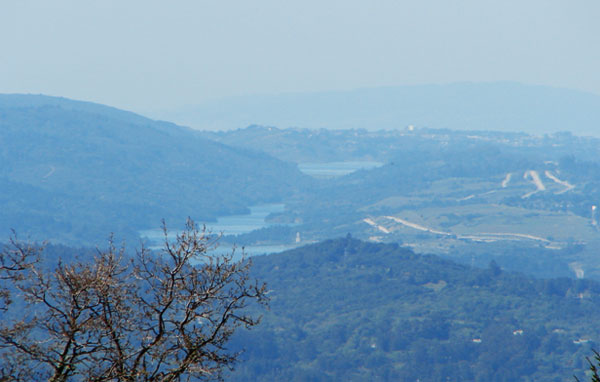
View of Crystal Springs Reservoir from Los Trancos Open Space Preserve, April 2009 (Jennifer Rycenga)
Author: Jennifer Rycenga
Uploaded:
April 12, 2009
Last Update:
November 5, 2022 10:01am
All content ©Sequoia Audubon Society and others
No use without written permission
