 Summer
 Fall
 Winter
Spring
Summer
Fall
Winter
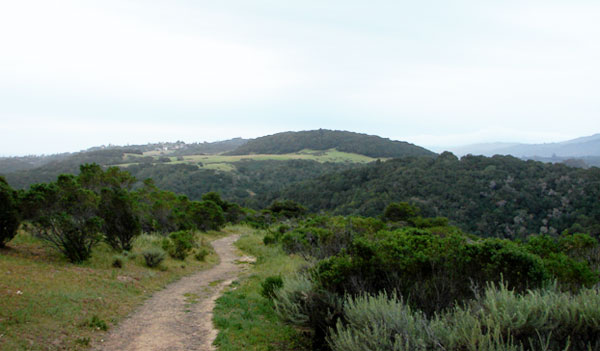
Looking south to Edgewood County Park, from Pulgas Ridge OSP, April 2009 (Jennifer Rycenga)
Pulgas Ridge Preserve north of Edgewood Park and across Edgewood Road is managed by the Midpeninsula Open Space District. Enter the Preserve along a trail that begins on Edmunds Road off of Crestview. The specialty birds of this preserve are Blue-gray Gnatcatcher and California Thrasher, both found in spring along the ridge. It is also a good spot for raptors in winter and in migration. The park is justly famous for its wildflower displays in spring, similar in species to what can be found at Edgewood.
There are two ways of hiking a large loop within the park. To avoid a fast uphill climb, and to steer clear of the dogs for a while, begin your explorations along the Cordilleras Trail. This trail takes you along some open space, creating edge habitat. When you get to the trail junction with Polly Geraci Trail and Dusky-footed Woodrat Trail, you can either decide to take the shorter loop of the Geraci Trail (total length about 2 miles from this point back to the parking lot), or the longer loop proffered by the Dusky-footed Woodrat Trail (just over 3 miles total length). Both trails take you through primarily oak woodland habitat, but emerge into open chapparal near their peaks. The birding at this park is not as spectacular as at Edgewood, but it is ideal for the beginning birder, or a birder with a companion dog. Canines are allowed, on leash only, on all trails. There is also a very popular off-leash area, clearly marked on the maps, near the intersection of the Blue Oak and Hassler Trails.
Pulgas Ridge was the site of a Tuberculosis sanitarium, Hassler Health Home, owned and operated by the city of San Francisco from 1926 to 1972. The land was purchased by the MROSD in 1983, with help from neighborhood groups. Few artifacts remain from the sanitarium, as the buildings were demolished in 1985 and a large-scale effort to eradicate introduced non-native plants followed.
Canada Goose, California Quail, Wild Turkey, Rock Pigeon, Band-tailed Pigeon, Eurasian Collared-Dove, Mourning Dove, White-throated Swift, Anna's Hummingbird, Rufous Hummingbird, Allen's Hummingbird, Western Gull, California Gull, Glaucous-winged Gull, Caspian Tern, Great Blue Heron, Turkey Vulture, White-tailed Kite, Golden Eagle, Northern Harrier, Sharp-shinned Hawk, Cooper's Hawk, Red-shouldered Hawk, Red-tailed Hawk, Great Horned Owl, Western Screech Owl, Red-breasted Sapsucker, Acorn Woodpecker, Nuttall's Woodpecker, Downy Woodpecker, Hairy Woodpecker, Northern Flicker, American Kestrel, Peregrine Falcon, Merlin, Olive-sided Flycatcher, Pacific-slope Flycatcher, Black Phoebe, Ash-throated Flycatcher, Western Kingbird, Cassin's Vireo, Warbling Vireo, Hutton's Vireo, California Scrub-Jay, Steller's Jay, Common Raven, American Crow, Chestnut-backed Chickadee, Oak Titmouse, Northern Rough-winged Swallow, Tree Swallow, Violet-green Swallow, Barn Swallow, Cliff Swallow, Bushtit, Wrentit, Golden-crowned Kinglet, Ruby-crowned Kinglet, Red-breasted Nuthatch (uncommon), White-breasted Nuthatch, Pygmy Nuthatch, Brown Creeper, Blue-gray Gnatcatcher, House Wren, Pacific Wren, Bewick's Wren, European Starling, California Thrasher, Northern Mockingbird, Western Bluebird, Varied Thrush, Hermit Thrush, American Robin, Cedar Waxwing, House Sparrow, House Finch, Purple Finch, Red Crossbill, Pine Siskin, Lesser Goldfinch, American Goldfinch, Fox Sparrow, Dark-eyed Junco, Golden-crowned Sparrow, White-crowned Sparrow, Song Sparrow, Spotted Towhee, California Towhee, Hooded Oriole, Bullock's Oriole, Brown-headed Cowbird, Orange-crowned Warbler, MacGillivray's Warbler, Yellow-rumped Warbler, Black-throated Gray Warbler, Hermit Warbler (migrant), Townsend's Warbler, Wilson's Warbler, Black-headed Grosbeak, Lazuli Bunting
In this guide, "rarities" are defined as those species given an County Abundance Code of 4, 5, or 6.
White-throated Sparrow (2005), Williamson's Sapsucker (2020)
From Edgewood Road (near I-280), go north on Crestview Drive, then take an immediate left onto Edmonds Road. The parking lot is clearly marked on Edmonds.
Red Markers: Parking Area or Trail Head
Hover mouse pointer over marker, or click marker, for pin identification.
Use + or - buttons to change map zoom. Click & Drag to pan.
Use of Pulgas Ridge Open Space is free.
Dawn to an hour after dusk.
Rattlesnakes, ticks, and poison oak. The park could host Mountain Lion, but its small size and constant canine activity reduce the already low likelihood of the big cat. Don't leave valuables visible in your car.
There is a restroom at the parking lot. The park is located at some distance from services and easily obtained food; come prepared.
The Cordilleras Trail in Pulgas Ridge OSP is represented on the Birdability website. This site, sponsored by the National Audubon Society, seeks to crowd-source information on accessibility and birding. Consider submitting a review of your favorite park, and/or revising the review that exists to better reflect your experience. Thanks for helping to ensure that birding really is for everyone.
You can contact the MROSD district office at 650-691-1200 for more information about trail conditions.
Pulgas Ridge Open Space Preserve is a hotspot in eBird, with data is forty-three of forty-eight time quadrants representing 100 species. This is quite a leap in coverage over the past decade! Please continue to contribute your sightings to the growing eBird database, so as to generate a genuine comparison between Pulgas Ridge and its southern neighbor of Edgewood.
The iNaturalist place marker for Pulgas Ridge has some good coverage, but this spot should be a candidate for a future Bio-Blitz.
Sudden oak death has affected some trees in this park, especially on the west side (near I-280). Visit the California Oak Mortality Task Force for general information on this blight and control of the disease.
There have been four Sequoia Audubon Society field trips to this spot, most of them in the late 2010s.
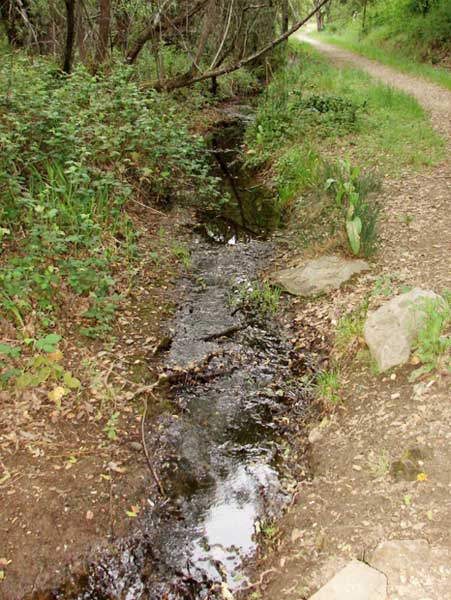
Stream at intersection of Cordilleras, Polly Geraci and Dusky-footed Wood-Rat Trails, Pulgas Ridge OSP, April 2009 (Jennifer Rycenga)
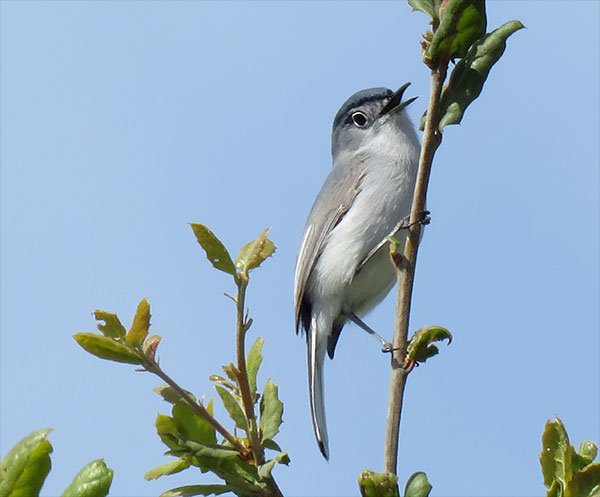
Blue-gray Gnatcatcher, one of the most significant species at Pulgas Ridge, April 2018 (Donna Pomeroy)
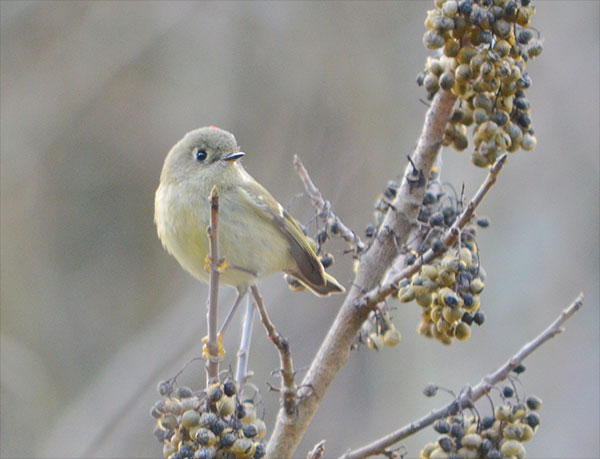
Ruby-crowned Kinglet, showing a hint of its namesake, December 2019 (Cedrik von Briel)
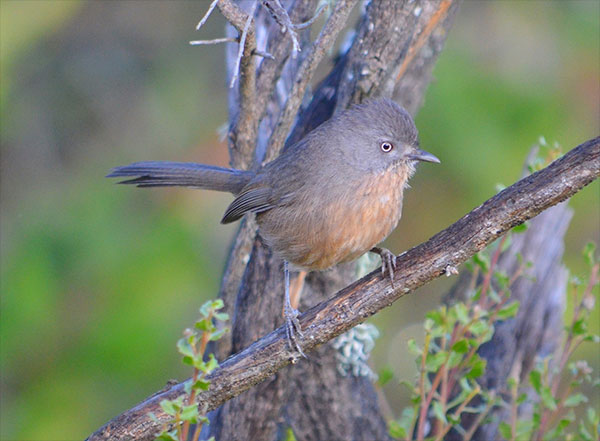
Wrentit, December 2019 (Cedrik von Briel)
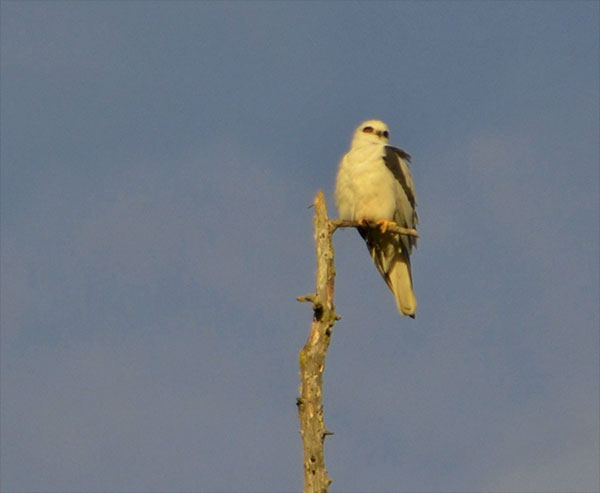
White-tailed Kite, another significant species for Pulgas Ridge, suffering a bad feather day, December 2018 (Cedrik von Briel)
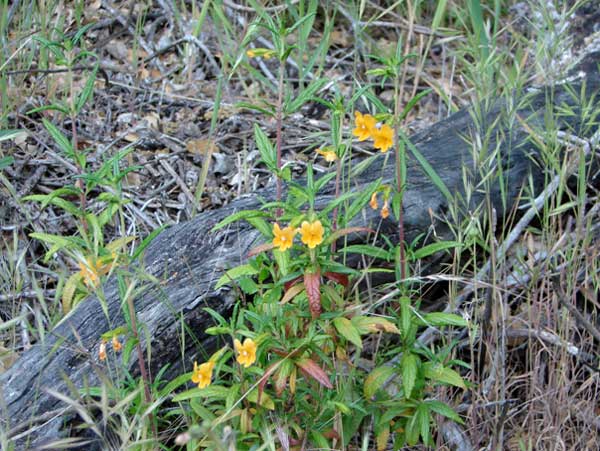
Wildflowers along the Dick Bishop trail, Pulgas Ridge OSP, April 2009 (Jennifer Rycenga)
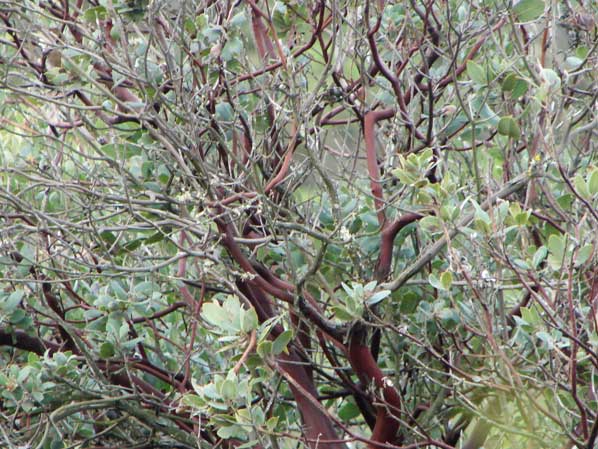
Manzanita, Pulgas Ridge OSP, April 2009 (Jennifer Rycenga)
Author: Jennifer Rycenga
Uploaded:
April 25, 2009
Last Update:
June 8, 2021 9:13am
All content ©Sequoia Audubon Society and others
No use without written permission