 Summer
 Fall
Winter

Spring
Summer
Fall
Winter
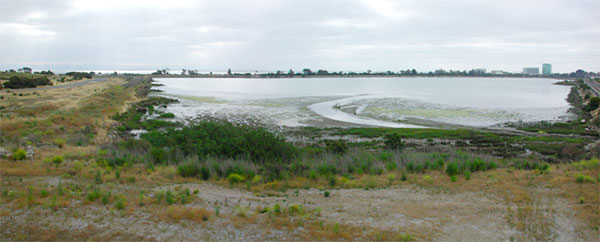
Panorama of Brisbane Lagoon, June 8, 2009, looking east (Laurie Graham/Jeff Fairclough)
Brisbane Baylands, for birders, means Brisbane Lagoon, which is a scalene triangle of water bordered on the east by Highway 101. Before the highway was built, the lagoon was part of the bay. It is best birded at low tide, in fall and winter. The large landfill portion of the Baylands that extends all the way to the SF county line is active with heavy machinery during the week, and is, in any case, private property. 1000 feet north of the junction of Tunnel and Lagoon Way is a creek that runs through the landfill to the bay.
From the Park & Ride lot, walk across the bridge to the intersection of Tunnel Rd and Lagoon way. Enter the bare area below the bridge. There was more vegetation here before the new bridge was built; it had to be cleared for construction. There is some growth, but it doesn't appear that any conscious replanting has been done. If it is swallow season, walk below the bridge to see the nests and the birds flying in and out. Near the willows is a jumble of rocks. This is the best place to get through the weeds to access the shore. Walk east along the shore to the corner of the lagoon. There is a faint path up to Sierra Point Parkway. Walk south to the fisherman's parking lot, pausing above the outflow to watch the tide. In season Surf Scoters dive for food in the rushing tide. At the fisherman's Parking lot, there is a Portapotty and benches. Depending on the sun, this is a good place from which to scope the lagoon.
In winter, the southern side of the lagoon is host to rafts of ducks, but they are hard to see, even with a scope. It is difficult to access this part of the lagoon. There is a company along Bayshore called VWR, but their lot is posted against trespassing. It is possible to walk along Sierra Point Parkway, in the bike lane, but the fast traffic along the road makes this unpleasant. Biking might be the best way. Also, at very low tide, it might be possible to walk along the long side of the lagoon, but the shore is rocky and the rocks are slippery.
Numbers of species vary by season, from the mid-30's from November through February, to under-10's in June. Waterfowl and shorebirds are the most common fall and winter birds. House Finches and American Goldfinches are found in the fennel and willows at the head of the lagoon. Red-winged Blackbird juveniles flock in the reeds near the creek exit in late spring. Cliff Swallows are a recent addition to the scene with the completion in 2007 of the new bridge over the Caltrain tracks, with frenetic activity from April through June.
Canada Goose, Mallard, Gadwall, Green-winged Teal, Canvasback, Greater Scaup, Lesser Scaup, Surf Scoter, Bufflehead, Common Goldeneye, Red-breasted Merganser, Ruddy Duck, Pied-billed Grebe, Horned Grebe, Eared Grebe, Western Grebe, Clark's Grebe, Brown Pelican, Brandt's Cormorant (unusual at this location), Double-crested Cormorant, Great Blue Heron, Great Egret, Snowy Egret, Turkey Vulture, Osprey (uncommon), White-tailed Kite, Northern Harrier, Red-shouldered Hawk, Red-tailed Hawk, American Kestrel, American Coot, Black-bellied Plover, Semi-palmated Plover, Killdeer, Black-necked Stilt, American Avocet, Spotted Sandpiper, Greater Yellowlegs, Willet, Whimbrel, Long-billed Curlew, Marbled Godwit, Black Turnstone, Western Sandpiper, Least Sandpiper, Dunlin, Wilson's Snipe, Short-billed Gull, Ring-billed Gull, Western Gull, Herring Gull, Glaucous-winged Gull, California Gull, Caspian Tern, Forster's Tern, Rock Pigeon, Eurasian Collared-Dove, Mourning Dove, Anna's Hummingbird, Belted Kingfisher, Red-breasted Sapsucker (rare at this location), Black Phoebe, American Crow, Common Raven, Cliff Swallow, Barn Swallow, Chestnut-backed Chickadee, Bushtit, American Robin, Northern Mockingbird, European Starling, Orange-crowned Warbler, Yellow Warbler, Yellow-rumped Warbler, California Towhee, Spotted Towhee, Savannah Sparrow, Song Sparrow, White-crowned Sparrow, Golden-crowned Sparrow, Red-winged Blackbird, Western Meadowlark, Brewer's Blackbird, House Finch, American Goldfinch
In this guide, "rarities" are defined as those species given an County Abundance Code of 4, 5, or 6.
Cackling Goose (2014), Least Tern (April 1999), Tropical Kingbird (2013), Mountain Bluebird, Clay-colored Sparrow (2011), Yellow-headed Blackbird (August 2005), Nashville Warbler (2013), Palm Warbler (2015)
Take Highway 101. From the south, exit at 426A, Bayshore Blvd./Cow Palace. From the north, take the South San Francisco exit and turn right on Airport Blvd. Continue on Airport/Bayshore Blvd. to Tunnel Avenue, turn right, and turn right immediately into the Park & Ride lot. To continue to the fisherman's lot, drive across the bridge, turn right on Lagoon Way, then turn right on Sierra Point Parkway. The lot is in a group of trees just past the outflow.
Red Markers: Parking Area or Trail Head
Hover mouse pointer over marker, or click marker, for pin identification.
Use + or - buttons to change map zoom. Click & Drag to pan.
Open all hours.
Because it is private property, there is no maintenance, and trails can be overgrown with foxtails. Poison Oak is not an issue, nor are ticks. This area is not handicapped accessible. The railroad tracks here are active: DO NOT cross the tracks, despite the fact that they are unfenced.
There is a Portapotty at the fisherman's parking lot, which is usually clean. There is no drinking water.
Accessibility information is currently not available for this location.
The entire site is private property; stay tuned for developments (and restorations) with the city of Brisbane websites listed below.
Brisbane Lagoon is a hotspot in eBird, with eighty-two species in twenty-five of forty-eight time quadrants. Please continue to build the data set here by contributing to eBird, as this will assist in conservation plans for the site.
The San Francisco Bay Bird Observatory (SFBBO) is conducting a long-range study of gull movements in the Bay Area. California Gulls have been leg-banded with plastic colored bands. If you see any of these gulls, please note the leg and the color of the band; if it is possible to read the number on the band, record that also. This information can be shared directly with Carly at SFBBO (cschacter@sfbbo.org). If the birds also have a metal band, and you can read that number, too, please report that to the National Bird Banding Lab.
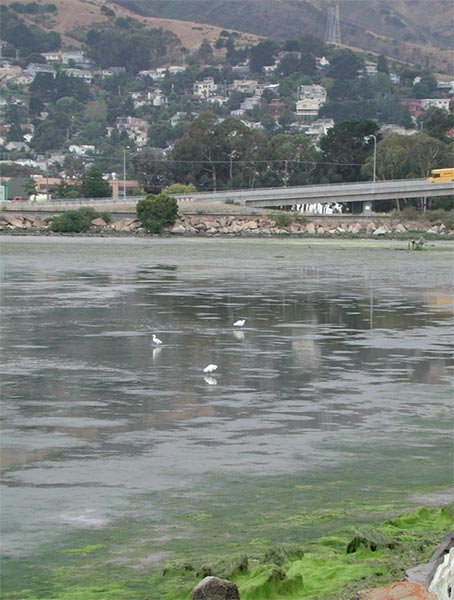
Three Snowy Egrets in Brisbane Lagoon, June 8, 2009, (Laurie Graham/Jeff Fairclough)
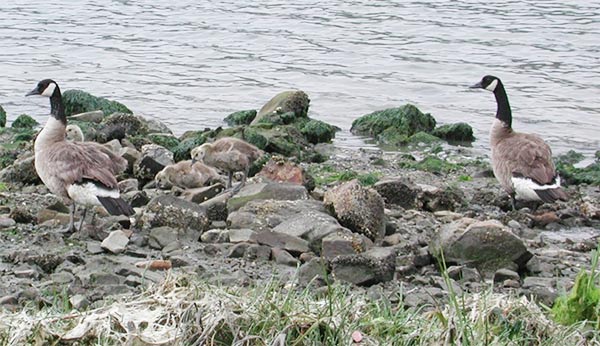
Canada Goose pair with young, Brisbane Lagoon, June 8, 2009, (Laurie Graham/Jeff Fairclough)
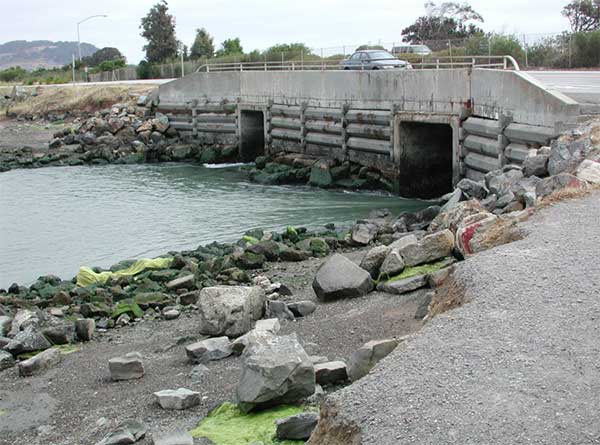
Tidal ports to the bay, Brisbane Lagoon (Laurie Graham/Jeff Fairclough)
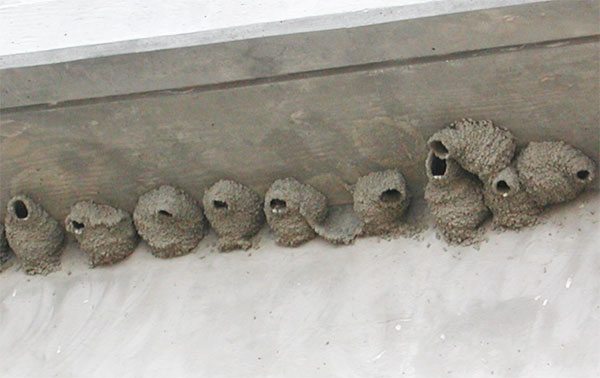
Cliff Swallow nests under the Tunnel Avenue Overpass, June 2009. Cliff Swallows did not nest on the old bridge. (Laurie Graham/Jeff Fairclough)
Author: Laurie Graham & Jeff Fairclough
Uploaded:
June 17, 2009
Last Update:
October 14, 2021 8:40am
All content ©Sequoia Audubon Society and others
No use without written permission
