 Summer
 Fall
Winter
Spring
Summer
Fall
Winter

Cypress Lawn, the largest of the ornamental ponds, April 2009 (Jeff Fairclough/Laurie Graham)
Cypress Lawn Cemetery forms a beautiful park-like setting that happens to have amenities favorable to birds. The large lake and the smaller ornamental ponds at the entrance off El Camino Real (ECR) are used in the recycling of the water used to maintain the grounds. The appeal to birds was undoubtedly secondary. The lake, ponds, and shores are populated by gulls, ducks, American Coots, Canada Geese, Black-crowned Night Herons, passerines, Rock Pigeons, and the occasional surprise bird. The surprises include Green-winged Teal, Greater White-fronted Geese, Eurasian Wigeon, a lost Red Phalarope during the famous 'wreck' of December 26, 2005, along with the only Marbled Godwit we have recorded there, and a lone Pectoral Sandpiper on the mudflat of the lake during a drain-down. Wood Ducks are frequent, Common Goldeneye and Hooded Merganser occasional. Great Blue Heron is an occasional visitor. Ducklings are seldom seen, often not surviving the attentions of the breeding Night Herons. All the swallows hunt over the lake, and Cliff Swallows nest on the old Columbarium.
Cypress Lawn Cemetery is an excellent place to study gulls; so far there are nine species and one hybrid recorded. The cemetery can also be highly recommended to beginners and those with disabilities.
The grounds rise, a bit steeply at first, then more gradually, toward Hillside Blvd. and San Bruno Mountain. The many trees host breeding birds, including at least one family of Western Bluebirds. American Robins are abundant in winter and spring. There is, as might be expected, a serenity felt in strolling among monuments to the dead. The statuary and architecture are remarkable.
Along its southeastern edge, Cypress Lawn borders Holy Cross Cemetery. Where they meet at Hillside Blvd., there is a little creek that flows from under the road, in which we have seen bathing Townsend's and Yellow-rumped Warblers and Chestnut-backed Chickadees. To the right of this area is a plant nursery, where Varied Thrush has been recorded.
The eastern portion of the cemetery is not as birdy, due to the lack of water features, but some interesting observations have been made: the first Eurasian Collared-doves seen in Colma, and a memorable sight of American Crows and Ring-billed Gulls - the same size! - feasting on worms after a rain.
Please, review Cemetery Etiquette for Bird-watching, another page on our site.
Canada Goose, Wood Duck, American Wigeon, Mallard, Cinnamon Teal, Green-winged Teal, Bufflehead, Common Goldeneye, Hooded Merganser, Ruddy Duck, Pied-billed Grebe, Double-crested Cormorant, Great Blue Heron, Great Egret, Snowy Egret, Black-crowned Night-Heron, Turkey Vulture, White-tailed Kite, Cooper's Hawk, Red-shouldered Hawk, Red-tailed Hawk, American Kestrel, American Coot, Killdeer, Spotted Sandpiper, Marbled Godwit, Red-necked Phalarope, Red Phalarope (accidental at this location), Heermann's Gull (unusual at this location), Bonaparte's Gull, Short-billed Gull, Ring-billed Gull, Western Gull, Western x Glaucous-winged Gull (hybrid), California Gull, Herring Gull, Iceland Gull thayeri, Glaucous-winged Gull, Rock Pigeon, Eurasian Collared-Dove, Mourning Dove, Anna's Hummingbird, Allen's Hummingbird, Nuttall's Woodpecker, Downy Woodpecker, Northern Flicker, Black Phoebe, Hutton's Vireo, Steller's Jay, American Crow, Common Raven, Tree Swallow, Violet-green Swallow, Northern Rough-winged Swallow, Cliff Swallow, Barn Swallow, Chestnut-backed Chickadee, Bushtit, Red-breasted Nuthatch, Pygmy Nuthatch, Brown Creeper, Golden-crowned Kinglet, Ruby-crowned Kinglet, Western Bluebird, Hermit Thrush, American Robin, Varied Thrush, Northern Mockingbird, European Starling, Cedar Waxwing, Yellow Warbler, Yellow-rumped Warbler, Townsend's Warbler, Common Yellowthroat, Wilson's Warbler, California Towhee, Fox Sparrow, Song Sparrow, White-crowned Sparrow, Golden-crowned Sparrow, Dark-eyed Junco, Black-headed Grosbeak, Brewer's Blackbird, Brown-headed Cowbird, Bullock's Oriole, Purple Finch, House Finch, Red Crossbill (rare at this location), Lesser Goldfinch, American Goldfinch, House Sparrow
In this guide, "rarities" are defined as those species given an County Abundance Code of 4, 5, or 6.
Greater White-fronted Goose (2012, 2021, 2022, 2023), Cackling Goose (2012, 2015, 2016, 2017, 2021, 2022 @ Holy Cross), Snow Goose (2020, 2021), Eurasian Wigeon, Eurasian Collared-dove, Merlin, Cattle Egret (2022), Pectoral Sandpiper, Red-necked Phalarope (2021 - not rare for the county, but quite odd here!), Laughing Gull (2018), Lesser Black-backed Gull (2018), Glaucous Gull (2008, 2011, 2016, 2018, 2019, 2020, 2022), Lewis's Woodpecker (2022), Yellow-bellied Sapsucker (2018, 2019, 2020), Tropical Kingbird (2003, 2019, 2020, 2021, 2022), Western Kingbird (2018), Vermilion Flycatcher (2016, 2017), Yellow-billed Magpie (at the nearby Italian Cemetery, 1998), Northern Parula (2022, Holy Cross Cemetery), Tennessee Warbler (2021, 2022, 2023), Palm Warbler (2017, 2018, 2021, 2022), Cape May Warbler (2023), Bay-breasted Warbler (2022), Blackpoll Warbler (2022), Hooded Warbler (2020), White-throated Sparrow (Holy Cross Cemetery, 2018), Chipping Sparrow (2018, 2019, 2021), Clay-colored Sparrow (2019), Lark Sparrow (Holy Cross Cemetery, 2018), Baltimore Oriole (2018, 2021), Orchard Oriole (2017, 2022), Summer Tanager (2017, 2020), Rose-breasted Grosbeak (2021, Holy Cross Cemetery), Painted Bunting (2022)
Going south on I-280, exit at Serramonte, then turn left under the freeway while in the central turn lane. At Junipero Serra Blvd., continue north on Serramonte Blvd. Turn right on El Camino Real. Move to the left lane. After two blocks, turn left into the cemetery. Park there or on El Camino alongside the ponds.
Going north on I-280, exit at Hickey Blvd. Continue on Hickey until it dead-ends on El Camino, at which point you will want to be in the left lane. Turn left onto El Camino Real, move into the right lane. In about 1 mile, the cemetery will appear on your right. Be aware of merging traffic from Old Mission Road on your right just before the cemetery entrance.
Red Markers: Parking Area or Trail Head
Hover mouse pointer over marker, or click marker, for pin identification.
Use + or - buttons to change map zoom. Click & Drag to pan.
There are no fees to visit Cypress Lawn Cemetery.
The gate is open from 8 a.m. to 5 p.m., but pedestrian access at other times is unimpeded. The site is wheelchair accessible when the gate is open.
Be respectful of posted rules: Cypress Lawn is a cemetery, and private property, too. Be mindful of traffic; most mourners are driving very slowly, but cemetery employees can be speedy at times.
None. There are restrooms in the new Columbarium in the eastern section of Cypress Lawn, across ECR and up the hill; at Holy Cross Cemetery, just a tad south on Old Mission Road; or at Kohl's Department Store, north on El Camino. Other facilities are in abundance at the nearby shopping centers. In any case, it is not appropriate to eat in the cemetery.
Accessibility information is currently not available for this location.
The best way to contact the Cemetery is to email them at info@cypresslawn.com. You can call Cypress Lawn Heritage Foundation at 650-755-0580.
Cypress Lawn Cemetery is a hotspot in eBird, with sixty-six species represented in sixteen time quadrants. Record the after-life lists of Cypress Lawn's permanent residents by entering your sightings into eBird.
The San Francisco Bay Bird Observatory (SFBBO) is conducting a long-range study of gull movements in the Bay Area. California Gulls have been leg-banded with plastic colored bands. If you see any of these gulls, please note the leg and the color of the band; if it is possible to read the number on the band, record that also. This information can be shared directly with Carly at SFBBO (cschacter@sfbbo.org). If the birds also have a metal band, and you can read that number, too, please report that to the National Bird Banding Lab.
Sequoia Audubon has sponsored three field trips to various and sundry cemeteries of Colma. This is an easy field trip for a new leader to conduct - consider volunteering!
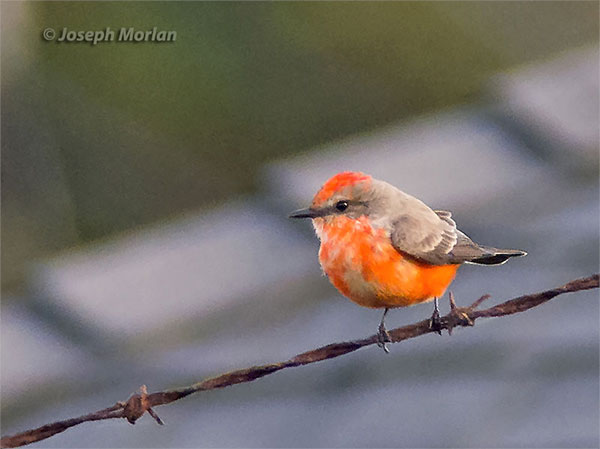
Vermilion Flycatcher male, found by Peter Metropulos in November 2016 (Joe Morlan)
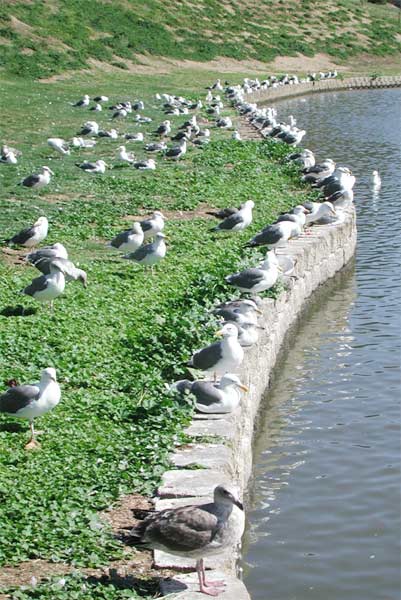
September gulls along the lake, Cypress Lawn Cemetery, September 2004 (Jeff Fairclough/Laurie Graham)
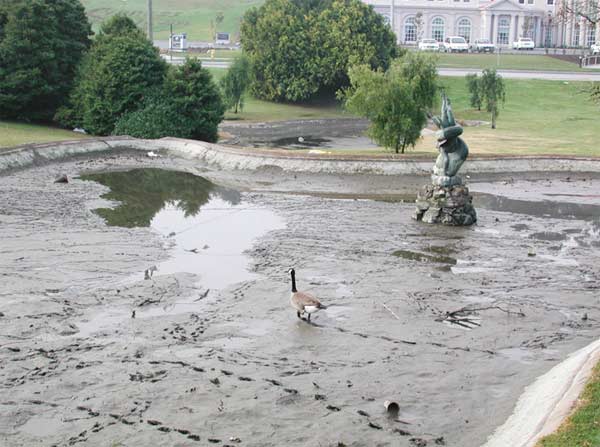
Christmas goose, 2004 "Where's the water?" December 2004 (Jeff Fairclough/Laurie Graham)
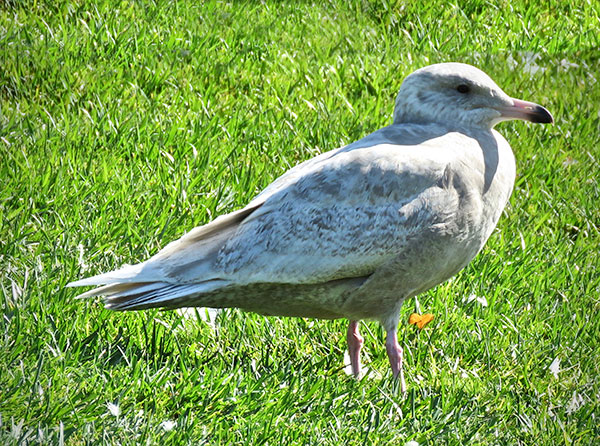
First-year Glaucous Gull, February 2020 (Jennifer Rycenga)
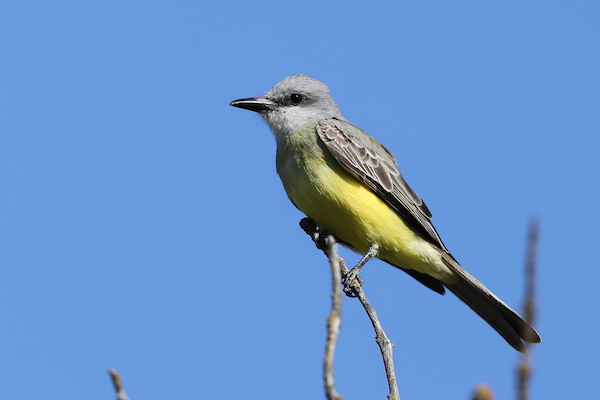
Tropical Kingbird, March 2020 (Aaron Maizlish)
Author: Laurie Graham and Jeff Fairclough
Uploaded:
June 30, 2009
Last Update:
September 17, 2023 7:59pm
All content ©Sequoia Audubon Society and others
No use without written permission
