 Summer
 Fall
Winter
Spring
Summer
Fall
Winter
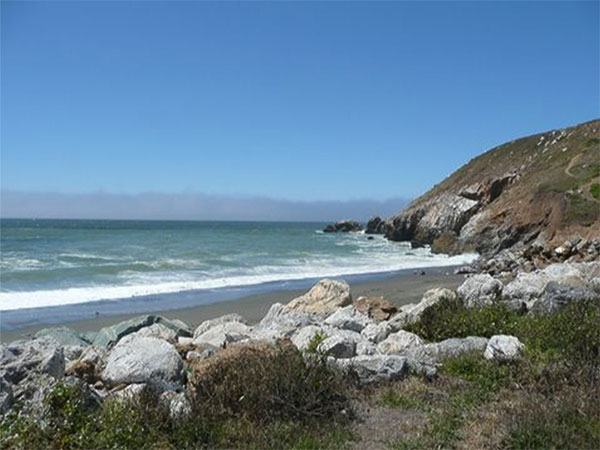
Rockaway Beach at Calera Creek Mouth, looking north. Western Gulls and Pigeon Guillemot have nested on these rocky cliffs, June 2010. (Dan Singer)
This area features beautiful views, a successful creek and riparian corridor restoration story, and an interesting mix of habitats and birds. Starting with both sandy and rocky coastline at Rockaway Beach, the rest of the area is defined by a varied topography of grassland, riparian, restored marsh and creek, and dramatic promontories, as well as the remains of an old rock quarry (right down to its dynamite cache)! The site's advantages include a range of hiking trails: some are paved and level, while others are narrow and windy, and even call for bushwhacking. Dogs are allowed at this park, so birders with canine pals (on leash) can explore together. Beware of bicyclists.
There are three parking lots for this area; running south to north: Rockaway Beach - located at the south end of Old County Road; Calera Creek - located at the west end of San Marlo Way; and Reina del Mar - located on the west side of Hwy. 1 at the junction of Reina Del Mar Avenue and Hwy. 1.
The beachfront at Rockaway Beach lot has some notable birds, largely because the sandy beach is surrounded by good habitat for rocky shorebirds. Pelagic Cormorant, Black Oystercatcher, Western Gull, and Pigeon Guillemot nest here; Double-crested Cormorant, Brandt's Cormorant, Black Turnstone, Wandering Tattler, and Surfbird can be found here during fall, winter or spring. Surf Scoter, three loon species, Brown Pelican, Western and Clark's Grebes, and less common winter waterbirds such as Red-necked Grebe, White-winged Scoter, Black Scoter, and Red-breasted Merganser have been observed here. The beach is too small to attract large gull or shorebird flocks, but the expected larids - Western Gull, California Gull, Glaucous-winged Gull, Heermann's Gull - and shorebirds - Willet, Whimbrel, Marbled Godwit, Sanderling - are regular during the appropriate time of year. The beach is relatively small and is used by lots of people - beach lovers, fishermen, dog walkers, swimmers and surfers - which can depress bird numbers. However, the rocky edges at either end of the beach can be scanned quite efficiently from the Rockaway or Calera Creek parking areas and rocky shore birds aren't normally impacted by beach traffic.
The Calera Creek parking area is adjacent to a small marsh at the creek mouth, which is sometimes productive for Sora, Virgina Rail and Swamp Sparrow. If you take the trail to the west of the marsh, it leads to an easy creek crossing and to some makeshift trails up the very steep and rocky hill north of the parking lot. The climb uphill can be treacherous and is not recommended, though the view once you reach the top is a nice reward. After crossing the creek you can turn to your right and follow a fairly well-used trail up stream along the west side (ocean-side) of the creek. It provides a different perspective of the lower creek habitat and mixed species flocks in the fall are sometimes easier to see from here.
A paved trail and bike path begins at the northeast corner of the parking lot and runs first along the marsh and then along the creek's riparian zone, all the way to the Reina Del Mar parking lot. Birds to look and listen for here during the appropriate season include Sora, Virginia Rail, Mourning Dove, Anna's Hummingbird, Black Phoebe, California Scrub-Jay, swallows, Chestnut-backed Chickadee, Bewick's Wren, Swainson's Thrush, Common Yellowthroat, Wilson's Warbler, Savannah Sparrow (in the grassy field to the east of the eastern trail), Fox Sparrow, Song Sparrow, Lincoln's Sparrow, White-crowned Sparrow, Red-winged Blackbird, Brown-headed Cowbird, Purple Finch, House Finch and American Goldfinch. Raptors frequent this area because of the combination of open grasslands and high cliffs. During fall and winter, birders should be alert for accipiters, White-tailed Kite, Red-shouldered and Red-tailed hawks, Peregrine Falcon, Merlin, American Kestrel, and Turkey Vulture. Red-tailed Hawk nests locally, and American Kestrel has nested in the relatively recent past.
About 1/3 of the way north along the paved path, one reaches "the Spillway", where the creek has been channeled underground and spills out of a culvert, creating a noisy waterfall. The riparian corridor is interrupted here by a wide intersection of trails, which lead in different directions. Lower Calera Creek refers to the area downstream of "the Spillway", and Upper Calera Creek refers to the area upstream of "the Spillway". These designations can be helpful when reporting birds from the area. The dirt trail leading northwest takes you along the west side of the riparian corridor of Upper Calera Creek, and eventually will take you over the hill to Mori Point (see separate entry in this guide). As you work your way upstream and then uphill, note the patch of fennel on the hillside, which can attract migrants in the late summer and fall when the fennel blooms. A Virginia's Warbler spent several days here in September 2001. The dirt trail heading southwest from the spillway takes you into the rock quarry, which has played occasional host to a Rock Wren or two, though records are few and far between. When present, they typically show up in the fall and linger through the winter, and even into spring. This species has been confirmed breeding not far to the south along Devil's Slide during the San Mateo County breeding bird atlas years. The quarry is not very birdy otherwise, though in fall and winter look for Say's Phoebe and American Pipit. It looks like a fine place to find a Canyon Wren someday. While these trails can be fun to explore, except during the fall they are unlikely to yield as many species as staying on the paved trail that adjoins the riparian zone. Here you might see many of the expected Western migrants during spring and fall, and summer breeders or residents such as Black Phoebe, Bushtit, Chestnut-backed Chickadee, Bewick's Wren, Swainson's Thrush, Common Yellowthroat, Wilson's Warbler, Song Sparrow, White-crowned Sparrow, and both towhees. The riparian corridor gets increasingly lush as you walk upstream above the spillway, with memorial benches surrounded with floral plantings, culminating in the "Liberty Garden" nurtured by Mike Mooney, adjacent to the Reina del Mar parking lot.
At the Reina del Mar parking lot, you can walk up the road toward the Calera Creek Water Treatment Plant, but do not go inside the gate, even if it's open. Right around the gate area there are some marshy spots (not visible) to the north that have turned up Swamp Sparrow on occasion. To the south of the gate, there is a small dirt trail that leads to a collection pool of reclaimed water that feeds into the main creek channel. You might get lucky and see a Red-legged Frog here before it jumps into the pond; birds to listen and look for include warblers, Green Heron (rare), and Swainson's Thrush. Another trail leads uphill from the north end of the parking lot and provides an overview of some of the original willows extant before the restoration project began in the mid 1990s. Two of half a dozen ponds throughout out the upper creek area are here, but are so overgrown you may not notice unless you pay close attention to the vegetation. These ponds provide habitat for Red-legged Frog and perhaps someday the San Francisco Garter Snake. Also note there are a few conifers here that typically hold a Townsend's Warbler or two in winter.
The large field between the creek and Hwy. 1 is dominated by pampas grass, but still has enough appropriate habitat to attract a few breeding pairs of Savanna Sparrow. The southeast corner of this field, bordered by Hwy. 1 and San Marlo Way, contains a large fennel patch that deserves checking during the fall. Yellow Warbler can be numerous here in fall and vagrants probably pass through undetected. A Green-tailed Towhee was seen here during fall before the creek restoration project began.
While this site has produced a nice list of species over the years, the riparian corridor along Calera Creek is limited in area and the number of breeding species is relatively low. However, after decades of degradation resulting from human activities, we are fortunate to have had this section of the creek restored to how it might have looked long ago. Prior to restoration, the creek had been channelized and all but a small clump of riparian vegetation had been removed. Now Black Phoebe, Swainson's Thrush, Common Yellowthroat, Wilson's Warbler, and Red-winged Blackbird breed regularly and fill the air with their wonderful song.
Cackling Goose (uncommon), Canada Goose, American Wigeon, Mallard, Cinnamon Teal, Northern Pintail, Surf Scoter, Black Scoter, Bufflehead, Common Goldeneye, California Quail, Common Loon, Pacific Loon, Red-throated Loon, Pied-billed Grebe, Horned Grebe, Red-necked Grebe, Western Grebe, Clark's Grebe, Northern Fulmar, Sooty Shearwater (unusual at this location), Brown Pelican, Brandt's Cormorant, Double-crested Cormorant, Pelagic Cormorant, Great Blue Heron, Great Egret, Snowy Egret, Green Heron, Turkey Vulture, Osprey, White-tailed Kite, Golden Eagle (unusual), Northern Harrier, Sharp-shinned Hawk, Cooper's Hawk, Red-shouldered Hawk, Red-tailed Hawk, Barn Owl (unusual at this location), Great Horned Owl (unusual at this location), Long-eared Owl, American Kestrel, Merlin, Peregrine Falcon, Virginia Rail, Sora, American Coot, Semipalmated Plover, Black-bellied Plover, Killdeer, American Avocet, Black Oystercatcher, Greater Yellowlegs, Willet, Wandering Tattler, Whimbrel, Marbled Godwit, Black Turnstone, Ruddy Turnstone, Surfbird, Sanderling, Least Sandpiper, Short-billed Dowitcher, Long-billed Dowitcher, Red-necked Phalarope, Spotted Sandpiper, Wilson's Snipe, Bonaparte's Gull, Short-billed Gull, Ring-billed Gull, Heermann's Gull, California Gull, Herring Gull, Iceland Gull thayeri, Western Gull, Glaucous-winged Gull, Caspian Tern, Forster's Tern, Elegant Tern, Common Murre, Pigeon Guillemot, Rock Pigeon, Band-tailed Pigeon, Mourning Dove, Eurasian Collared-Dove, Vaux's Swift, White-throated Swift (uncommon), Anna's Hummingbird, Allen's Hummingbird, Belted Kingfisher, Downy Woodpecker, Nuttall's Woodpecker, Hairy Woodpecker, Northern Flicker, Western Wood-Pewee, Willow Flycatcher, Pacific-slope Flycatcher, Olive-sided Flycatcher, Black Phoebe, Say's Phoebe, Ash-throated Flycatcher, Western Kingbird, Tropical Kingbird (uncommon), Loggerhead Shrike, Hutton's Vireo, Cassin's Vireo, Warbling Vireo, California Scrub-Jay, Steller's Jay, American Crow, Common Raven, Tree Swallow, Violet-green Swallow, Northern Rough-winged Swallow, Bank Swallow, Cliff Swallow, Barn Swallow, Chestnut-backed Chickadee, Bushtit, Pygmy Nuthatch, Red-breasted Nuthatch, Bewick's Wren, House Wren, Marsh Wren, Pacific Wren, Golden-crowned Kinglet, Ruby-crowned Kinglet, Blue-gray Gnatcatcher, Swainson's Thrush, Hermit Thrush, American Robin, Wrentit, Northern Mockingbird, California Thrasher, European Starling, American Pipit, Cedar Waxwing, Orange-crowned Warbler, Nashville Warbler, Yellow Warbler, Yellow-rumped Warbler, Black-throated Gray Warbler, Townsend's Warbler, MacGillivray's Warbler, Common Yellowthroat, Wilson's Warbler, Western Tanager, Spotted Towhee, California Towhee, Lark Sparrow, Savannah Sparrow, Grasshopper Sparrow (rare at this site), Fox Sparrow, Song Sparrow, Lincoln's Sparrow, White-crowned Sparrow, Golden-crowned Sparrow, Dark-eyed Junco, Black-headed Grosbeak, Lazuli Bunting, Red-winged Blackbird, Tricolored Blackbird, Western Meadowlark, Brewer's Blackbird, Brown-headed Cowbird, Bullock's Oriole, Hooded Oriole, Purple Finch, House Finch, Pine Siskin, Lesser Goldfinch, American Goldfinch, House Sparrow.
In this guide, "rarities" are defined as those species given an County Abundance Code of 4, 5, or 6.
Cackling Goose (2009), Long-tailed Duck (2011), Red-necked Grebe (2014), American Bittern, Sandhill Crane (1999), Golden Eagle (2002), Tropical Kingbird (2014), Plumbeous Vireo, Rock Wren (rare but regular here), Tennessee Warbler (2019), Virginia's Warbler, Palm Warbler (2010), Blackpoll Warbler, American Redstart, Northern Waterthrush, Green-tailed Towhee, Clay-colored Sparrow (2020), Brewer's Sparrow (2020), Swamp Sparrow, White-throated Sparrow, Harris's Sparrow (2018), Indigo Bunting, Bobolink.
There are three parking areas for hiking here. The first two - those for Rockaway Beach and the Calera Creek mouth and marsh - are accessed by turning west off of Highway One onto Rockaway Beach Avenue (opposite Fassler). Taking an immediate left off of Rockaway Beach Avenue onto Old County Road takes you directly to the public parking lot for the south end of the beach. Going right on Old County Road or Dondee, then left on San Marlo Way to its end, leads you to the parking lot for Calera Creek and the north end of Rockaway Beach. The third parking lot, perhaps the easiest to use for ready access to the best riparian habitat, is just west of the junction of SR1 at Reina del Mar (the last traffic light heading north on SR1, and the first traffic light in Pacifica heading south on SR1). This last lot has limited parking, but for birders arriving early in the day, it should normally provide some spaces.
Red Markers: Parking Area or Trail Head
Hover mouse pointer over marker, or click marker, for pin identification.
Use + or - buttons to change map zoom. Click & Drag to pan.
This area has no fees associated with it.
There are no posted hours.
The park and its trails are used by dog walkers and cyclists, so be ready to look up, down, and behind you for your own safety. Cars have been broken into on at least one occasion at the Reina Del Mar parking lot, but this is unusual. There is some poison oak in scattered clumps on the hillsides, but none that we're aware of along the creek. Ticks seem to be absent from the area.
There is a public restroom at the Rockaway Beach parking lot. The gray commercial building on Dondee houses a coffee house and public restrooms. There are loads of places in Pacifica to pick up food, drink, and other provisions.
Accessibility information is currently not available for this location.
There is no official contact point for the park; the Water Recycling Plant is responsible for maintaining and monitoring the water in the creek, phone number 650-738-4660.
This area has three hotspots in eBird, detailed below:
Calera Creek and Rockaway Beach is the principal hotspot, holding data in 40 of 48 time quadrants representing 130 species.
Rockaway Beach has its own hotspot, with data in 34 of 48 time quadrants representing 90 species.
Likewise, Calera Creek has a hotspot too, with 118 species in 26 of 48 time quadrants.
The iNaturalist place marker for Rockaway Beach and Calera Creek is sorely lacking in data.
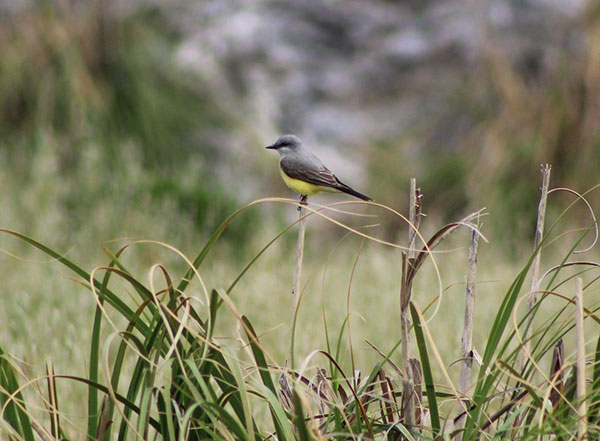
Western Kingbird, an uncommon passage migrant, May 2019 (Cédric Duhalde)
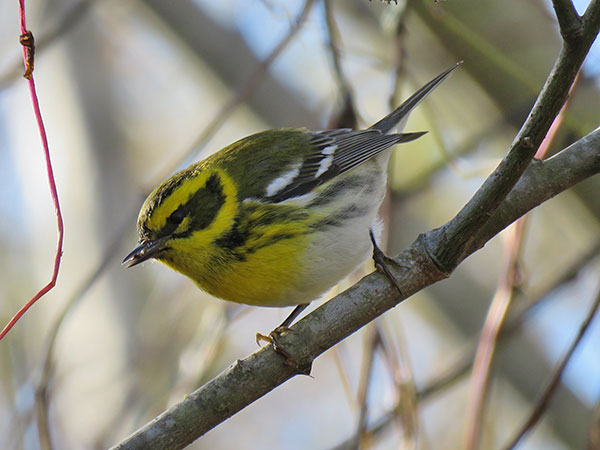
Townsend's Warbler, December 2019 (John Perry)
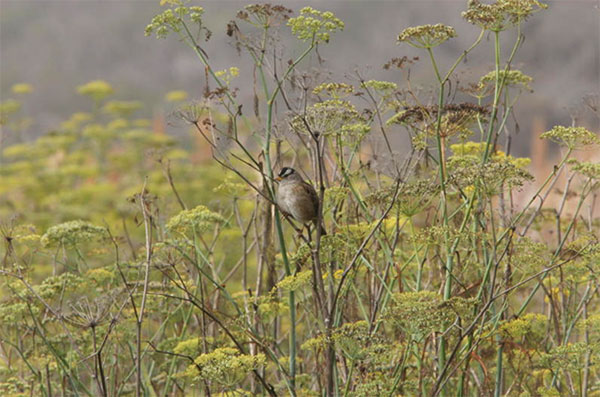
White-crowned Sparrow, subspecies Nuttalli, a year-round resident and breeder at Calera Creek, September 2004 (Dan Singer)
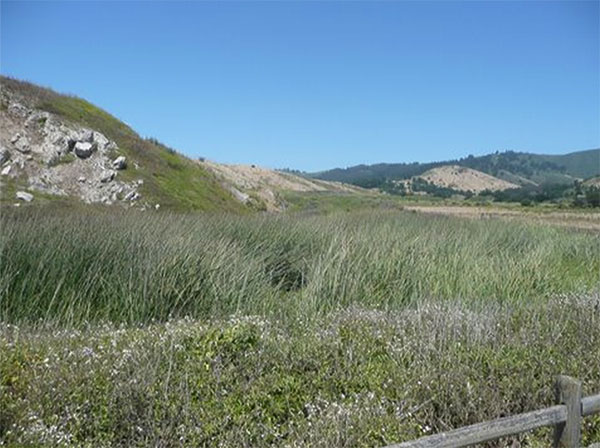
Marsh at creek mouth, with rocky cliff sides, June 2010. (Dan Singer)
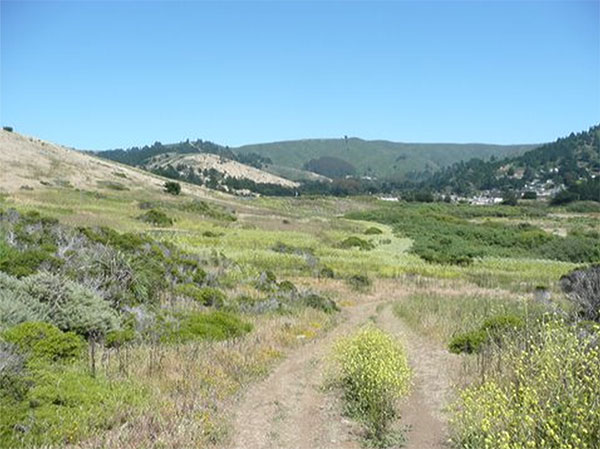
Another view looking east from above upper Calera Creek, June 2010. (Dan Singer)
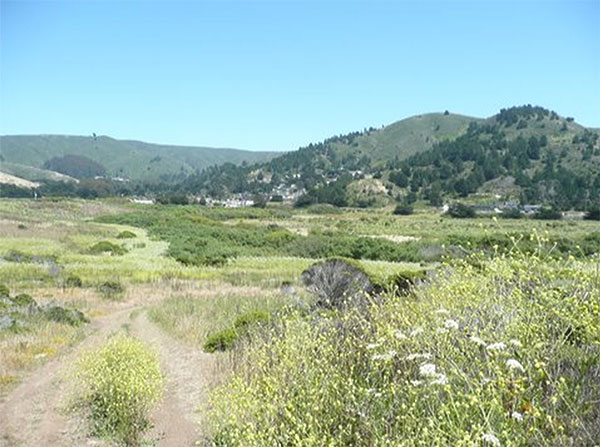
Upper Calera Creek riparian corridor, June 2010. (Dan Singer)
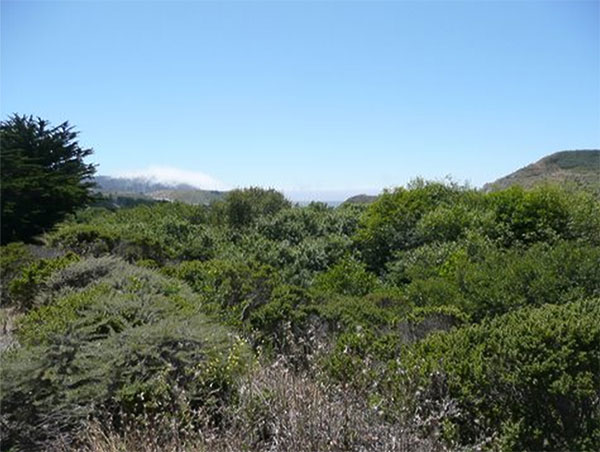
Upper Calera Creek Riparian, June 2010. (Dan Singer)
Author: Dan Singer and Jennifer Rycenga
Uploaded:
July 1, 2010
Last Update:
October 7, 2022 11:35am
All content ©Sequoia Audubon Society and others
No use without written permission
