 Summer
 Fall
Winter

Spring
Summer
Fall
Winter
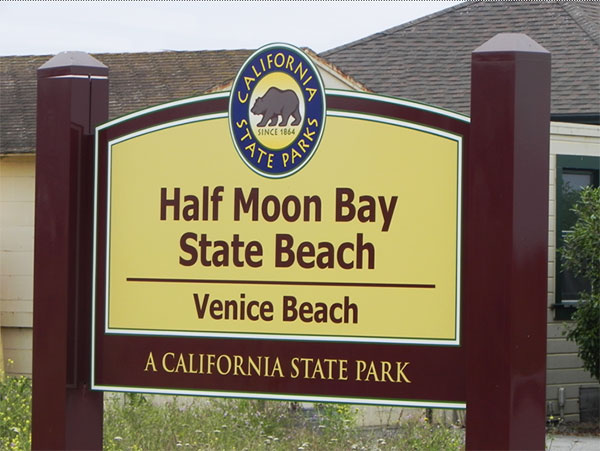
Entrance sign and ranger's residence, Half Moon Bay State Beach, Venice Beach, August 2011 (Jennifer Rycenga)
Venice Beach in Half Moon Bay: Home to the Slaty-backed Gull! The humongous gull flock often assembled here in winter is the reason to come to Venice Beach. Ranging from a handful to between 5,000 and 10,000 gulls, this can be a daunting challenge - but experience has proven it is well worth the time investment to examine the flock. The cause of the gull flock is that inland from here we find the Ox Mountain Landfill where many gulls feed, and the creek mouth offers a fresh water source for the gulls to bathe in. In the last few years (from 2009 onwards) there have been active methods used at the landfill to control gull use. This has created a marked decrease in gulls using the Venice Beach area. Gone are the days of 10K gulls, but in early 2011, even with this smaller number of gulls a Slaty-backed Gull was here, as was an Iceland Gull. So the attraction for the gulls and birders remains.
This entry will deal primarily with the gull flock: how to strategize when to visit, how to scope it, how to study the birds, and how to raise the alarm that you have a rarity. The final paragraph will deal with the other birding possibilities here. Please note that there are articles for a number of contiguous locations: Dunes Beach to the immediate north, Pilarcitos Creek Mouth to the immediate south, Frenchman's Creek Park across SR1, and the Half Moon Bay Sewer Authority to the southeast.
Twelve species of gulls have been recorded at Venice Beach, along with four identifiable hybrid forms. Those totals make Venice Beach one of the best gull-watching spots in North America. The flock in winter is dominated by three species: California Gull, Western Gull, and Glaucous-winged Gull; in summer Western and California along with Heermann's are the only species present. Present in smaller although variable numbers are Heermann's Gull (late summer and fall mainly, rare in winter and spring), Herring Gull, Short-billed Gull, and Thayer's Gull. Bonaparte's Gull migrates through the area, primarily in spring. The more unusual larid-family members to search for include Glaucous Gull, and in some years Black-legged Kittiwake, and - a surprise to many who don't know they are rare on the coast - Ring-billed Gull. The gull that grabs the headlines when it is around, though, is the Slaty-backed Gull. This northeast Asian species has become a winter regular here since Alvaro Jaramillo first documented a bird here in January 2005, and many more have been observed here since then. The species has been seen here almost every year since, and sometimes multiples. The max observed at one time was a total of three in Feb of 2006.
Perhaps off the radar for many birders is that this is also the best site in the lower 48 to see the "Vega" Gull, the Asian subspecies (vegae) of the Herring Gull. Current research strongly suggests this form should be separated from the typical North American Herring Gull; when it is a separate species surely more attention will be paid to its identification and distribution. Almost all Vega Gulls seen here are in their speckled first year plumage, although older ages have been suspected.
While the gull flock will (and should) absorb most of your time here, other birds are possible. Ducks, geese and shorebirds are attracted to the creek mouths and tidal areas. There is a horse farm just to the east of the parking area, that features large blackbird flocks in winter; these often contain Tricolored Blackbird. The coastal scrub holds birds like White-crowned Sparrow and California Scrub-Jay.
Brant, Canada Goose, Wood Duck (rare at this location), American Wigeon, Mallard, Cinnamon Teal, Northern Shoveler, Northern Pintail, Canvasback, Greater Scaup, Surf Scoter, White-winged Scoter, Black Scoter, Bufflehead, Common Goldeneye, Barrow's Goldeneye (unusual at this location), Red-breasted Merganser, Red-throated Loon, Pacific Loon, Common Loon, Pied-billed Grebe, Horned Grebe, Eared Grebe, Western Grebe, Clark's Grebe, Northern Fulmar (irruptive, winter), Short-tailed Shearwater (winter), Sooty Shearwater (late summer), Brandt's Cormorant, Pelagic Cormorant, Double-crested Cormorant, Brown Pelican, Great Blue Heron, Great Egret, Snowy Egret, Black-crowned Night-heron, Turkey Vulture, White-tailed Kite, Northern Harrier, Sharp-shinned Hawk, Cooper's Hawk, Red-shouldered Hawk, Red-tailed Hawk, American Kestrel, Merlin, American Coot, Snowy Plover, Semipalmated Plover, Killdeer, Black Oystercatcher, Black-necked Stilt (unusual at this location), Willet, Long-billed Curlew, Marbled Godwit, Black Turnstone, Surfbird, Sanderling, Western Sandpiper, Wilson's Snipe (uncommon here), Red-necked Phalarope, Red Phalarope (rare, usually storm-driven), Black-legged Kittiwake, Bonaparte's Gull, Heermann's Gull, Short-billed Gull, Ring-billed Gull, Western Gull, California Gull, Herring Gull, Thayers Gull,, Glaucous-winged Gull, Caspian Tern, Forster's Tern, Elegant Tern, Common Murre, Marbled Murrelet, Ancient Murrelet, Rock Pigeon, Band-tailed Pigeon, Eurasian Collared-Dove, Mourning Dove, Anna's Hummingbird, Allen's Hummingbird, Great Horned Owl, Barn Owl, Belted Kingfisher, Downy Woodpecker, Northern Flicker, Olive-sided Flycatcher, Black Phoebe, Say's Phoebe, Western Scrub-Jay, American Crow, Common Raven, Barn Swallow, Chestnut-backed Chickadee, Bushtit, Pygmy Nuthatch, Bewick's Wren, Marsh Wren, Blue-gray Gnatcatcher, Ruby-crowned Kinglet, Swainson's Thrush, Hermit Thrush, American Robin, Northern Mockingbird, European Starling, Orange-crowned Warbler, Common Yellowthroat, Yellow Warbler, Yellow-rumped Warbler, Townsend's Warbler, Spotted Towhee, California Towhee, Savannah Sparrow, Fox Sparrow, Song Sparrow, Lincoln's Sparrow, White-crowned Sparrow, Golden-crowned Sparrow, Dark-eyed Junco, Black-headed Grosbeak, Red-winged Blackbird, Tricolored Blackbird, Western Meadowlark, Brewer's Blackbird, Brown-headed Cowbird, Purple Finch, House Finch, Lesser Goldfinch, American Goldfinch, House Sparrow
In this guide, "rarities" are defined as those species given an County Abundance Code of 4, 5, or 6.
Dusky Canada Goose (1 record), Cackling Goose, Greater White-fronted Goose (2020), Long-tailed Duck, Fork-tailed Storm-petrel (2011), White-faced Ibis (2016), Slaty-backed Gull (2018, 2020), Vega Gull, Black-legged Kittiwake (2018), Glaucous Gull (a few annually), Iceland Gull kumlieni (2011), Arctic Tern, Common Tern, Burrowing Owl (2019), Tropical Kingbird (2018), Purple Martin (2017), Chipping Sparrow, Lark Sparrow (2013, 2021), Swamp Sparrow (2011), White-throated Sparrow (2015), Palm Warbler (2020), Northern Waterthrush (2018)
From SR1 in Half Moon Bay, turn west onto Venice Boulevard. This is north of the junction with SR 92, well-marked, north of Kehoe and Spindrift Way. north of Venice Boulevard (see listing under Venice Beach). Traveling south, take the first right after the light at Ruisseau Francais. The parking area for Venice Beach is located at the end of (bumpy and pock-marked)Venice Boulevard. You will see the state park kiosk; this area is regularly checked for evidence of payment. If you wish to avoid the fee, follow the instructions for accessing Pilarcitos Creek Mouth given in that entry.
Red Markers: Parking Area or Trail Head
Hover mouse pointer over marker, or click marker, for pin identification.
Use + or - buttons to change map zoom. Click & Drag to pan.
Since this beach is part of Half Moon Bay State Beach, there is the usual state parks admission fee for this level of park; as of this writing (March 2011) that fee is $10. It pays to buy an annual pass for the state parks.
Sunrise to sunset for the formal parking lot; the area is accessible by foot at any hour.
Some of the walks to the seashore are steep. Bluff and cliff edges can be unstable. Rip tides and high wave conditions can exist along the beach; swimming is not advised for children or people alone. Dog-walking and bicycling are encouraged in this park, so stay alert if you are standing for lengths of time along the paved trail.
There are bathrooms in the main parking lot and across the way at Dunes Beach's Sweetwood campground (where there is also a nice picnic area). There are plenty of places to buy victuals and other supplies in Half Moon Bay to the south or El Granada to the north. The paved Coastal Trail is wheelchair accessible; in its entire length it runs for over two miles. It does not, however, provide good views of the gull flock.
Accessibility information is currently not available for this location.
Half Moon Bay State Beach has jurisdiction over this area. They can be reached at 650-726-8819.
This is a well-populated hotspot in eBird, under the title "Half Moon Bay SB--Venice Beach." Data currently fills twenty-seven of forty-eight quadrants, clustered strongly in the fall and winter months. Because of the fluctuations in the size and variety of the gull flock, any data you can contribute, especially with reliable counts, can play a significant role in helping assess changes in gull populations. Trying to count the gulls here will aid your powers of observation, increase your obsessive attention to small larid details, and build character.
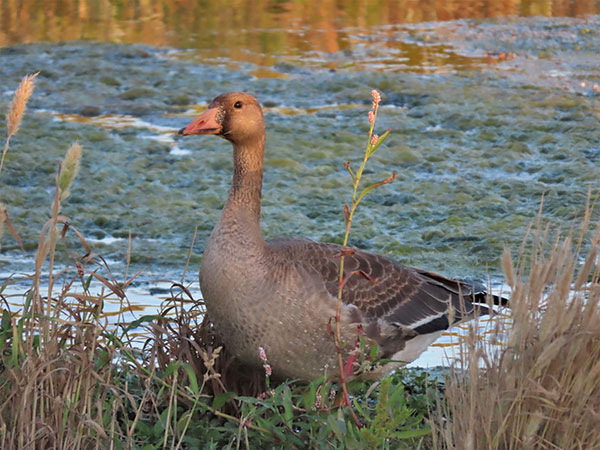
Greater White-fronted Goose, Tule subspecies, Pilarcitos Creek Mouth at Venice Beach (Anser albifrons elgasi), October 2020 (Chris Hayward)
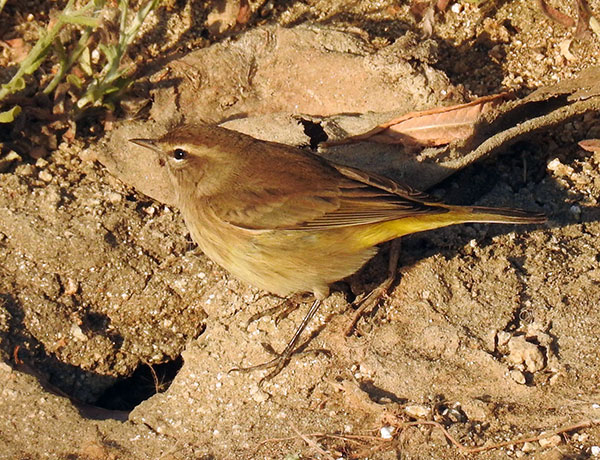
Palm Warbler, October 2020, Pilarcitos Creek Mouth at Venice Beach (Malia DeFelice)
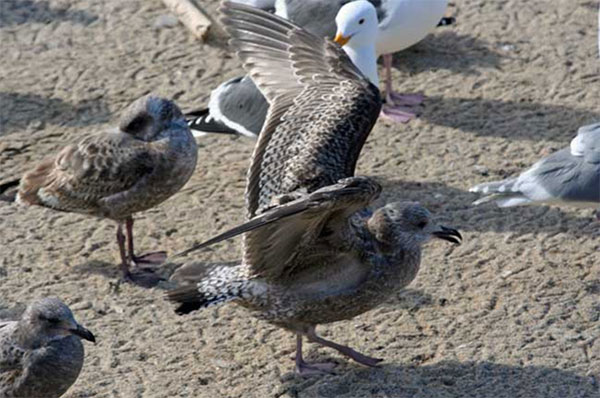
A first cycle Vega Gull (currently considered an Asian subspecies of Herring Gull), at Venice Beach, February 2006 (Alvaro Jaramillo)
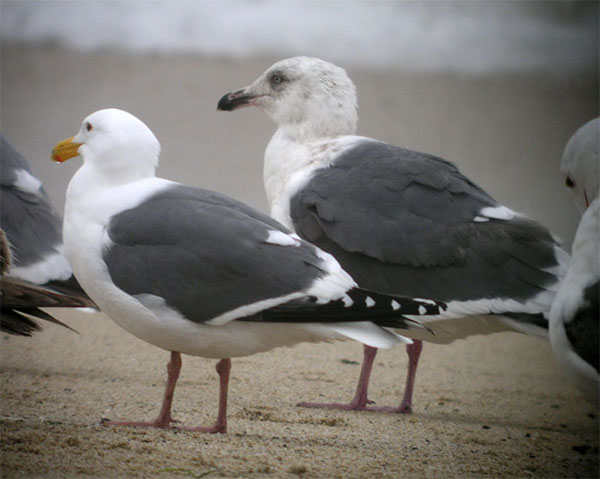
Western Gull and Slaty-backed Gull comparison (Western in foreground), Venice Beach Half Moon Bay, March 2005 (Alvaro Jaramillo)
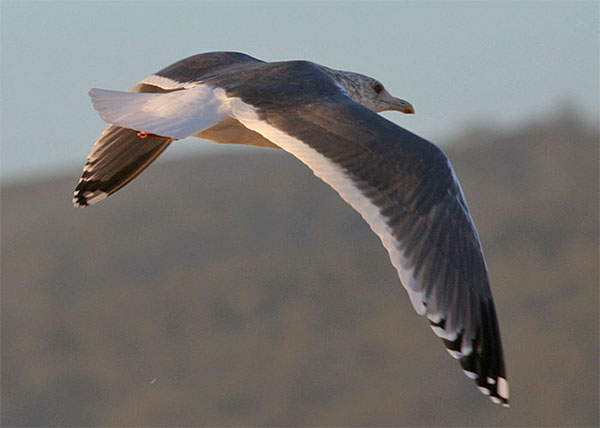
Slaty-backed Gull adult in flight, Venice Beach, Half Moon Bay, January 2007 (Alvaro Jaramillo)
Author: Alvaro Jaramillo and Jennifer Rycenga
Uploaded:
August 22, 2011
Last Update:
January 16, 2023 7:32pm
All content ©Sequoia Audubon Society and others
No use without written permission
