 Summer
Fall
Winter
Spring
Summer
Fall
Winter
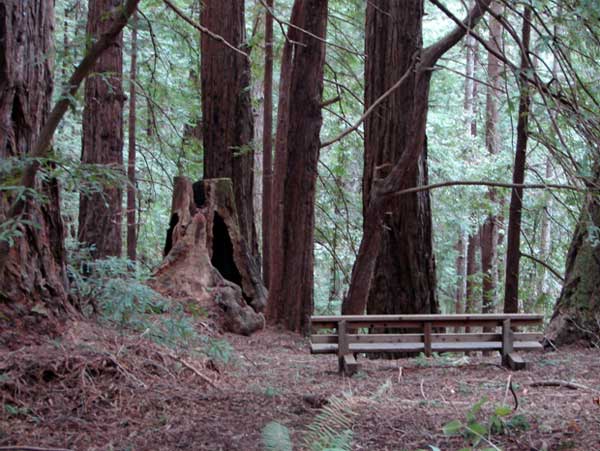
Trailside Bench, Butano State Park, March 2009 (Jennifer Rycenga)
Butano State Park is part of the redwood forests of the Santa Cruz Mountains. A birding visit to this park is easily combined with a day's birding along Gazos Creek Road, Cloverdale Road, Pescadero Marsh or Village, or any of the other local redwood parks, such as Pescadero Creek and Memorial County Parks. In fact, the best birding at Butano may well be in the waning hours of night and first hours of dawn. This is an excellent location for Western Screech-Owl (a difficult bird in the county), as well as Northern Saw-whet Owl, Northern Pygmy-Owl, and Great Horned Owl. Historically, Common Poorwill were summer residents near the entrance road. However, the early morning highlight at Butano is having the opportunity to hear the morning call of Marbled Murrelets in flight, as they leave their high forest nest sites to head for the ocean. Listen for their pinched, gull-like mewling. They often travel in pairs, and usually move rapidly across the sky. There is something eerie and thrilling when one hears this oceanic-style sound in the midst of a thick forest. The morning soundscape is made all the more delightful by the park's most conspicuous sonic resident, the Winter Wren, whose bubbling sounds enliven the many flowing creeks.
Butano Park is predominantly, and thickly, forested in Coast Redwoods and Douglas Fir with most of the same bird species as along Gazos Creek Road. Pileated Woodpeckers are resident in the park, although they are wide-ranging and not easy to see. Common Poorwills have bred in chaparral in higher elevations here, but have not been audible or visible recently. Some of the species which occur as winter visitors to coastal lowlands breed in the higher portions of Butano State Park: Hermit Thrush, Golden-crowned Kinglet, Red-breasted Nuthatch and Yellow-rumped Warbler are among these.
As is the case with most Redwood forest, the bird diversity at Butano is not great, and dim lighting under the thick canopy doesn't make the task of finding birds any easier. Stellar's Jay, Chestnut-backed Chickadee, Dark-eyed Junco, and Winter Wren are year-round common residents. Golden-crowned Kinglets are always present, but are rarely low enough to ogle. Brown Creepers reveal their location by their high pitched sounds, and Hairy Woodpeckers are usually present where the forest is not exclusively redwood. Townsend's Warbler, Fox Sparrow, and Varied Thrush enliven the winter months. The finches, including Red Crossbill, Pine Siskin, and Purple Finch, can all be found with dedication. Butano is a lovely park, but not the place to build a long day list. For those birders who enjoy camping, this park is nearly perfect, as camping gives access to the night birds in a near-perfect classic California setting.
The best spot for listening for the Marbled Murrelets is at the east end of the entrance road. Park your car here, or walk up from the campground, and listen for the sounds overhead. There is good birding along the entrance road (1/2 mile), between the entrance station and the first parking lot beyond the entrance kiosk, and plenty of possibilities for hiking within the park's extensive trail system. The first parking area beyond the entrance kiosk is the best place to listen for Western Screech-Owl. The trail system includes a number of streamside trails, which have sometimes revealed American Dippers. The longest trail actually starts outside of the park, along Cloverdale Road: the Butano Fire Road Trail. This trail features more open vistas then some of the interior trails.
Mallard, Common Merganser (unusual here), California Quail, Wild Turkey (uncommon at this site), Double-crested Cormorant, Brown Pelican, Great Blue Heron (flyovers), Turkey Vulture, Osprey (uncommon at this site), White-tailed Kite, Northern Harrier (unusual), Sharp-shinned Hawk, Cooper's Hawk, Red-shouldered Hawk, Red-tailed Hawk, American Kestrel, Merlin, Peregrine Falcon, Marbled Murrelet, California Gull, Rock Pigeon, Band-tailed Pigeon, Mourning Dove, Barn Owl, Western Screech-Owl, Great Horned Owl, Northern Pygmy-Owl (uncommon), Northern Saw-whet Owl, White-throated Swift, Anna's Hummingbird, Allen's Hummingbird, Rufous Hummingbird (unusual), Belted Kingfisher, Acorn Woodpecker, Red-breasted Sapsucker, Downy Woodpecker, Nuttall's Woodpecker, Hairy Woodpecker, Northern Flicker, Pileated Woodpecker, Olive-sided Flycatcher, Pacific-slope Flycatcher, Black Phoebe, Say's Phoebe (uncommon here), Hutton's Vireo, Warbling Vireo, Cassin's Vireo (uncommon, fall migration), Steller's Jay, California Scrub-Jay, American Crow (uncommon but steadily encroaching), Common Raven, Tree Swallow, Violet-green Swallow, Barn Swallow, Cliff Swallow, Chestnut-backed Chickadee, Oak Titmouse, Bushtit, Red-breasted Nuthatch, Pygmy Nuthatch, Brown Creeper, Bewick's Wren, House Wren, Pacific Wren, Golden-crowned Kinglet, Ruby-crowned Kinglet, Blue-gray Gnatcatcher (uncommon fall migrant), Western Bluebird (unusual at this location), Swainson's Thrush, Hermit Thrush, American Robin, Varied Thrush, Wrentit, California Thrasher (rare here), Northern Mockingbird (unusual here), European Starling, Cedar Waxwing, Orange-crowned Warbler, Yellow Warbler, Common Yellowthroat, Nashville Warbler (migration), Yellow-rumped Warbler, Townsend's Warbler, Black-throated Gray Warbler, Hermit Warbler, MacGillivray's Warbler, Wilson's Warbler, Spotted Towhee, California Towhee, Fox Sparrow, Song Sparrow, Savannah Sparrow (uncommon here), Lincoln's Sparrow, White-crowned Sparrow, Golden-crowned Sparrow, Dark-eyed Junco, Western Meadowlark (uncommon here; in farm field), Red-winged Blackbird (farm fields), Brewer's Blackbird (farm fields), Tricolored Blackbird (farm fields), Brown-headed Cowbird, Black-headed Grosbeak, Lazuli Bunting (rare here), Purple Finch, House Finch, Red Crossbill, Pine Siskin, Lesser Goldfinch, American Goldfinch, Western Tanager
In this guide, "rarities" are defined as those species given an County Abundance Code of 4, 5, or 6.
Golden Eagle, Common Poorwill (1975, 1976, 1984, 1987, 2009, 2010, 2013), Calliope Hummingbird (2011), Red-naped Sapsucker (2009, 2011), Williamson's Sapsucker (2014), Hammond's Flycatcher (2011), American Dipper, Townsend's Solitaire (1975), Hooded Warbler (2009, 2011), Ovenbird (2009), Evening Grosbeak (2019)
Butano State Park's lone auto entrance is off of Cloverdale Road. From the north, take SR 1 to Pescadero Road, go east on Pescadero Road, make a right onto Cloverdale, and drive until you see the Butano entrance sign; make a left there. From the east, take Pescadero Road west, then turn left at the Butano Cutoff (before Phipps Ranch). At the end of Butano Cutoff, take a left onto Cloverdale, and drive until you see the Butano entrance sign; make a left there. From the south, take SR 1 to Gazos Creek Road. At the junction with Cloverdale Road, bear left onto Cloverdale. After 2-1/4 miles from the Gazos Creek Road intersection, you will see a sign marking the road to Butano State Park on your right.
Red Markers: Parking Area or Trail Head
Hover mouse pointer over marker, or click marker, for pin identification.
Use + or - buttons to change map zoom. Click & Drag to pan.
The usual State Park Day Use Fee of $6.00 applies.
Day use is from 8:00 am to sunset. However, because camping is permitted in the park, it is usually possible to enter for owling.
Ticks are present in grassland areas, especially along the entrance road, in spring and early summer. Poison oak is plentiful.
Camping and picnic facilities are available at Butano State Park. There are ample restrooms and well-maintained restrooms.
Accessibility information is currently not available for this location.
Call the park at 650-879-2040.
Butano State Park has two HotSpots in eBird. The principal one, "Butano SP" has 112 species in 42 of 48 time quadrants. The subsidiary "Butano Fire Trail" has 36 species in a mere nine checklists in 7 of 48 time quadrants; its utility seems limited. While it is true that one's species list will not grow exponentially here, it is a beautiful park for a hike, and because of the precarious nature of the California population of Marbled Murrelet, it is a good idea for birders to visit and record their avian encounters on eBird
Butano State Park is a wonderful location for fungi, lichens, and amphibians. As a result, the iNaturalist place page is rich with excellent sightings and photos.
Sequoia Audubon Society has led over 30 field trips to Butano State Park and its adjoining areas, starting from the earliest year for which records exist, in 1953. Almost all field trips to Butano, though were conducted in the twentieth-century; its popularity as a destination has declined in the 2000s.
This park was affected severely by the CZU Complex Fires in August-September 2020. Please join the iNaturalist project charting the response to this fire - the largest in southwestern San Mateo county in over a century - by visiting its home page here.
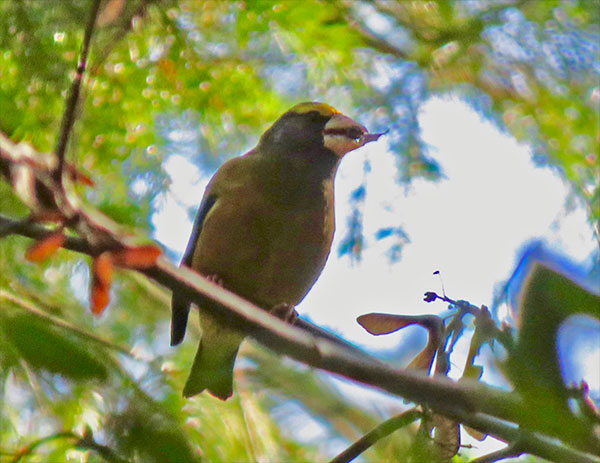
Evening Grosbeak, an uncommon irruptive in San Mateo County, December 2019 (Leslie Flint)
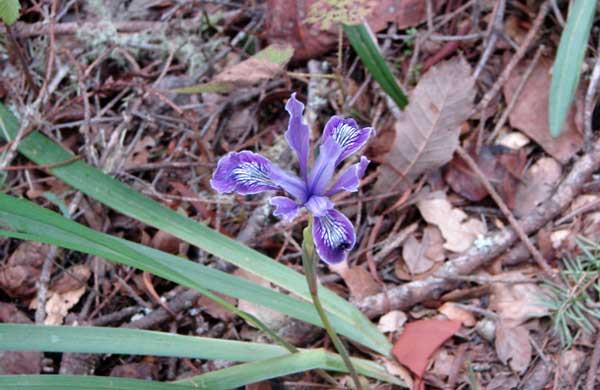
Wild Iris, Butano State Park, March 2009 (Jennifer Rycenga)
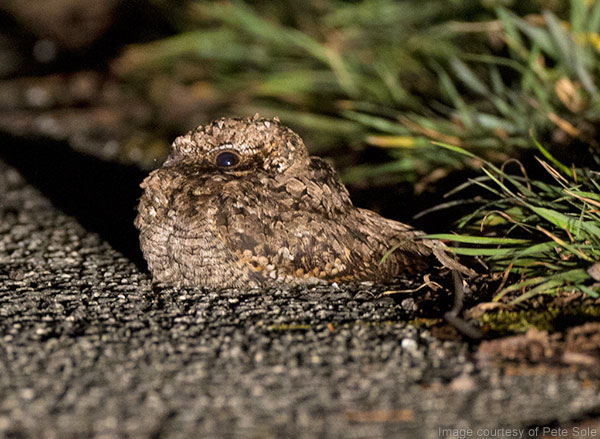
Common Poorwill, a rare but likely regular bird in the county, February 2013 (Pete Sole)
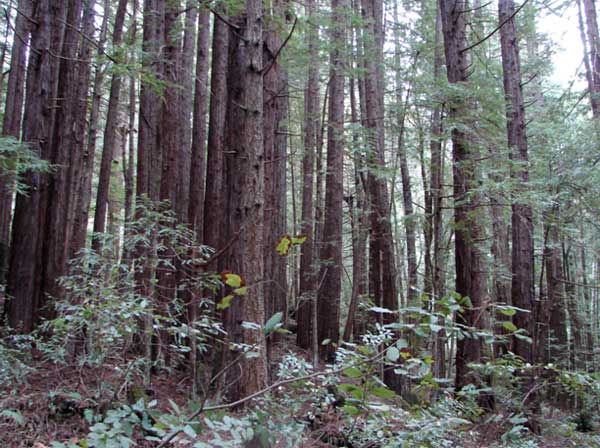
Woodlands, Butano State Park, March 2009 (Jennifer Rycenga)
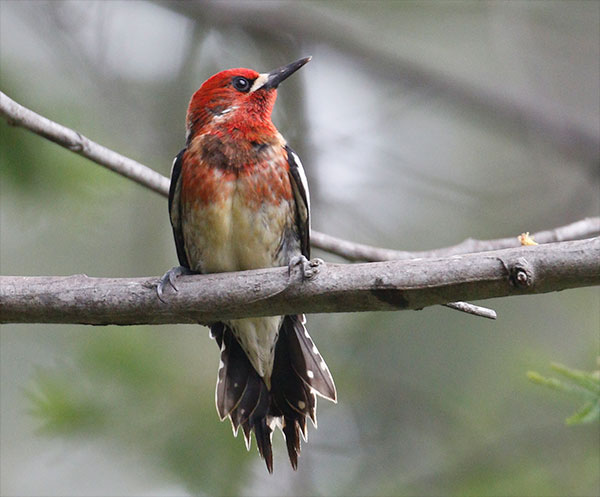
Red-breasted Sapsucker, showing us its red breast (Donna Pomeroy)
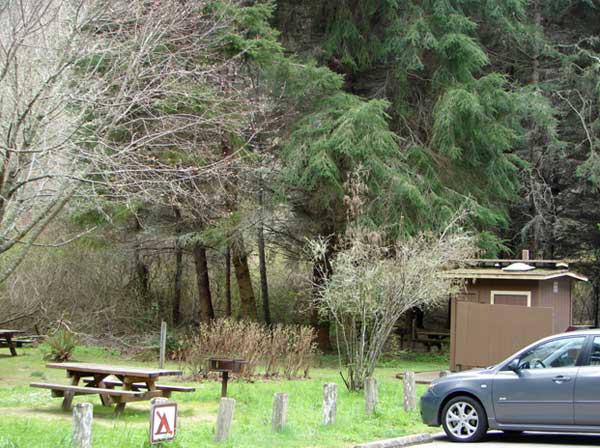
Butano Parking Area - best listening post for Western Screech-Owl, March 2009
(Jennifer Rycenga)
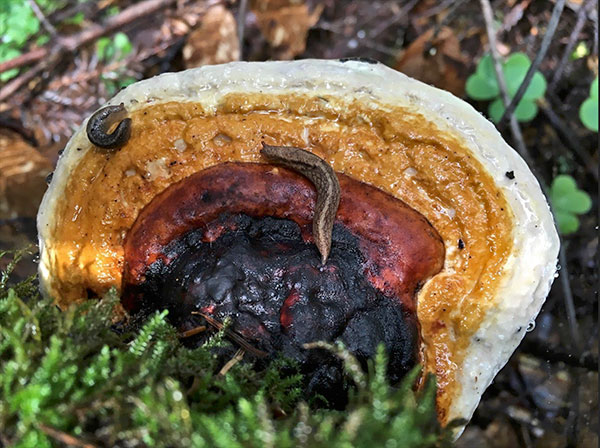
Don't miss the snails for trees! The wealth of Butano is found in the entire mixed Redwood forest habitat. (Leslie Flint)
Author: Peter J. Metropulos
Uploaded:
March 15, 2009
Last Update:
August 29, 2026 8:27am.
Updated by: Jennifer Rycenga
All content ©Sequoia Audubon Society and others
No use without written permission
