 Summer
 Fall
Winter
Spring
Summer
Fall
Winter
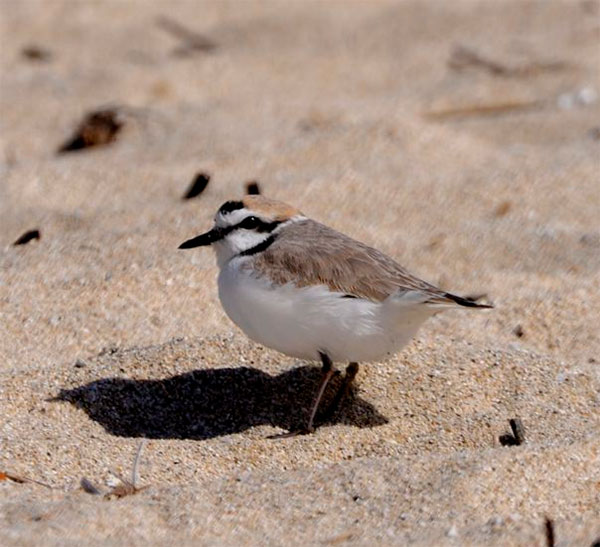
Snowy Plover, Half Moon Bay State Beach, July 2011 (Leslie Flint)
Half Moon Bay State Beach, stretching across miles of the Pacific coast, is best understood in sections. This article will cover the southernmost portion of the park, which features a campground, a small Visitor's Center (open on weekends), and extensive parking. Located at the end of Kelly Street in Half Moon Bay, this is also one of the busiest and most crowded sections of the park. Despite this fact, the birdlife here is notable, and two species of special concern - Snowy Plover and Marbled Murrelet - occur here.
This section of Half Moon Bay State Beach covers the area known as Francis Beach. The western boundary is the beach; the eastern boundary is the paved Coastside Trail. A horse trail runs east of the park boundary, parallel with the Coastside Trail. Between the trail and the beach are located the campground, the parking area, the visitor's center, and an amphitheater. For the best birding results, walk along the Coastside Trail first. Here you are on a borderline between the coastal scrub habitat and some agricultural fields, plus some areas owned by the Coastside Land Trust, that have abundant amounts of thistles and fennel, attracting finches and migrants. Walking along the Coastside Trail can be productive for birds of prey: Red-shouldered and Red-tailed Hawks, American Kestrel and other falcons in winter, Northern Harrier and White-tailed Kite. A dusk walk here might well yield detections of Great Horned and Barn Owls. As you proceed along the Coastside Trail, you will see the corporation yard ahead of you. This area is worth exploring (there is more on this in the "Pilarcitos Creek Mouth" entry in this guide), as it has attracted quite a few rare birds in the past.
Stay on the paved trail, walking past the corporation yard. Just before you come to the bridge over Pilarcitos Creek, you will see a sandy opening to your left (at one point there was a boardwalk there). Use this to go to the beach, where you will find the Snowy Plover protection area. There are roped-off areas are clearly marked as reserves for the Snowy Plovers. Off course, you might well see them using the beach outside of the roped areas too. Be careful not to run fast on this section of the beach! They are small! Scope the ocean from here, too, for alcids (including Marbled Murrelets), gulls, terns, cormorants, sea ducks, grebes, and Brown Pelicans.
At this point you can choose to walk back along the beach, or you can walk through the coastal scrub on a narrow trail. This latter choice takes you through some very rich habitat, featuring birds like Bewick's Wren, White-crowned Sparrow, Song Sparrow, California Towhee, Spotted Towhee, and Bushtit. It also produced a very rare Sedge Wren in time for the Christmas Count of 2002. The trail takes you to the amphitheater, from which you can easily see your way back to Day Use Parking.
This park's paved and level trail makes large sections of it handicapped accessible. However, there are bicyclists and dog-walkers who use the Coastside Trail, too. Upon leaving the Francis Beach section of Half Moon Bay State Beach, you can catch up to the south-bound portions of the Coastside Trail along the expanse of Blufftop Park.
Brant, Greater Scaup, Surf Scoter, Red-breasted Merganser, Bufflehead, Ruddy Duck, Red-throated Loon, Pacific Loon, Common Loon, Pied-billed Grebe, Western Grebe, Clark's Grebe, Northern Fulmar, Sooty Shearwater, Brandt's Cormorant, Double-crested Cormorant, Pelagic Cormorant, Brown Pelican, Great Blue Heron, Great Egret, Snowy Egret, Turkey Vulture, Northern Harrier, White-tailed Kite, Sharp-shinned Hawk, Cooper's Hawk, Red-shouldered Hawk, Red-tailed Hawk, American Kestrel, Merlin, Peregrine Falcon, Black-bellied Plover, Snowy Plover, Killdeer, Willet, Whimbrel, Marbled Godwit, Sanderling, Long-billed Dowitcher, Wilson's Snipe, Heermann's Gull, Short-billed Gull, Western Gull, Ring-billed Gull (uncommon at this location), California Gull, Herring Gull, Iceland Gull thayeri, Glaucous-winged Gull, Caspian Tern, Forster's Tern, Elegant Tern, Common Murre, Pigeon Guillemot, Marbled Murrelet, Rock Pigeon, Band-tailed Pigeon, Mourning Dove, Eurasian Collared-Dove, Barn Owl, Great Horned Owl, Anna's Hummingbird, Allen's Hummingbird, Northern Flicker, Downy Woodpecker, Black Phoebe, Say's Phoebe, Loggerhead Shrike (uncommon, winter), American Crow, Common Raven, Barn Swallow, Tree Swallow, Northern Rough-winged Swallow, Violet-green Swallow, Cliff Swallow, Chestnut-backed Chickadee, Bushtit, Pygmy Nuthatch, Bewick's Wren, Marsh Wren, Ruby-crowned Kinglet, American Robin, Swainson's Thrush (spring migrant), Hermit Thrush (winter), Northern Mockingbird, European Starling, American Pipit, Yellow-rumped Warbler, Townsend's Warbler, Common Yellowthroat, Spotted Towhee, California Towhee, Savannah Sparrow, Fox Sparrow, Song Sparrow, Lincoln's Sparrow, White-crowned Sparrow, Golden-crowned Sparrow, Dark-eyed Junco, Western Meadowlark, Red-winged Blackbird, Tricolored Blackbird, Brewer's Blackbird, Brown-headed Cowbird, House Finch, Purple Finch, Pine Siskin, American Goldfinch, House Sparrow
In this guide, "rarities" are defined as those species given an County Abundance Code of 4, 5, or 6.
Ross's Goose (2014), Cackling Goose (2013, 2014), Long-tailed Duck (2021), Bonaparte's Gull (2012), Black-legged Kittiwake (2011), Laughing Gull (2017), Least Tern (2013), Ferruginous Hawk (2015, fly-over), Burrowing Owl (2018), Tropical Kingbird (2009), Lark Sparrow (2018), Palm Warbler (2015), Yellow-headed Blackbird, Sedge Wren (2002, 2003), Orchard Oriole (2009, in adjacent neighborhoods)
From the intersection of SR 92 and SR 1, go south on SR1. At the first light, go west on Kelly. The beach is located at the end of Kelly.
Red Markers: Parking Area or Trail Head
Hover mouse pointer over marker, or click marker, for pin identification.
Use + or - buttons to change map zoom. Click & Drag to pan.
State Park fees apply; admission for day use is $10.00, at all seasons for the Half Moon Bay State Beach parking lots. Getting an annual state parks pass is your best way to support the parks. Camping fees vary depending on type of campground, and sometimes by season as well. This webpage presents a PDF of all state park campground fees.
Because of the presence of the campground, the entrance station at the Kelly Avenue entrance is staffed most hours. Day use is officially in daylight hours; however, the paved Coastal Trail doesn't have effective closing hours, and is used by Half Moon Bay locals at all hours.
Always use caution around the ocean, especially since rip tides can occur at this beach. There are bicyclists and dog walkers along the paved trail. The habitat can produce ticks, though they are not as endemic here as elsewhere. Small homeless encampments sometimes spring up in sheltered areas along riparian zones. In general, though, because of the high level of human activity, and the presence of rangers due to camping, this park is a low-risk location for birding.
There are excellent and plentiful bathrooms here, and a small visitor's center. This is one of the few state park campgrounds along the San Mateo coast. You are less than a mile from the shops and restaurants of Half Moon Bay.
Accessibility information is currently not available for this location.
Half Moon Bay State Beach park personnel can be reached at 650-726-8819. If you wish to reserve campground space, those reservations must be made through Reserve America by calling 1-800-444-PARK (7275) or through their website.
Snowy Plover monitoring is a major aspect of citizen science at Half Moon Bay State Beach. Sequoia Audubon Society helps to recruit and encourage volunteer monitors. Please consider adding this activity to your life! For more information: website and PDF.
The hotspot in eBird that corresponds to this principal area of Half Moon Bay State Beach is named "Half Moon Bay SB-Francis Beach." Given the popularity of this area, this spot is woefully impoverished in the eBird record, with only 81 species recorded, and 22 of 48 time quadrants holding data. We can do better, San Mateo county birders!
Sequoia Audubon Society has held eight field trips to Half Moon Bay State Beach, five of those focusing on the Snowy Plovers.
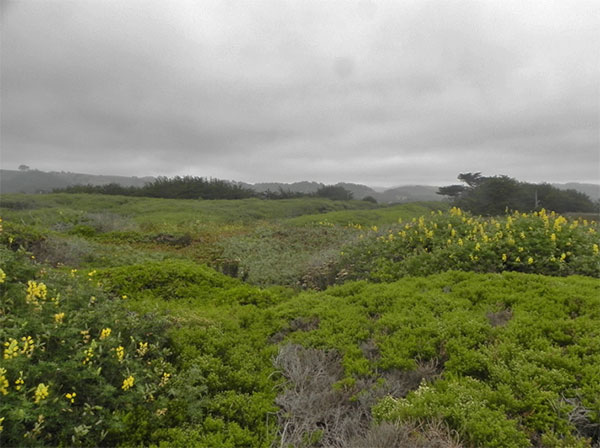
Coastal Scrub habitat, looking west, Half Moon Bay State Beach, Francis Beach area, August 2011 (Jennifer Rycenga)
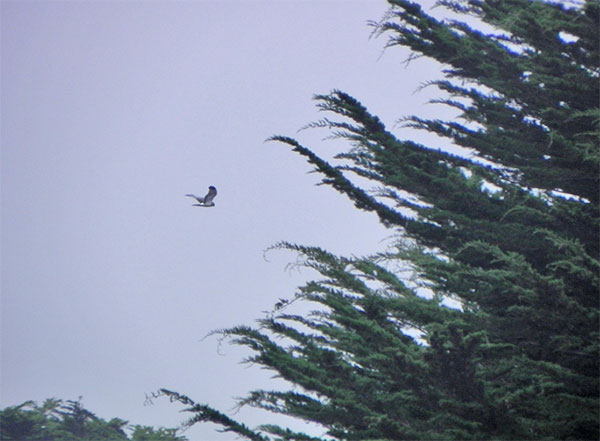
Young male Northern Harrier, Coastside Trail, Half Moon Bay State Beach, Francis Beach section, August 2011 (Jennifer Rycenga)
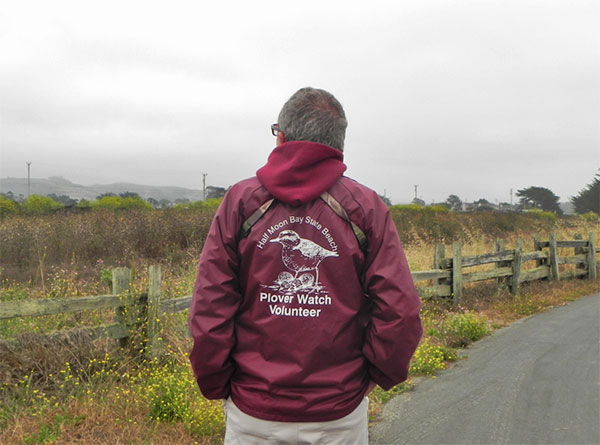
JC Shaver, volunteer Plover Watcher and a member of Sequoia Audubon, models the excellent and warm jacket you get to use when you volunteer to assist nesting Snowy Plovers. Half Moon Bay State Beach, Francis Beach section, along Coastside Trail, August 2011. (Jennifer Rycenga)
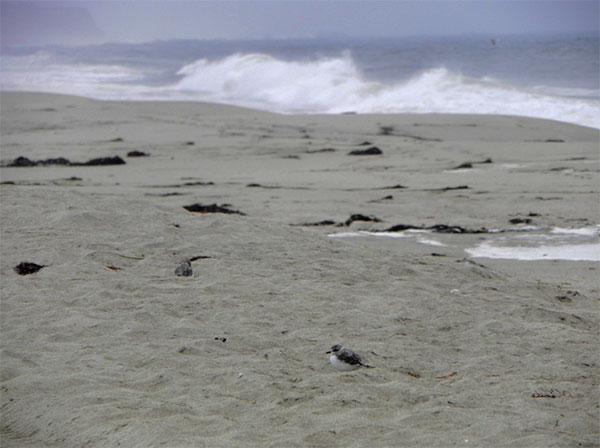
Snowy Plovers roosting in small sand depressions, Half Moon Bay State Beach, Francis Beach, August 2011 (Jennifer Rycenga)
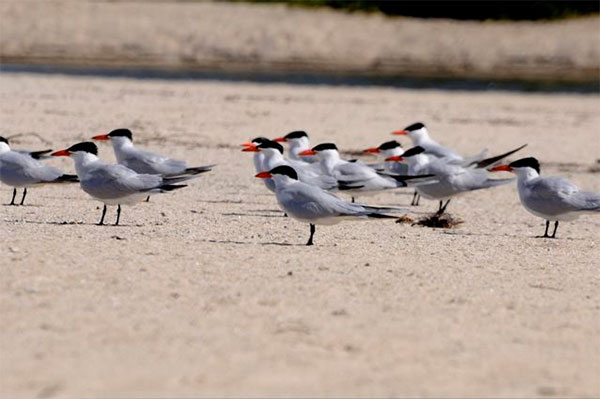
Caspian Terns, Half Moon Bay State Beach, August 2011 (Leslie Flint)
Author: Jennifer Rycenga, Nelle Lyons, Edwin Geer, JC Shaver, and Katherine Whyte
Uploaded:
August 31, 2011
Last Update:
October 14, 2021 8:44am
All content ©Sequoia Audubon Society and others
No use without written permission
