 Summer
 Fall
 Winter
Spring
Summer
Fall
Winter
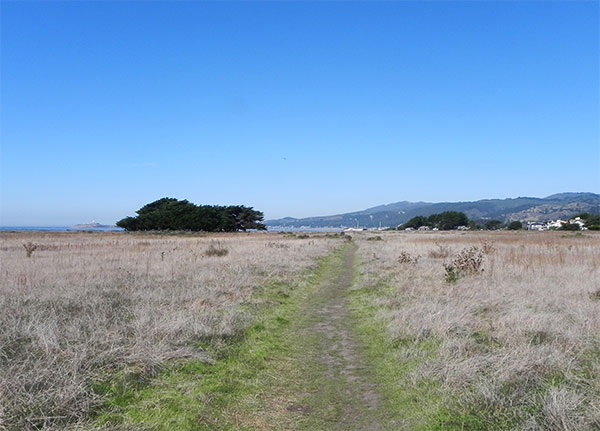
Blufftop Coastal Park, looking north, October 2011 (Jennifer Rycenga)
Blufftop Coastal Park is an extensive coastal terrace prairie nestled between Half Moon Bay State Beach and Wavecrest. Basically similar to Wavecrest in its bird list, Blufftop differs in having only a few, small stands of Monterey cypresses, making for fewer passerine locations. Furthermore, the park exemplifies multi-use: dogs and their walkers, horses on the beach and trails, surfers, bicyclists, even para-gliders contribute to conditions that can make birds scarce. But, as noted above, this is a large park, and the openness of the habitat makes it irresistible to raptors, owls, flycatchers, and sparrows.
Blufftop Coastal Park provides access to Poplar Beach, and is sometimes called Poplar Beach Park. Blufftop Coastal Park's westernmost trail is part of the Half Moon Bay Coastal Trail, as well: paved and wide enough for bicycles, tricycles, and baby bassinets. There are many informal dirt trails, both along the cliff edges and within the interior of the coastal terrace prairie: these are better for birders, as it puts you out of the way of horses (who are often spooked by binoculars) and their droppings (similar canine gifts, though, litter many of the dirt trails).
The park stretches south from Kelly Avenue - where Blufftop's coastal trails connect to the entry to Half Moon Bay State Beach - to beyond the end of Magnolia Street to a stand of Monterey cypresses along a creek bed, that forms the dividing line between Wavecrest and Blufftop. The two parks are connected by the Seymour Bridge, built in 2001. Take a close look at this bridge: it is an inverted flatbed rail car!
In one sense, this is a long walk without much species diversity. However, it is also a magnet for some unusual, and some spectacular, birds. When the vole population grows, the raptors obligingly arrive to consume them. Large numbers of White-tailed Kites, American Kestrels, Merlins, Red-tailed Hawks, and Red-shouldered Hawks have been observed here in peak years. The open area makes Blufftop particularly attractive to Barn Owls. While their mortal enemy - the Great Horned Owl - is also present, the Barn Owl population can be so large in some years that the bird becomes common at night. While the parking areas to Blufftop are closed at night, there are many pedestrian entrances to this area for night birding. Similarly, the eastern outskirts of this area are one of the better places to listen for night-calling migrants; in September and October of 2011, large numbers of migrating Swainson's Thrush were heard in this vicinity in the hours just after sunset and immediately before dawn.
Within the geography of Blufftop Park, there are access points to the beach near the parking area at the end of Poplar, and close to the north edge of the park, too. These descents are steep but not dangerously so. About half way across the north/south distance, near Myrtle Street, there is a culvert/creek, that sometimes has water in it. As a result, the vegetation around the Myrtle Street transect is richer, and the resident and winter sparrows (Lincoln's, Savannah, White-crowned, Song and Golden-crowned) can be most easily found here. Rarer sparrows should also be sought, especially in fall migration.
The more acrobatic, open-air flycatchers love this park: Black Phoebe, Say's Phoebe, and, in migration, Kingbirds. Having the dexterity to escape the humans and their animals, they also have the gumption to attack the many raptors! Their escapades make any walk richer.
From the trails by the cliff, you can scope out open ocean species. The seas here are not as richly productive as they are by the rocky coastline near Moss Beach, or off Redondo. But plenty of ocean birds move through here, and the careful observer should be able to detect some alcids in addition to grebes, loons, pelicans, and gulls.
In completing a round trip, be advised that to reconnect with the east side of Blufftop Park from Kelly Avenue, do not use the empty lot that has the Half Moon Bay Beach Parking sign in it. Because of a deep culvert, you cannot cross back to the main fields easily here. Instead, take the second empty lot going east, which connects with Ocean Street. Take your first right to the cul-de-sac for Miramontes Avenue, where the trail system is apparent.
Canada Goose, Green-winged Teal, Northern Shoveler (uncommon here, fly-by), Northern Pintail, Surf Scoter, Red-throated Loon, Pacific Loon, Common Loon, Western Grebe, Clark's Grebe, Brandt's Cormorant, Double-crested Cormorant, Pelagic Cormorant, Brown Pelican, Great Blue Heron, Great Egret, Turkey Vulture, White-tailed Kite, Northern Harrier, Sharp-shinned Hawk, Cooper's Hawk, Red-shouldered Hawk, Red-tailed Hawk, American Kestrel, Merlin, Peregrine Falcon, Black-bellied Plover, Killdeer, Black Oystercatcher, Willet, Whimbrel, Marbled Godwit, Sanderling, Western Sandpiper, Red-necked Phalarope, Black-legged Kittiwake (rare at this location), Heermann's Gull, Ring-billed Gull (rare at this location), Western Gull, California Gull, Herring Gull, Iceland Gull thayeri, Glaucous-winged Gull, Caspian Tern, Elegant Tern, Parasitic Jaeger (late summer-early fall), Common Murre, Pigeon Guillemot, Ancient Murrelet, Rock Pigeon, Band-tailed Pigeon, Eurasian Collared-Dove, Mourning Dove, Barn Owl, Great Horned Owl, Short-eared Owl, Vaux's Swift (unusual at this location, migrant), Anna's Hummingbird, Allen's Hummingbird, Downy Woodpecker, Northern Flicker, Black Phoebe, Say's Phoebe, Hutton's Vireo, Common Raven, American Crow, Tree Swallow, Barn Swallow, Cliff Swallow, Chestnut-backed Chickadee, Bushtit, Pygmy Nuthatch, Bewick's Wren, American Robin, Ruby-crowned Kinglet, Golden-crowned Kinglet (uncommon here), Northern Mockingbird (uncommon at this location), European Starling, Common Yellowthroat, Yellow-rumped Warbler, Townsend's Warbler, Spotted Towhee, California Towhee, Savannah Sparrow, Grasshopper Sparrow (rare, found on 2012 CBC in winter!), Song Sparrow, Lincoln's Sparrow, White-crowned Sparrow, Golden-crowned Sparrow, Dark-eyed Junco, Red-winged Blackbird, Western Meadowlark, Tricolored Blackbird (uncommon here), Brewer's Blackbird, Brown-headed Cowbird, Bullock's Oriole (uncommon here), House Finch, Pine Siskin, Lesser Goldfinch, American Goldfinch, House Sparrow
In this guide, "rarities" are defined as those species given an County Abundance Code of 4, 5, or 6.
Ross's Goose (2013), Snow Goose (2010 fly-by), Greater White-fronted Goose (2012 fly-over), White-faced Ibis (2020), Bald Eagle (2020), Ferruginous Hawk (2017, 2019), Prairie Falcon (2021), Baird's Sandpiper (2010), Ancient Murrelet (2017), Franklin's Gull (fly-by in migration, 2020, 2021), Rufous Hummingbird (2015), White-winged Dove (2009, 2010), Willow Flycatcher (2016), Western Kingbird (2010), Tropical Kingbird (2017, 2021), Loggerhead Shrike (2018), Yellow-green Vireo (2014, 2020, both in Jaramillo Neo-tropical Fallout Zone), Bank Swallow (2013, 2020), Purple Martin (2016, 2020), Horned Lark (2016, 2020), Lapland Longspur (2015, 2017), Lark Sparrow (2018), Le Conte's Sparrow (2017), Field Sparrow (2018, backyard adjacent to park), Clay-colored Sparrow (2012, 2018, 2020), Vesper Sparrow (2014), White-throated Sparrow (2011, 2012, 2013, 2020), Dickcissel, Bobolink, Yellow-headed Blackbird, Orchard Oriole (2014, 2020 Jaramillo Neo-tropical Fallout Zone), Great-tailed Grackle, Red-throated Pipit, Indigo Bunting (2015), Prothonotary Warbler (Jaramillo Neo-tropical Fallout Zone), Lucy's Warbler (2020, Jaramillo Neo-tropical Fallout Zone), Blackpoll Warbler (2015), Palm Warbler (2012, 2014, 2015, 2017), Tennessee Warbler (2014), Virginia Warbler (Jaramillo Neo-tropical Fallout Zone, 2010), Nashville Warbler (2014), Ovenbird (2012, Jaramillo Neo-tropical Fallout Zone), Lawrence's Goldfinch (fall 2018)
To reach the parking area for Blufftop Park, take Poplar Avenue west from SR 1 to its end. You can also walk here from Half Moon Bay State Park or Wavecrest. Parking in the neighborhoods surrounding Blufftop is possible; however, since the parking fees were put into effect in the summer of 2011, parking on weekends has become a nuisance to the residents of this neighborhood (known as Arleta Park neighborhood). So be careful, and be friendly to the locals (of which your author is one).
Red Markers: Parking Area or Trail Head
Hover mouse pointer over marker, or click marker, for pin identification.
Use + or - buttons to change map zoom. Click & Drag to pan.
The parking lot at the end of Poplar Avenue is, as of June 2011, a pay lot. The fee is $2/hour, or $10 for the entire day. There is a machine that takes credit cards. Residents can purchase a yearly pass for $50. On calm weekdays, street parking around the neighborhood is still available for free. However, on weekends in the summer, this ceases to be true. Read the official word on the adoption of parking fees.
The gate to the parking area at Poplar is only open during daylight hours. It is usually locked promptly after sunset. However, the park is easily accessible by foot, and is used by locals for walking their dogs or taking an evening stroll after the gate is locked.
The usual hazards are somewhat reduced here, though ticks are still possible. Other hazards, though, take their place. Primary among these for birders with scopes: the eroding cliff edges! Be careful not to get too close to the edge. The horses and the dogs that frequent this park deposit little nuisance-hazards wherever they go. Horses are often under the command of inexperienced riders here, so be careful not to spook the animals. It is better to steer clear of the horses than to invite encounters, in the opinion of this writer.
In the summer of 2011, there was an outbreak of gang violence in the Arleta Park neighborhood. Discussions with law enforcement revealed that the gangs sometimes used the rows of cypresses as meeting places and locations for stashes. While we all hope these issues are addressed and cease to be a problem, do take appropriate cautions, especially when birding alone.
There are two port-a-potties in the Poplar parking area. Benches are liberally scattered throughout the western ocean-facing side of the park. Facilities are also available at Half Moon Bay State Beach, including camping. See separate entry for that location in this guide. Provisions can be purchased in Half Moon Bay's shopping areas.
Accessibility information is currently not available for this location.
This is a park run by the city of Half Moon Bay, but the city's website does not include a contact for this park in particular. The general number for Half Moon Bay city government is 650-726-8270, and the Parks Department can be reached at 650-802-4382.
"Blufftop Coastal Park" is a hotspot in eBird, with data in all forty-eight time quadrants, representing an astounding 213 species. The information page in eBird can be found here. The phenomenal coverage and scope can be largely attributed to noted ornithologist, author and tour leader Alvaro Jaramillo making this his regular patch - examine the truth of this statement by looking at the leader board for checklists at this site!
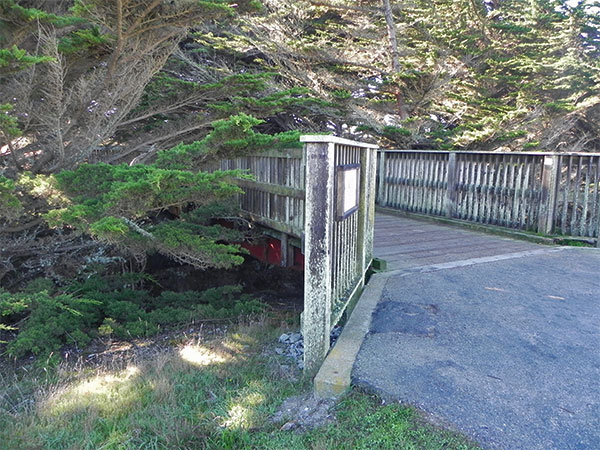
Seymour Bridge, connecting Blufftop Coastal Park to Wavecrest Open Space. October 2011 (Jennifer Rycenga)
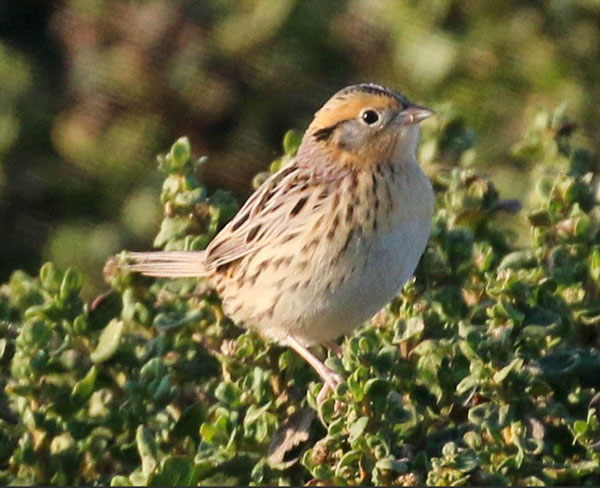
LeConte's Sparrow, found by Alvaro Jaramillo, October 2017 (Alvaro Jaramillo)
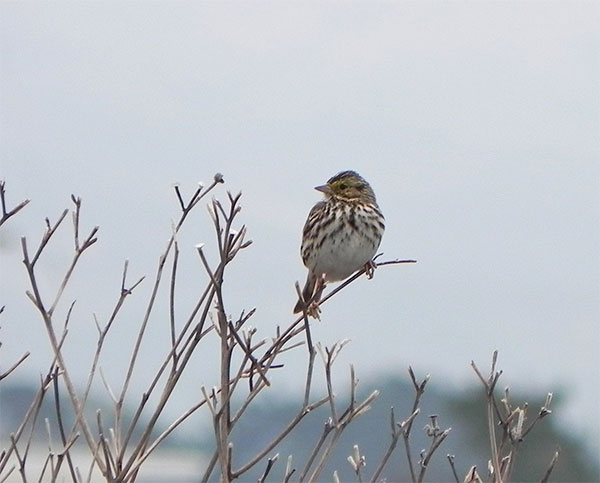
Savannah Sparrow, Blufftop Park, January 2011 (Jennifer Rycenga)
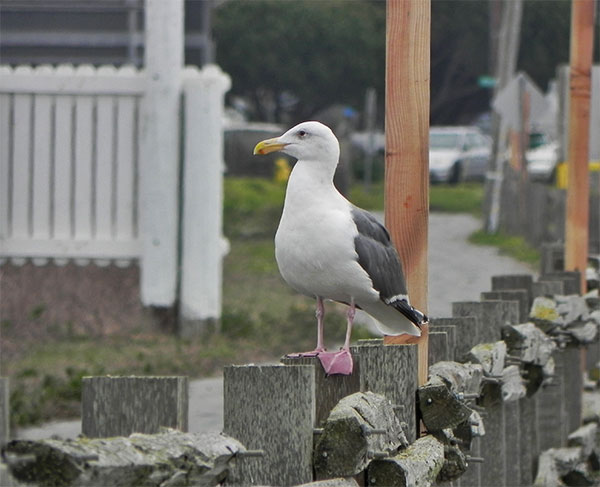
Western Gull showing off its pink feet, Blufftop Park, January 2011 (Jennifer Rycenga)
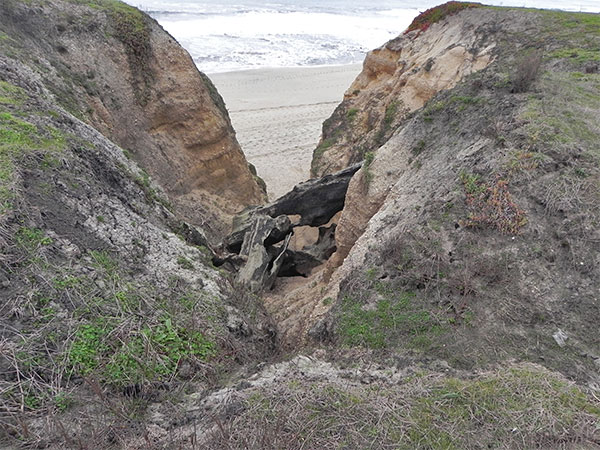
Fallen rocks in gorge, and beach below, Blufftop Park, January 2011 (Jennifer Rycenga)
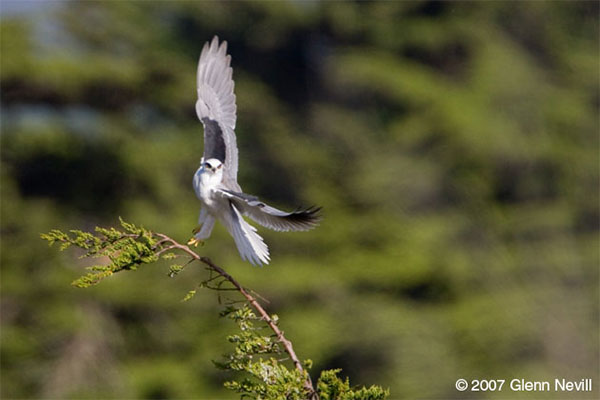
White-tailed Kite, Blufftop Park, October 2007 (Glenn Nevill)

Red-tailed Hawks talon-grasping, Blufftop Coastal Park, October 2007 (Glenn Nevill)

Northern Harrier, Blufftop Coastal Park, October 2007 (Glenn Nevill)
Author: Jennifer Rycenga
Uploaded:
October 23, 2011
Last Update:
October 5, 2021 9:01pm
All content ©Sequoia Audubon Society and others
No use without written permission
