 Summer
 Fall
Winter
Spring
Summer
Fall
Winter
Trail sign, indicating contributing organizations, April 2014. (Jennifer Rycenga)
Devil's Slide Trail, a previously treacherous section of Highway 1, is now open to the public and offers rich ocean views, coastal landscapes, and wildlife sightings. The trail is 1.3 miles long one-way. The bird list for this newly-opened park is still being established. Nesting species are the major draw here. Devil's Slide Rock (a.k.a. Egg Rock) is home to a large Common Murre breeding colony. Brandt's and Pelagic Cormorants use the cliffs for breeding, and Black Oystercatcher is also a known nester in the area. A pair of Peregrine Falcons were long-known to drivers on this road, but now with the opening of the trail, the presence of (we hope) nesting Rock Wrens can be confirmed, after almost twenty years with no data. This trail also provides an excellent setting for sea-watching; you are well-advised to bring a scope.
The trail is a San Mateo County Park and is open to dogs, bicyclist, equestrians, and hikers. The trail is a segment of the California Coast Trail. Trail parking lots are open 8 a.m. to sunset, year round. There are three overlook locations that offer benches and observation scopes, ten interpretive panels that discuss the history, geology, and animal and plant species of the area. The trail is paved, with separate lanes for hikers and directional bike traffic. Many convenient amenities are provided as well, such as pet waste stations, bike racks, drinking fountains and restrooms. Please make sure that your dog is kept on leash. Other common wildlife sightings include Harbor Seal, California Sea Lion, Western Fence Lizard, and various cetacean species.
Brant (uncommon here), Canada Goose (uncommon here), Surf Scoter, Black Scoter, Bufflehead, Common Goldeneye, California Quail, Horned Grebe, Eared Grebe, Western Grebe, Clark's Grebe, Rock Pigeon, Band-tailed Pigeon, Eurasian Collared-Dove, Mourning Dove, Black Swift (rare at this location, but habitat warrants watching for it), White-throated Swift, Anna's Hummingbird, Allen's Hummingbird, Black Oystercatcher, Black-bellied Plover, Whimbrel, Black Turnstone, Surfbird, Sanderling, Red-necked Phalarope, Wandering Tattler, Willet, Pomarine Jaeger, Marbled Murrelet, Cassin's Auklet, Rhinoceros Auklet, Common Murre, Pigeon Guillemot, Bonaparte's Gull (unusual here), Short-billed Gull (unusual here), Western Gull, California Gull, Herring Gull, Iceland Gull thayeri, Glaucous-winged Gull, Caspian Tern, Elegant Tern, Forster's Tern (unusual here), Red-throated Loon, Pacific Loon, Common Loon, Northern Fulmar, Pink-footed Shearwater, Sooty Shearwater, Black-vented Shearwater, Brandt's Cormorant, Double-crested Cormorant, Pelagic Cormorant, Brown Pelican, Great Blue Heron, Great Egret, Snowy Egret, Turkey Vulture, Osprey, White-tailed Kite, Northern Harrier, Red-shouldered Hawk, Red-tailed Hawk, Downy Woodpecker (rare here), Hairy Woodpecker, Northern Flicker, American Kestrel, Merlin, Peregrine Falcon, Olive-sided Flycatcher (migration), Black Phoebe, Say's Phoebe, Hutton's Vireo, Cassin's Vireo (rare in spring from parking lots), Steller's Jay, California Scrub-Jay, American Crow, Common Raven, Chestnut-backed Chickadee, Northern Rough-winged Swallow, Tree Swallow, Violet-green Swallow, Barn Swallow, Cliff Swallow, Bushtit, Wrentit, Ruby-crowned Kinglet, Pygmy Nuthatch, Blue-gray Gnatcatcher, House Wren, Pacific Wren, European Starling, California Thrasher (rare at this location), Bewick's Wren, Swainson's Thrush, Hermit Thrush, American Robin, House Sparrow, American Pipit, House Finch, Purple Finch, Pine Siskin, American Goldfinch, Lesser Goldfinch, Dark-eyed Junco, Fox Sparrow, White-crowned Sparrow, Golden-crowned Sparrow, Savannah Sparrow, Song Sparrow, Lincoln's Sparrow, California Towhee, Spotted Towhee, Red-winged Blackbird, Brown-headed Cowbird, Brewer's Blackbird, Orange-crowned Warbler, MacGillivray's Warbler (rare at this location), Common Yellowthroat, Yellow Warbler, Yellow-rumped Warbler, Black-throated Gray Warbler (rare at this location), Townsend's Warbler, Wilson's Warbler
In this guide, "rarities" are defined as those species given an County Abundance Code of 4, 5, or 6.
Greater White-fronted Goose (fly-by, 2019), White-winged Scoter, Long-tailed Duck (2021), Red-necked Grebe (2020, 2021, 2022), Wild Turkey (in surrounding hills), Brown Booby (2015, 2018, 2021), Nazca Booby (2022), Northern Gannet (2015, 2017, 2018, 2019), Bald Eagle (migration), Golden Eagle (2017), Black-legged Kittiwake (2016, 2020), Franklin's Gull (2017), Western Kingbird (2017), Purple Martin (2017, migration), Rock Wren (breeding), Palm Warbler (2014)
The Trail can be accessed on either end. There are parking lots on both the south (Half Moon Bay) and north (Pacifica) sides of the trail. The parking lots can be accessed from Highway 1. The northern parking lot is just north of the Tom Lantos Tunnels and the southern parking lot is just south of the tunnels.
Red Markers: Parking Area or Trail Head
Hover mouse pointer over marker, or click marker, for pin identification.
Use + or - buttons to change map zoom. Click & Drag to pan.
Use of the trail and parking lot are free.
The Reserve is open at 8 a.m. and closes at different times seasonally. Check the park website for updated information: https://parks.smcgov.org/.
The cliff face is fragile and steep; stay on the paved trail.
Restrooms are located on either end of the trail by the parking lots.
Accessibility information is currently not available for this location.
Rangers can be contacted at 650-355-8289.

This trail is an eBird hotspot, under the name "Devil's Slide Trail and Egg Rock." When this entry was initially published in 2014, there was data in four time quadrants. Now this is one of the most visited sites in the county, with data in every quadrant, and 147 species recorded. Great job, collective birder community!
The iNaturalist place marker constitutes a handy guide to some of the unusual plants and marine mammal life also found at this unique location.
The United States Fish and Wildlife Service has an ongoing study of the Common Murres that nest on Egg Rock off the coast of Devil's Slide.
Sequoia Audubon Society sponsored a field trip here in 2015, soon after the park opened. Devil's Slide was the site of a BioBlitz in Spring, 2022
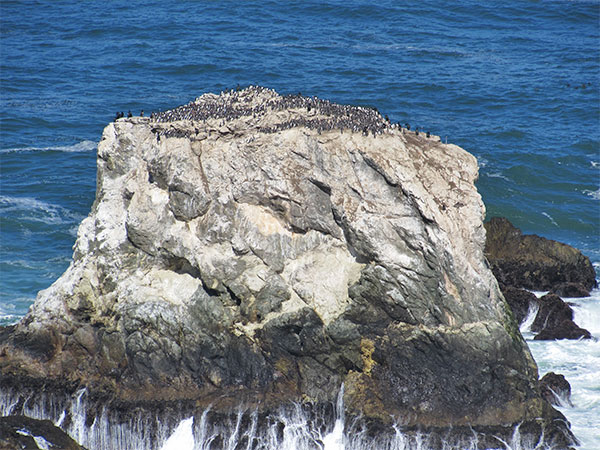
Devil's Slide Rock, with Murre Colony and breeding Brandt's Cormorants, April 2014 (Jennifer Rycenga)
Adult Brown Booby enjoying the sun on Egg Rock at Devil's Slide, March 2021 (Alane Gray)
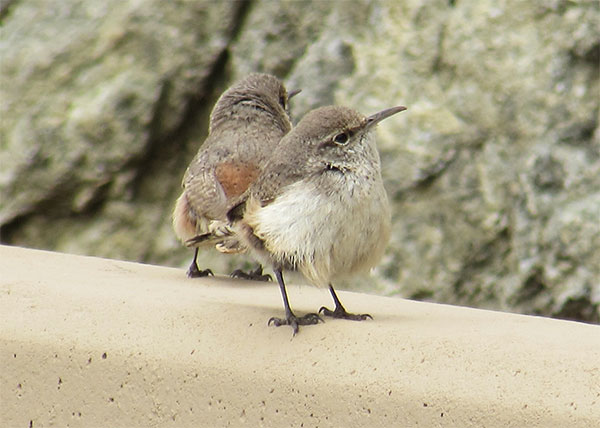
Rock Wrens, Devil's Slide Trail, April 2014 (Jennifer Rycenga)
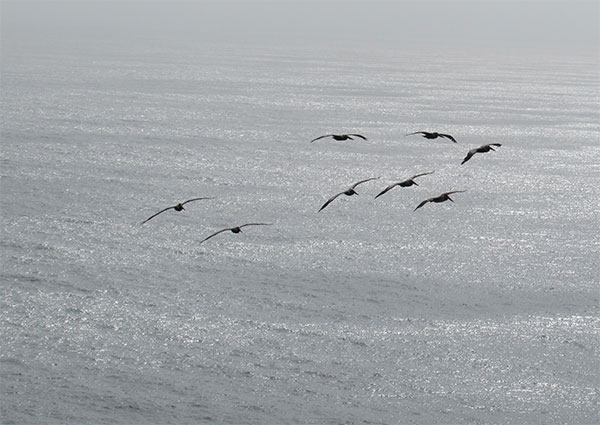
Brown Pelicans, Devil's Slide Trail, April 2014 (Jennifer Rycenga)
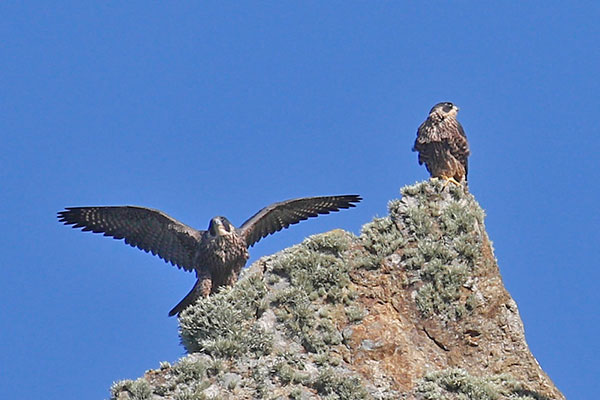
Peregrine Falcon Fledglings, Devil's Slide Trail, June 2018 (Donna Pomeroy)
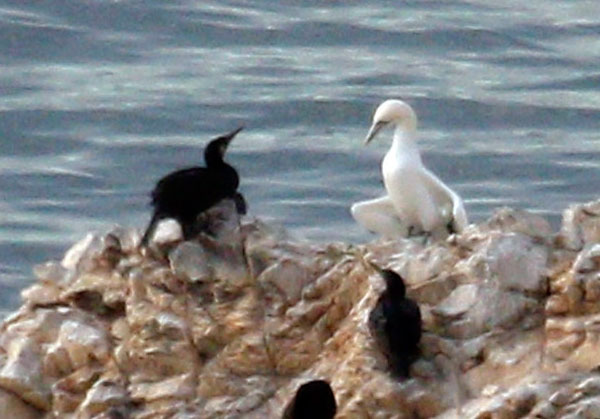
The Pacific Ocean's lone known Northern Gannet, alone and lonely, and thus displaying to Brandt's Cormorants on Egg Rock, December 2015 (Donna Pomeroy)
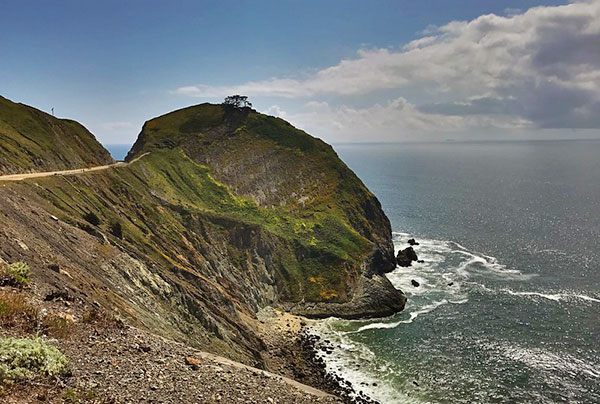
A view of Devil's Slide, April 2018(Donna Pomeroy)
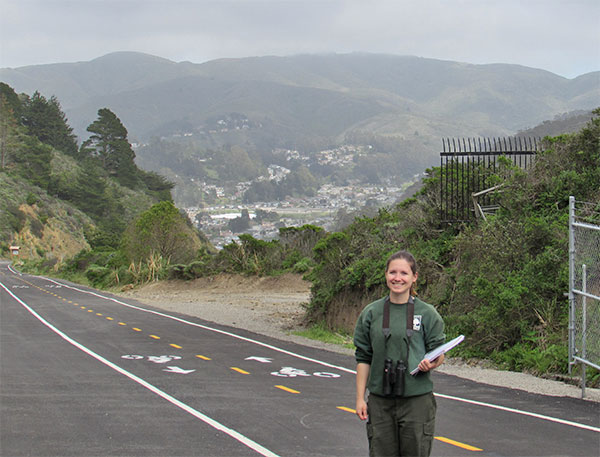
Katherine Wright, author of this article, with Pacifica in the fog behind, April 2014 (Jennifer Rycenga)
Author: Katherine Wright
Uploaded:
May 16, 2014
Last Update:
November 8, 2022 10:39am.
Updated by: Jennifer Rycenga
All content ©Sequoia Audubon Society and others
No use without written permission
